
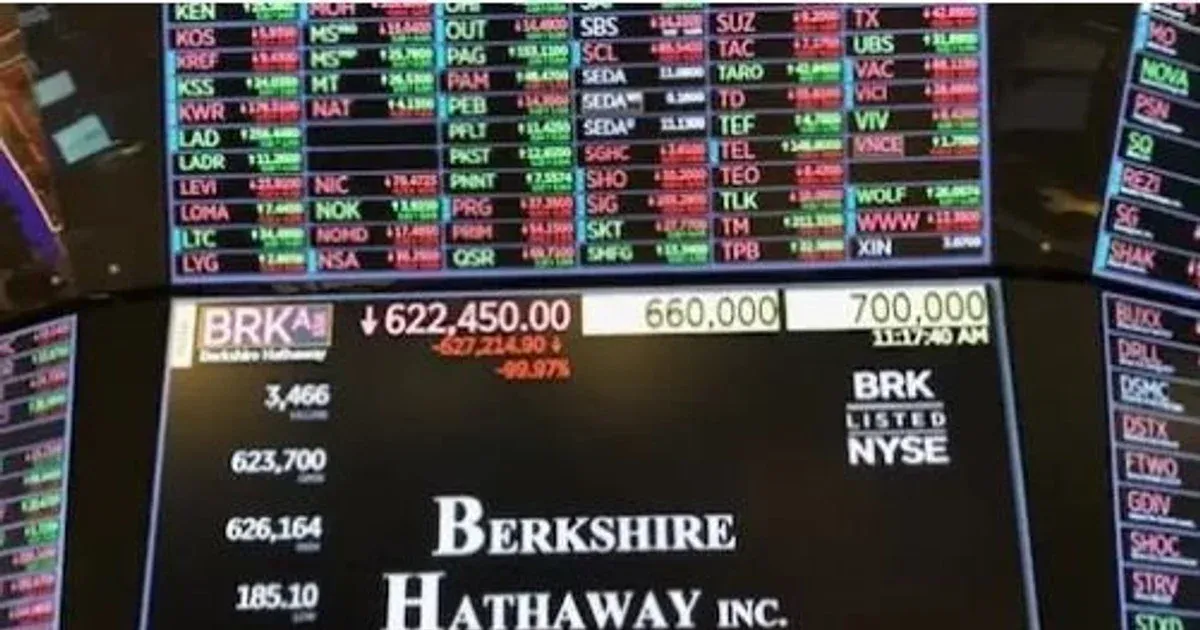

In the second quarter of 2026, Berkshire Hathaway's cash, cash equivalents and U.S. Treasury bills fell from $397.4 billion to $365.5 billion. The $31.9 billion decline, or 8.0%, is the first clear footprint investors can use to assess how Greg Abel is deploying the capital Berkshire accumulated over many years. It is not evidence that Berkshire has abandoned cash. At Berkshire's scale, though, a change in capital use matters far more than a static balance-sheet number.AP
The right thesis is straightforward: Berkshire has entered a measurable test of capital allocation, not yet a proven shift in investment philosophy. Investors should not merely ask what the company bought. The more useful question is whether every dollar leaving the cash pile raises economic value per share over time.
Cash is lower, but liquidity remains an advantage
$365.5 billion is still a formidable liquidity reserve. It gives Berkshire room to meet insurance obligations, absorb market stress and wait for opportunities without being forced to sell assets at depressed prices. Reading the cash decline as evidence of sudden aggression would therefore go too far.
What the report does show is that capital has begun to move in several directions. The most visible transaction was a $10 billion investment in Alphabet. AP also reported that Berkshire added more than $21 billion to commercial, industrial and other equity investments, although the full identities of those holdings will appear in a later portfolio filing. That information gap matters: investors can evaluate Alphabet, but cannot assign quality to the whole of the new deployment from one familiar name.AP
Alphabet is an interesting test because the investment is not simply a bet on the stock price. The company is spending heavily on artificial-intelligence infrastructure, so the long-term outcome depends on whether today's spending becomes future cash flow and earnings. Berkshire's purchase may reflect confidence in that capacity, but a quarterly report does not establish the timing, average cost or intended holding period. Events that appear together should not be turned into a causal conclusion without evidence.
It would also be a mistake to add the $10 billion Alphabet investment to roughly $4.5 billion of repurchases and treat that sum as a complete explanation for the cash decline. In the first half, Berkshire generated $21.653 billion in operating cash flow and spent $10.631 billion on property, plant and equipment. Securities trades, spending at subsidiaries, debt payments and Treasury-bill maturities also move through cash flow. The $31.9 billion change is a net result, not the invoice for a single transaction.Berkshire Hathaway
Repurchases are a price question, not a ritual
Berkshire repurchased $4.527 billion of its own shares in the second quarter. Its equivalent Class A shares outstanding fell from 1,438,223 at year-end 2025 to 1,431,693 at the end of June 2026. That is a modest change in share count, but its economic meaning depends not on the reduction itself, but on the price Berkshire paid to achieve it.Berkshire Hathaway
The company's policy has no fixed repurchase amount, expiry date or required schedule. The Chief Executive Officer may buy only after consulting the Chairman and when he believes the market price is below conservatively estimated intrinsic value. Berkshire also will not repurchase if consolidated cash, cash equivalents and Treasury bills would fall below $30 billion.Berkshire Hathaway
Put simply, a repurchase does not automatically make remaining shareholders wealthier. Buying below intrinsic value means the same pool of assets and future earnings is divided among fewer shares. Buying at too high a price has the opposite effect: cash leaves while the value received may not match it. For Berkshire, investors should therefore track changes in share count alongside operating earnings per share over several quarters, instead of treating $4.527 billion as a self-evidently positive badge.
Operating earnings tell the clearer quarterly story
Second-quarter operating earnings were $12.983 billion, up 16.3% from $11.160 billion a year earlier. That is a closer measure of the health of the businesses Berkshire runs. Net earnings were $25.667 billion, but included $12.684 billion of after-tax investment gains; market moves can reverse that component without saying much about whether the insurer or railroad is operating better.Berkshire Hathaway
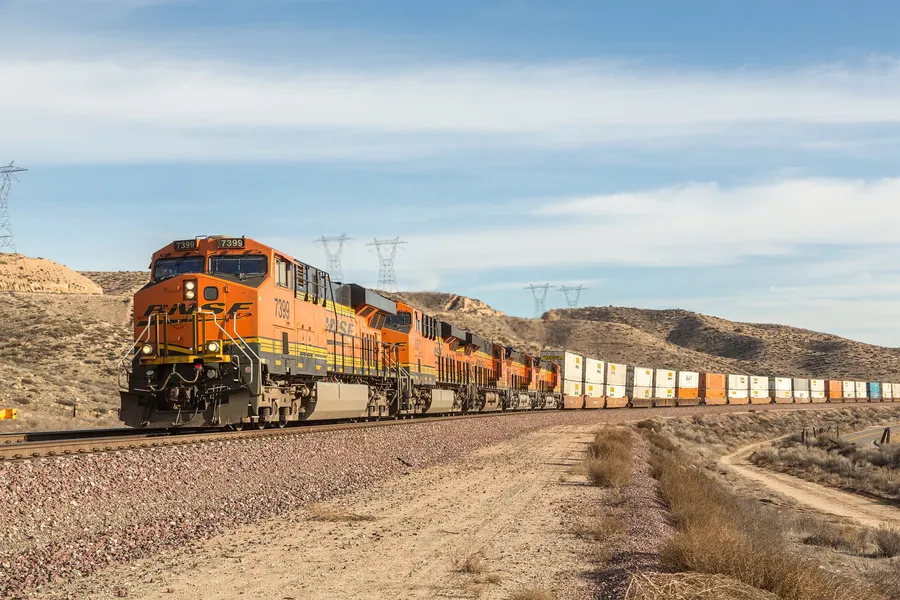
The segment picture was uneven. After-tax earnings in manufacturing, service and retail rose 24.1% year on year; Berkshire Hathaway Energy increased 26.9%; and BNSF rose 6.3% on higher volume and improved operating efficiency. Those figures show that part of the quarterly gain came from operating businesses, not solely from the investment portfolio.Berkshire Hathaway
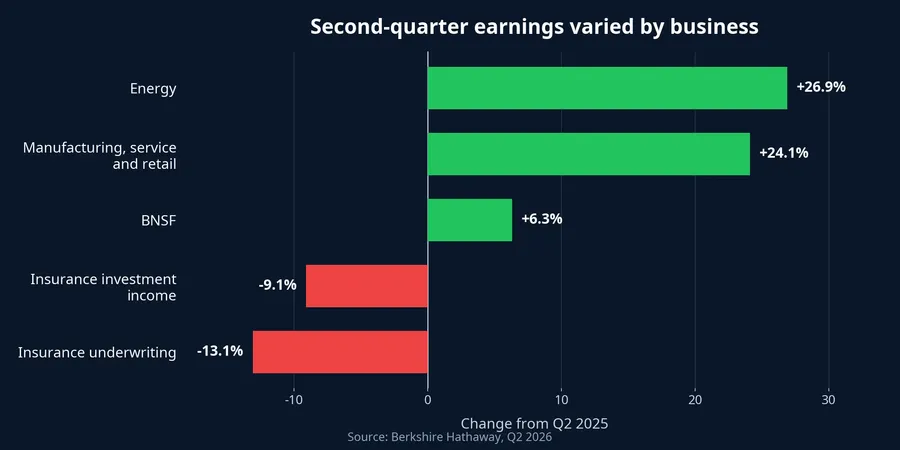
Insurance underwriting earnings, however, fell 13.1% as GEICO saw higher claim frequency and average claim severity. Insurance investment income declined 9.1% as lower interest rates reduced interest income. The “other” group recorded a $326 million foreign-exchange gain, compared with an $877 million loss a year earlier, a $1.203 billion swing. Some consumer and building-products businesses also benefited from tariff refunds during the quarter. These are recorded profits, but not all of them are a foundation that will repeat at the same pace.Berkshire Hathaway
A scorecard for the new tenure
Greg Abel, Chief Executive Officer of Berkshire Hathaway Inc., has held the role since January 2026. Warren Buffett, Chairman of Berkshire Hathaway Inc., still forms part of the consultation process for repurchase decisions. That structure supports a restrained reading: Berkshire is transferring capital-allocation authority through decisions that can be tested, rather than through a declaration of departure from its past.AP
For investors, the second quarter need not be read as a vote for or against Abel. It creates a clearer scorecard for subsequent quarters. The value of the Alphabet investment will depend on cash flow received relative to cost and foregone alternatives. The value of the repurchases will depend on price paid relative to intrinsic value. And earnings quality needs to be assessed after separating foreign-exchange effects, tariff refunds and hard-to-repeat portfolio movements.
The current thesis is therefore conditionally constructive: Berkshire has begun to use capital at a scale large enough to evaluate while retaining abundant liquidity. What could change that assessment is not one quarter of lower cash, but evidence in later quarters that operating earnings per share rise sustainably and that new investments are made with valuation discipline. That is the fair test for Buffett's successor.