


Deposit rates may not need to rise further in the coming months. But treating that as proof that banks’ funding stress has passed would miss the more important part of the picture. Funding costs are not contained in a single advertised rate: they are embedded in old deposits rolling over, short-term funding needs, and the race between deposit growth and credit growth.
At MB’s August 6 investor conference, Phạm Như Ánh, Chief Executive Officer of Military Commercial Joint Stock Bank (MB), said rates were likely to remain broadly flat for the rest of the year under the policy direction. He also said liquidity remained a major challenge because credit demand was growing faster than the ability to raise deposits.CafeF Those statements are not contradictory. Headline rates can be stable while a bank’s average cost of funding remains under pressure.
The central point is straightforward: flat advertised rates may indicate that competition for deposits is cooling. They do not establish that funding is abundant or that sector margins have recovered. The next quarterly reports, rather than any isolated rate quote, should offer the clearer answer.
One posted rate does not reveal the full funding cost
Think of a household replacing water bottles. A bottle bought when prices were low costs the same today. The bill only rises when it runs out and is replaced at a higher price. Banks work similarly: a fixed-term deposit keeps its original rate until maturity, even after the rate board has changed.
That is why average funding costs usually move later than posted rates. When low-rate deposits mature and customers renew at higher rates, the new cost gradually reaches the income statement. Even when advertised rates stop rising, banks may still need targeted incentives or certificates of deposit to retain funding. Those costs are not always visible on a public rate table.
MB said its NIM, along with that of many banks, narrowed in the first half as input costs increased. To balance funding, it combined customer deposits, international bonds, valuable papers, and certificates of deposit.CafeF That does not by itself rank MB’s strength against peers. It does show why banks facing the same headline rate environment can have very different sensitivity to funding costs.

NIM is the gap between interest income on earning assets and interest paid on funding. Put simply, it is the margin left after a bank receives interest from borrowers and pays interest to depositors. If funding costs rise faster than lending rates, NIM narrows. Credit can still expand, while core profit fails to keep pace.
This is also why a high NIM at one point in time should not automatically be read as evidence of cheap funding. NIM also reflects the borrower mix, loan risk, and a bank’s ability to price lending. The useful question is how NIM moves across several quarters alongside deposit and credit growth.
Decision 1743 creates a technical buffer
From August 1, 2026, Decision 1743/QĐ-NHNN allows 50% of State Treasury term deposits to be counted as mobilized funding when calculating LDR, up from 20% previously. The rule applies through July 31, 2028.CafeF
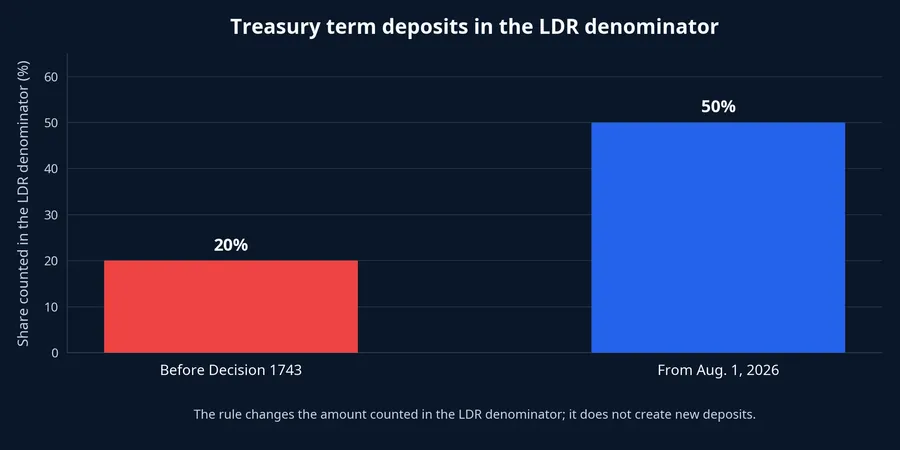
LDR measures loans against the funding base defined by regulation. When the portion counted in the denominator increases, LDR falls mechanically and banks gain more room to manage their balance sheets. It is like being allowed to count an extra compartment in a backpack’s capacity: the load ratio falls, but the amount of luggage does not disappear.
The distinction matters. This buffer does not create new deposits, automatically add lending capacity, remove maturity mismatches, or replace the ability to attract customer funding. Banks holding more Treasury term deposits benefit more directly. For others, any benefit would mainly come if competition for deposits becomes less intense.

It would therefore be a leap to regard a changed LDR calculation as proof that system-wide liquidity is settled. The rule is already in force; funding health still needs to be tested against actual deposit balances and actual funding costs.
The interbank market is a short-term thermometer
Interbank rates are not the rates paid to retail depositors. They are the short-term rates banks pay each other to deal with temporary funding needs. Because they respond quickly to immediate supply and demand, they are better treated as a thermometer than as a complete diagnosis for the banking system.
From late July to early August, the overnight interbank rate rose from 0.7% per year on July 30 to 4.3% on July 31, then reached 6.3% on August 3 and 6.4% on August 4. The one-month rate was 7.3% per year on August 4.Tin nhanh Chứng khoán The move shows that short-term funding demand can change quickly, though it does not establish that pressure will persist.
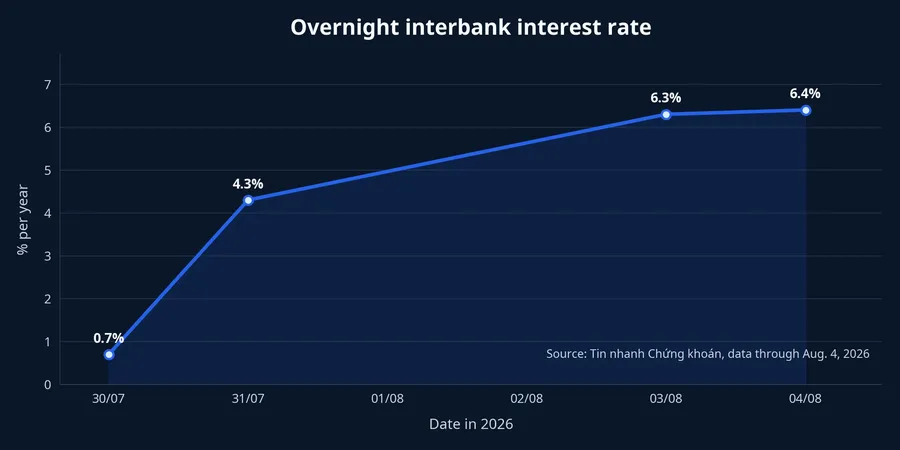
There is no basis to assign the rise to one driver alone. Seasonal effects, settlement demand, reserve management, and the gap between deposits and lending may all contribute. What matters for investors is whether the move proves temporary or remains elevated in subsequent periods, and how it compares with deposit data.
Two paths to watch, not one rushed conclusion
The constructive path emerges when deposits grow fast enough to narrow the gap with credit. Short-term borrowing between banks may then ease, special rate top-ups to retain customers may become less common, and average funding costs may cool after a lag. Banks with a stronger share of non-term deposits often have an advantage, although a strong quarter-end ratio still needs to be tested for durability.
The other path is credit continuing to outgrow deposits over several periods. Banks may then need to pay more to retain depositors, issue more valuable papers, or borrow more in the interbank market. The strain commonly reaches reported earnings later than it appears in posted rates. Confirmation would not be one volatile trading day; it would be interest expense rising faster than interest income while NIM continues to narrow.
These are not firm forecasts. They are a framework for avoiding a common mistake: assuming that unchanged rates mean funding pressure is over. The same LDR can conceal very different funding structures. A bank with stable deposits and longer-term funding is not in the same position as one more dependent on short-term funding, even if the headline ratio looks similar.
Reading bank stocks through a sequence of signals
For newer investors, the practical approach is not to decide immediately which bank benefits most. Follow a linked set of signals: whether deposits are growing faster or slower than credit, whether interbank rates are cooling, how the non-term deposit ratio is changing, and whether NIM has stopped declining. Each measure alone tells only part of the story.
The evidence currently supports a wait-for-confirmation stance, rather than a conclusion that funding pressure has disappeared. Flat advertised rates are a more comfortable signal. A genuine improvement requires deposits to catch up with credit and NIM to stop narrowing. The next quarterly reports and the course of interbank rates will show whether the policy buffer is becoming a real economic benefit or merely giving the system more time to rebalance.