

About USD 100 billion in refunds for IEEPA tariffs has been certified by U.S. Customs and Border Protection and sent to the Treasury Department for disbursement. That is a major milestone, but it is not the same as saying that every business has received cash. For investors, the distinction between “sent to Treasury” and “received in an account” changes how to read cash flow, earnings and even retail-price prospects.
Put simply, a tariff refund is not a blanket payment. The government is retracing the path by which the money entered public coffers: identifying the customs entry, identifying who paid, and processing the individual claim. The shopper who faced a higher price at the checkout may have borne part of the economic cost, but the importer of record is usually the party named on the customs declaration. Those are not automatically the same person.
From court ruling to payment process
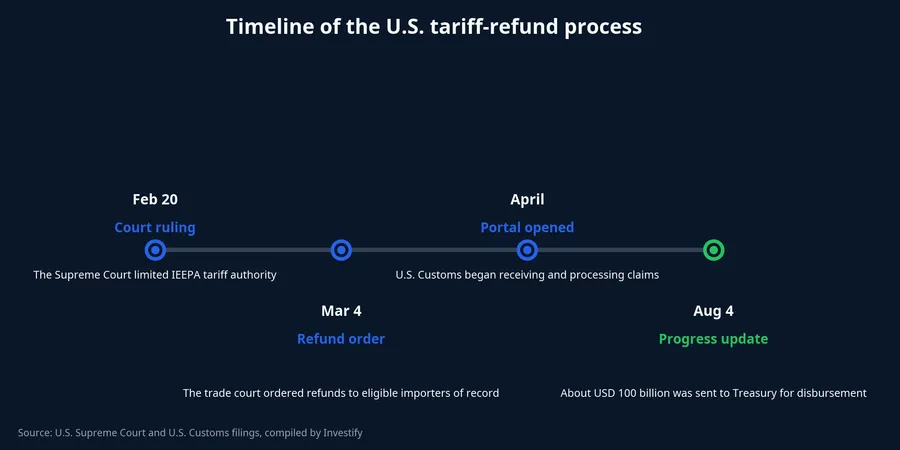
On February 20, the U.S. Supreme Court concluded that IEEPA did not give the president authority to impose tariffs of that breadth. The ruling resolved the question of legal authority, while the mechanics of repayment had to be built through the trade court and the administration. On March 4, the Court of International Trade ordered refunds for eligible importers of record. Supreme Court
Why does that take several steps? Every import entry carries its own product code, date, duty amount, liquidation status and payer information. Customs has to reconcile those details before calculating the refund and any related interest. Treasury can then make the payment. A court decision can take effect immediately, but cash still has to move through an administrative record system.

By the end of July, Customs had received 252,496 refund declarations covering 25.1 million import entries. About USD 100 billion, including duty and interest, had completed the necessary processing steps and been sent to Treasury for disbursement. That is approximately 60% of the roughly USD 166 billion collected under IEEPA tariffs.
The three states should not be collapsed into one. “Eligible” means an entry falls within the refund scope. “Certified” means Customs has calculated the amount and sent a payment request onward. “Disbursed” means the recipient has cash in its account. The remaining task is not only to certify unresolved claims, but also for Treasury to execute the payment requests it has received.
This distinction also prevents a common valuation mistake. A headline about the size of a refund pool is not yet evidence of quarterly cash conversion. The relevant company-level questions are whether its own entries were accepted, whether the amount is measurable, and whether any portion is owed to another party.
Who is entitled to the refund
The legal principle is straightforward: a tariff is collected at the border from the named importer that paid it. The first right to seek a refund therefore returns to that same party. It may be a retailer, distributor, manufacturer importing inputs, or a logistics business named in the transaction structure.
That distinction removes a common misconception. The country where goods were made does not itself determine who receives the refund. For a Vietnamese business selling into the United States, if its U.S. customer is the importer on the declaration, the refund is that customer’s cash flow. The Vietnamese exporter may benefit only indirectly if the customer can order more goods, negotiate less aggressively on price, or share the money under a contract.
The reverse can also be true. If a Vietnamese company has a U.S. entity that is itself the importer of record, it may have a direct claim in the process. Investors should therefore not infer an individual company’s refund from a country’s export total. They need to know who is named as importer, where the claim stands, and how the contract allocates the benefit.

Why shoppers are not automatically repaid
Tariffs are collected at the border, but their economic cost can travel through an entire supply chain. An importer may absorb part of the cost through its margin, ask a supplier to lower prices, or pass part of it into the price charged to retailers and final customers. The split differs by industry, competitive pressure and the availability of substitutes.
When a tariff is refunded, the government has records of the party that paid at the border. It does not have a ledger showing how much of the tariff each shopper bore across millions of retail receipts. Fortune reports that consumers are pursuing potential relief through separate lawsuits, while the administrative refund process goes to importers. Fortune
Two points follow. A company may choose to lower prices, refund a separately stated surcharge, or renegotiate with a business partner. That is a commercial choice or a contractual obligation, not an automatic step in Treasury’s process. And the existence of litigation does not mean that consumers have won a case or are certain to receive money.

Where the money may appear in financial statements
New investors often look immediately for profit, but that may not be the first trace of the refund. Start with cash and receivables. When a company has a recognizable claim but has not yet received payment, a receivable may appear or rise. Once the cash arrives, operating cash flow is the next place to reconcile.
The accounting depends on where the original tariff cost was recorded. KPMG explains that the refund is generally recognized in the same location as the original cost: if the tariff was included in inventory, a refund can reduce inventory-related cost; if the goods were sold and the tariff was in cost of sales, the refund can reduce cost of sales when recognition criteria are met. Interest is commonly presented separately in other income. KPMG
For that reason, a refund does not necessarily become an extraordinary profit item in a single quarter. It can improve inventory, cost of sales, receivables or cash flow at different points in time. If a company has committed to share the money with customers, investors should also read the notes for a payable or contractual obligation. Better earnings only become persuasive when the route of the cash can be traced through the accounts.
What to monitor next
The central thesis is not that USD 100 billion will create the same benefit for every company. The funds may improve liquidity for eligible importers, but the realised benefit depends on importer status, claim progress, accounting treatment and contractual duties. Retail prices do not automatically fall simply because a refund has been certified.
In upcoming reports, three signals matter most: cash actually received, changes in receivables, and movement in inventory or cost of sales. A disclosed pricing policy or a refund-sharing agreement with customers would be direct evidence that the benefit has moved beyond the importer. The court decision began the process; financial statements will show where the money ultimately lands.