

On August 5, international gold prices rose even as the prospect of reopening the Strait of Hormuz became clearer. At first glance, that sounds counterintuitive: less geopolitical stress should normally reduce the appeal of a safe haven. Gold, however, is not priced only on fear. It is also priced against the return an investor gives up by holding an asset that pays no income.
Trading Economics put gold at USD 4,157.09 per ounce, up 1.94% on the day and extending its advance to a third session. Internal end-of-day data showed USD 4,167.62 per ounce, up 2.20%; the difference reflects two timestamps within the same session, not conflicting trends.Trading Economics Rather than treating one strong session as a long-term forecast, new investors can use it to understand an important mechanism: encouraging energy news can reshape rate expectations and then feed back into gold.
Hormuz is not only a safe-haven story
The Strait of Hormuz is a crucial energy shipping route. AP reported that roughly one-fifth of the world's oil and gas had passed through the waterway. News that shipping may normalise therefore reduces some of the risk premium embedded in oil prices.AP

Internal data showed Brent falling 5.26% to USD 79.36 per barrel on August 4, before edging up 0.43% to USD 79.70 by the end of August 5. AP linked the earlier fall to expectations of progress in talks on reopening Hormuz, while noting that a final agreement had not been completed.AP
The useful reading is not that oil must keep falling. It can rebound if negotiations reverse or shipping is disrupted again. More important, a drop in oil prompts markets to reassess energy-driven inflation risk. Fuel, freight, chemicals, and many production inputs are connected to oil, so a lower oil price can ease headline inflation pressure.
That is the bridge from Hormuz to gold. If inflation risk looks less acute, markets may assign a lower chance to further Federal Reserve tightening. That reassessment is not a Fed decision and does not guarantee an outcome. It is simply how traders reprice possible paths through futures markets.
Real rates are the central calculation
The basic idea is straightforward: gold is an asset without a regular interest payment. When US dollar bonds or deposits offer more income, holding gold carries a larger opportunity cost. When expected yields decline, the income sacrificed by holding gold declines as well.
Do not stop at nominal rates, though. A useful approximation is that the real rate equals the nominal yield minus expected inflation. If oil cools inflation expectations while nominal yields do not move, real rates rise. That would not support gold. The interest-rate channel helps only when nominal yields fall far enough for real rates to decline, or at least not rise.
Trading Economics said the market-implied probability of a September Fed rate increase fell from approximately 67% to 57%. This is a probability inferred from futures pricing, not an official Fed signal.Trading Economics The 10-percentage-point shift helps explain why news that eased oil risk could still support gold at the same time.
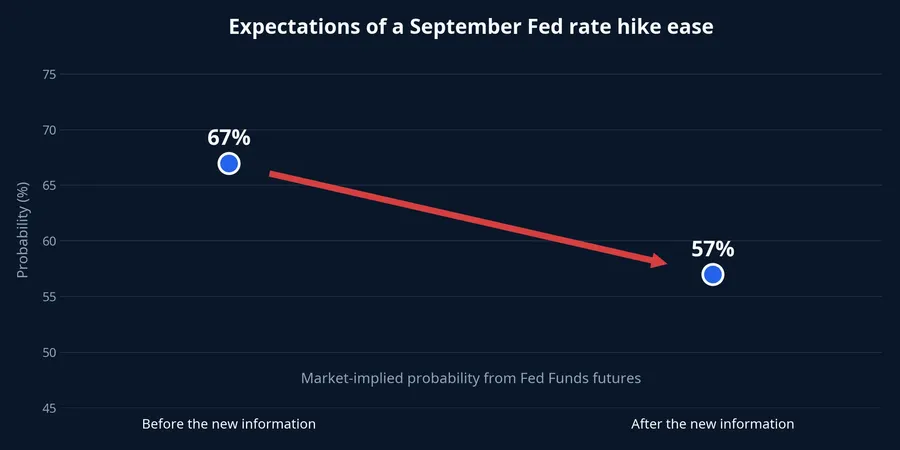
The full chain is therefore longer than “oil falls, gold rises.” Easier passage through Hormuz may cool oil. Lower oil may reduce expected inflation. Markets may then lower the odds of a Fed rate increase, reducing yields and gold's opportunity cost. Each “may” matters: a reversal at any link changes the final implication for gold.
One session should not have one assigned cause
The rate channel fits the August 5 moves, but it is not enough to establish a single cause. Hormuz talks had not reached a final agreement, so safe-haven demand had not disappeared. Trading Economics also mentioned inflows into Chinese gold ETFs, while the US dollar can amplify or soften gold's move because the metal is mostly priced in dollars.Trading Economics
Events moving together do not prove causation. Gold may have been supported by lower expected rates, with additional help from hedging demand, fund flows, or a weaker dollar. The day's evidence leans toward the rate channel because rate-hike probabilities fell as oil had just dropped sharply. But there is not enough detail to allocate the contribution of each force precisely.
This is also why historical reactions do not always match. The World Gold Council notes that high rates commonly pressure gold through real yields and the US dollar, but outcomes still depend on how markets interpret growth, inflation, and policy.World Gold Council No automatic formula turns every geopolitical headline into a gold buy or sell signal.
Three screens to watch together
For sessions like August 5, start with Hormuz and oil. A practical change matters more than a negotiating headline: whether an agreement is signed, whether ships are actually moving again, and how shipping insurance costs respond. Those signals indicate whether the energy risk premium is genuinely receding or merely pausing.
The second screen is US Treasury yields, real rates, and futures-market probabilities. If oil falls, the odds of a Fed rate increase decline, and real rates fall too, the case for a gold tailwind becomes more coherent. If oil falls while real rates rise, investors should look to the dollar, fund flows, or renewed hedging demand rather than drawing a quick conclusion.
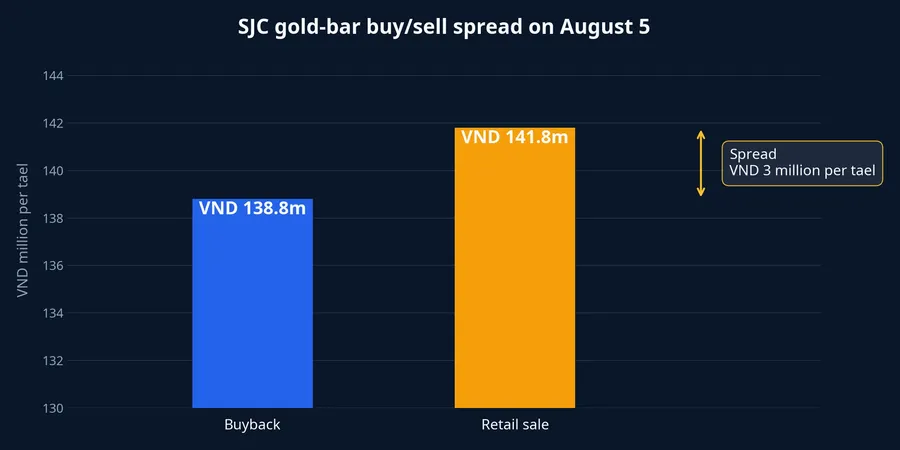
The third screen is for Vietnamese retail buyers. Internal data put the August 5 SJC gold-bar retail sale price at VND 141.8 million per tael and the buyback price at VND 138.8 million per tael. The VND 3 million-per-tael spread is a cost that must be recovered before the transaction becomes profitable. A rise in the international price therefore does not translate one-for-one into a local gain; exchange rates and the domestic-versus-global price gap matter too.
This distinction changes how a local price move should be read. A buyer who enters at the retail sale price begins below the dealer's quoted buyback price, even before international gold, the exchange rate, or the local premium move. The global quote is therefore a reference point, not a return calculation. Looking at both sides of the domestic quotation is a more useful discipline than comparing only today's selling price with yesterday's.
For the same reason, a short-term gain in the world market does not tell an investor whether the local spread is widening or narrowing. Those are separate variables. The global gold price explains part of the direction; the local quotation determines how much of that move is available after trading costs. Keeping them separate prevents a dramatic international headline from becoming an overly simple personal return story.
August 5 does not confirm a long-term uptrend for gold. The clearest conclusion is that several pricing channels are operating at once, and the path of real rates can outweigh a temporary easing in safe-haven demand. The next signals to monitor are actual progress at Hormuz, real yields, and flows into gold funds. When those signals disagree, waiting for more evidence is more informative than acting on a single headline.