


A net-buying headline can make it seem as if foreign investors have returned to the whole Vietnamese equity market. The 4 August session shows why that conclusion would be premature: foreign investors were net buyers of about VND 872 billion, yet most of the demand was concentrated in VIC and VHM. That is support for the index, not proof that foreign capital has spread across the board.MarketTimes
Think of the market as a road with many lanes. When traffic is moving in every lane, the flow is broad. When most vehicles are packed into one or two lanes, total traffic can still be heavy while the other lanes remain difficult to use. The 4 August session looked much more like the second case, so the useful question is not simply whether foreigners were net buyers but how that buying was structured.
The headline number is only the starting point
On HOSE, foreign investors recorded VND 890 billion of net buying on 4 August. The whole-market figure was lower, at roughly VND 872 billion, because HNX and UPCoM trading still tilted to net selling. The two figures are not inconsistent; they cover different market scopes.MarketTimes
The next step is to inspect the names receiving the money. VIC saw more than VND 438 billion of net buying, VHM more than VND 284 billion and MBB VND 172 billion. VIC and VHM alone absorbed more than VND 722 billion, or nearly 83% of the whole-market net-buying total for the session.MarketTimes
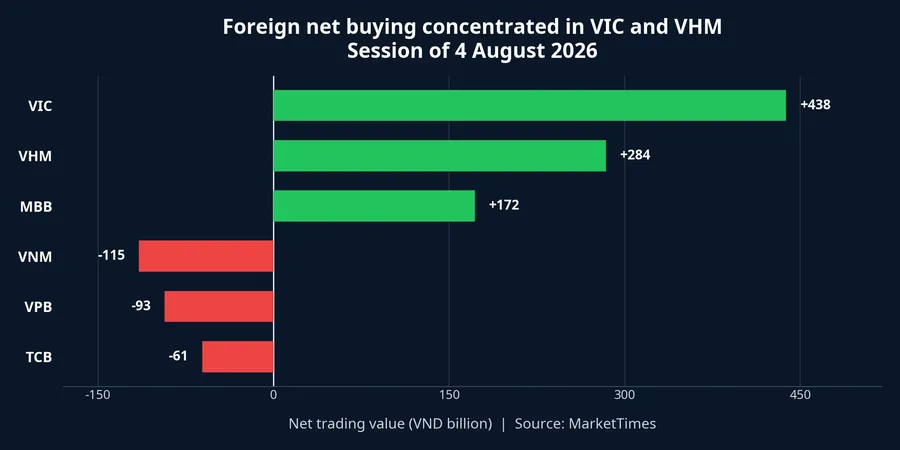
Nearly 83% does not mean those two stocks were the only names bought. It shows how concentrated the activity was. For newer investors, that distinction matters: “foreigners were net buyers” describes the aggregate result, while “foreign buying was broad” requires demand to show up across more stocks and more sectors.
The arithmetic also resolves an apparent anomaly. Net buying in VIC, VHM and MBB totaled roughly VND 894 billion, exceeding the total net-buying figure for the market. The difference came from net selling in names including VNM, VPB and TCB, plus selling on HNX and UPCoM. Strong demand for a few large shares was therefore partly offset by selling elsewhere.MarketTimes
Why the index does not tell the entire story
The VN-Index closed at 1,777.23, up 14.39 points or 0.82%. VIC rose 2.30% to VND 217,900; VHM gained 2.70% to VND 152,000; and MBB added 1.46% to VND 24,350. Because all three are large-cap stocks, their price moves carry substantial weight in the VN-Index.
Put simply, an index does not give every listed stock one equal vote. The larger a company’s market capitalization, the more its move can influence the benchmark. A strong index session can therefore coexist with a less encouraging experience for investors holding shares outside the leading group.
This is not a flaw in the VN-Index; it is how a capitalization-weighted benchmark is designed to work. It is a reminder that the benchmark answers a narrower question than a personal portfolio does. The index tells us how the market’s largest listed companies performed in aggregate. A portfolio tells an investor how the shares they actually own performed, and that result can diverge sharply when leadership is concentrated.
For that reason, a first-time investor should resist replacing a portfolio review with a glance at the VN-Index. Check whether the stocks you follow were among the names receiving demand, whether their sector participated and whether their own liquidity was adequate. This is not a call to chase or avoid any stock. It is a way to make the headline number useful: treat it as context, then test whether that context applies to the shares and risks in front of you.
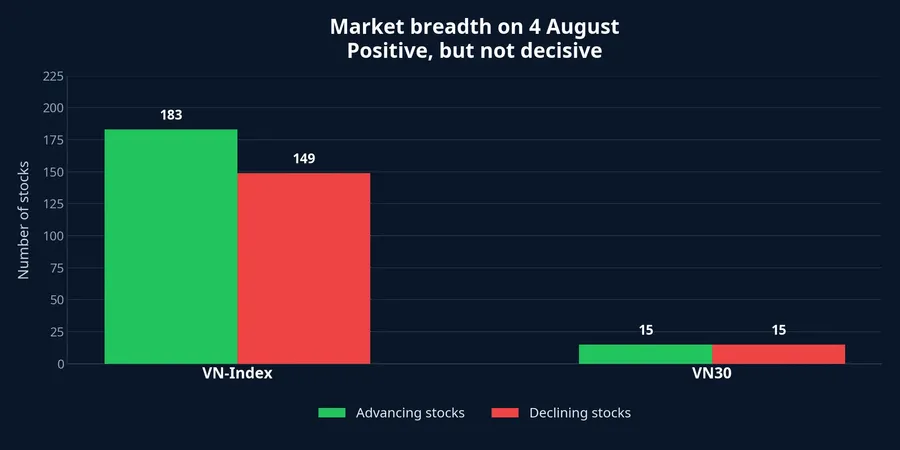
That does not invalidate the rally. HOSE recorded 183 advancing stocks and 149 decliners, so the market did lean positive. But the margin was not broad enough to call buying decisive, especially as VN30 had an even split of 15 gainers and 15 losers.

It is also important not to assign a single cause to the price move. Foreign demand was notable, but domestic flows, portfolio rebalancing and stock-specific supply and demand may all have contributed. One session of data cannot separate those contributions precisely, so it would be too strong to say VIC or VHM rose solely because foreigners bought them.
Breadth shows whether demand travels further
Market breadth counts advancing and declining stocks rather than focusing only on the index. If the VN-Index rises while a large number of shares also advance, the move has a broader foundation. If a few very large companies lift the index while much of the market is weak, index health and portfolio health can look very different.
Breadth was positive on 4 August, but not overwhelming. The VN-Index had 183 gainers against 149 decliners, while VN30 was balanced at 15 each. That pattern fits a market where money is discriminating rather than buying everything at once.
Turnover provides another check. VN-Index volume was 686,936,880 shares, below the previous session’s 760,113,033 shares. HOSE trading value still exceeded VND 18,000 billion, but an index gain on lower volume does not by itself demonstrate that fresh money has spread through the market.MarketTimes
That should not automatically be read as negative. Volume can fall when sellers become less aggressive while concentrated demand is still enough to lift the leaders. But for a more durable advance, investors would normally want to see improving breadth and turnover alongside the index move, not just the index moving higher.
Three checks for the next session
First, watch whether the net-buying list broadens. If most of the value remains in VIC, VHM and a handful of large caps, the “selective buying” structure has not changed even if the aggregate total stays positive. A wider mix of sectors among the bought names would offer firmer evidence of breadth.
Second, look at breadth before looking at index points. Are advancing stocks clearly outnumbering decliners, and does VN30 remain evenly split? Those answers help distinguish an advance supported by many shares from one driven mainly by the largest constituents.
Third, compare turnover with both prices and breadth. The more convincing structure is a rising index, a clearly expanding number of gainers and trading activity that does not weaken. If the index continues higher while volume falls and foreign buying remains narrowly clustered, reliance on the leaders remains the key risk.
The appropriate conclusion from 4 August is that foreign capital provided meaningful demand for a small group of important stocks, while the available evidence still supports a selective-buying thesis. That thesis changes only if foreign flows reach more names, price breadth improves and turnover confirms the move. The next session does not need to answer every question, but those three signals will show whether this is becoming a broader trend or remains a localized bright spot.