


A single US trading session delivered an easy-to-love sequence: Brent crude fell 4.7%, US Treasury yields eased, and major equity indices rose together. Yet for a Vietnamese investor, the useful takeaway is not a prediction that the VN-Index must follow the Dow. It is a working hypothesis to test against local price action.
The central view is straightforward: cheaper oil can improve sentiment and help sectors that consume large amounts of fuel, but breadth, turnover, and sector performance determine whether Vietnamese equities actually validate that signal. A strong US close may lift the opening mood. It cannot substitute for confirmation in Vietnam's own session.
One US session, several moving parts
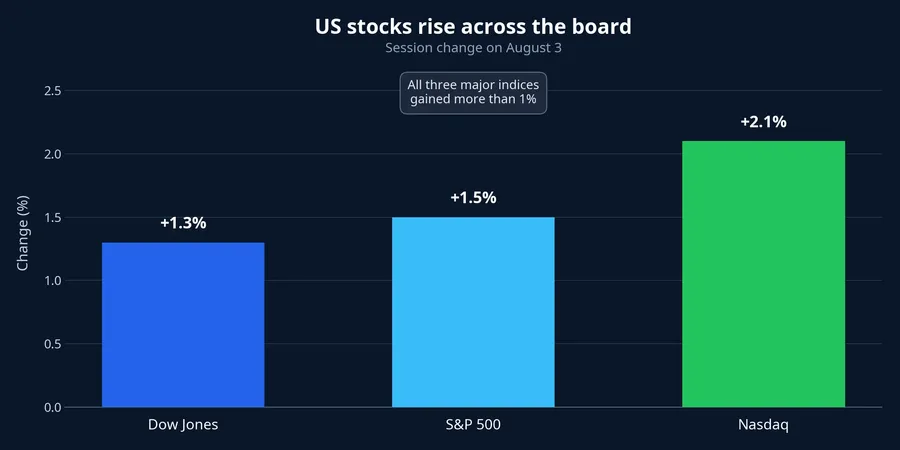
On August 3, the Dow Jones gained 693.38 points, or 1.3%, to a record 53,178.41. The S&P 500 added 1.5% and the Nasdaq rose 2.1%.AP Brent fell 4.7% to USD 83.77 a barrel that day, while the US 10-year Treasury yield declined from 4.75% to 4.68%.AP
The immediate focus was US President Donald John Trump of the US Government saying that he would pause further strikes on Iran at the request of regional allies. For the oil market, that reduced some of the price premium attached to possible supply disruption. Less acute energy risk also eased concern over a fresh short-term inflation impulse.AP
The transmission mechanism is coherent: lower oil prices can ease fuel costs; lower inflation anxiety can pull long-term yields down; and a lower discount rate can support equity valuations. But it would be a mistake to assign the entire Wall Street rally to oil. AP also pointed to improving manufacturing data, a broadly encouraging earnings season, and certification for a new Boeing aircraft as additional supports.AP

Timing alone does not prove causation. Oil helped sentiment, but the index gains reflected several pieces of information arriving together. A more durable reading is to identify those forces, then see which ones remain visible once Vietnam starts trading.
Cheaper oil does not help every stock equally
Think of oil as an input bill moving through different business models. A fuel-intensive company may see pressure ease relatively quickly. A company that sells petroleum products or services exploration may face questions about selling prices and future investment. The same oil move therefore sends opposing messages.
Airlines offer the clearest example. In the US session, United Airlines climbed 5.8%, American Airlines gained 5%, and Norwegian Cruise Line advanced 6.6% as fuel costs looked less threatening.AP For VJC and HVN, lower oil is likewise constructive for costs. It does not, however, translate mechanically into profit: exchange rates, hedging, fares, passenger demand, and load factors still matter.

On the other side, GAS, PVD, PVS, and PLX occupy different points in the oil and gas value chain. Contract pricing, workload, inventories, and price regulation can make their share-price responses diverge. A broad decline across the group may express a common view on oil. One stock moving differently is not enough to establish that the whole sector has resisted the pressure.
Transport, chemicals, and consumer businesses also need separate treatment. Road transport is generally more sensitive to fuel costs, whereas shipping and ports are heavily influenced by freight rates, cargo volumes, and trade demand. Lower oil can reduce chemical feedstock and logistics costs, but it may also pull selling prices lower. Consumer companies benefit more clearly only when they can hold prices without losing demand.
Oil is an input to a business model, not a switch that raises every company's earnings at once. A sector-by-sector reading helps investors avoid both errors: buying broadly because lower oil must be good, or selling all oil-related names because Brent had one weak session.
That distinction matters most when the opening move is fast. A share price can react to a broad headline before investors have had time to reassess company-specific variables. Fuel hedging can delay the benefit for an airline; inventory accounting can change the near-term effect for a distributor; a service contractor may be driven more by its order book than by a single oil close. The market's first reaction is therefore a clue to examine, not a finished earnings forecast.
Vietnam starts from an already-rising base
The VN-Index did not enter the new session from a neutral level. In the prior session, it closed at 1,762.84, up 27.06 points or 1.56%. Breadth favored buyers, with 245 gainers and 73 decliners, while volume reached 760,113,033 shares. Those figures show that domestic sentiment was already constructive before the US signal arrived.
That changes how an early gain should be interpreted. If the VN-Index opens higher with Wall Street, it is still only an initial reaction, not a decisive new signal. Some favorable expectations may already be reflected in prices. The more useful questions are whether buying extends beyond a handful of large caps and whether investors are willing to transact at higher price levels.
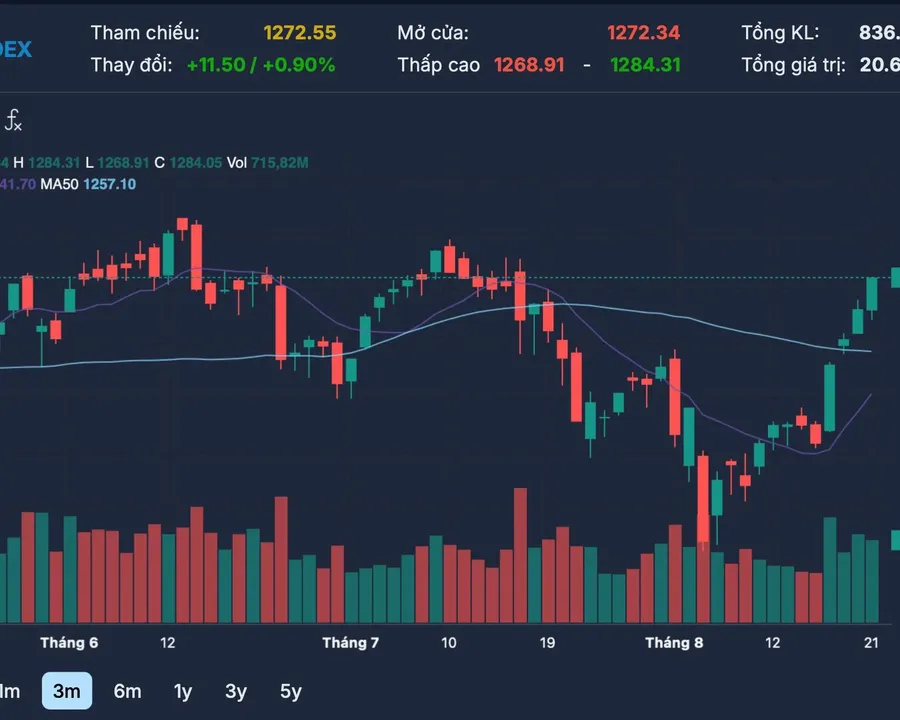
Breadth is the first filter. When advancers clearly outnumber decliners for most of the session, constructive sentiment is more widely shared. If the index remains green while losers increasingly dominate, leadership may be narrow. In that case, the overseas news may have created an opening burst rather than a broad change in valuation.
Turnover is the second filter. Rising prices accompanied by active trading across sectors show that money is accepting a higher price range. An index that rises while trading contracts can simply mean that sellers have stepped back. The chart may look similar, but the implication for the rally's staying power is very different.
Three checks instead of a forecast
The chart shows that the US move was broad rather than confined to one index. It is a global-sentiment indicator, not a direct buy or sell signal for Vietnamese shares.
First, watch Brent during Asian trading hours. If oil remains weak, the market is still treating supply risk as less severe. If it rebounds quickly, the cost and inflation narrative can change even after a favorable US close.
Second, compare the relative response of airlines and oil and gas names. Airlines outperforming while oil-linked shares come under pressure, particularly with better turnover, would fit a market interpretation of lower fuel costs. It is still an observation of price behavior, not proof that oil is the sole cause. Exchange rates, company news, and short-term positioning can matter at the individual-stock level.
Finally, look for agreement among the index, breadth, and turnover. When all three confirm, the external signal has a firmer basis in domestic sentiment. When they diverge, confidence in the scenario should fall. A record Dow alongside narrow VN-Index gains, a quick oil rebound, or no inflow into cost beneficiaries would point to a mood boost rather than a durable shift.
Conclusion: treat it as a checklist, not a trade signal
Lower Brent prices are easing one source of cost and inflation pressure. That is supportive for general sentiment, especially for businesses with large fuel bills. The main conclusion remains intact: benefits are uneven across sectors, and the VN-Index is under no obligation to replay Wall Street's reaction.
For the next session, the signals worth monitoring are oil during Asian hours, Vietnamese market breadth, turnover, and the relative performance of airlines versus oil and gas. Tension around Iran remains the specific risk that could reverse the picture if negotiations do not progress. Only confirmation from those domestic signals would give the overnight optimism a stronger claim to durability than an opening move.