

The VN-Index closed 3 August at 1,762.84 points, up 27.06 points or 1.56%.Thời báo Tài chính VN For a new investor, though, the headline number is like a final grade without seeing the individual subjects. It tells us how much the market rose, not whether most portfolios shared in it or whether buyers supplied enough depth for the move to persist.
One detail matters: 266 stocks advanced and 82 declined, with 11 hitting their upper price limit and only two falling to their lower limit. In plain terms, green was not confined to a handful of large-cap names. The central conclusion is that 3 August was a higher-quality rebound than a 27.06-point gain alone suggests, because breadth, money flow and leadership all improved. The evidence covers one session, however, not a confirmed new bull leg.
Breadth shows whether portfolios joined the move
Market breadth simply counts advancing, declining and unchanged stocks. It is especially useful in a market where large caps can exert substantial influence on the VN-Index: the benchmark can post a handsome gain while many accounts lag if the rest of the board is weak.
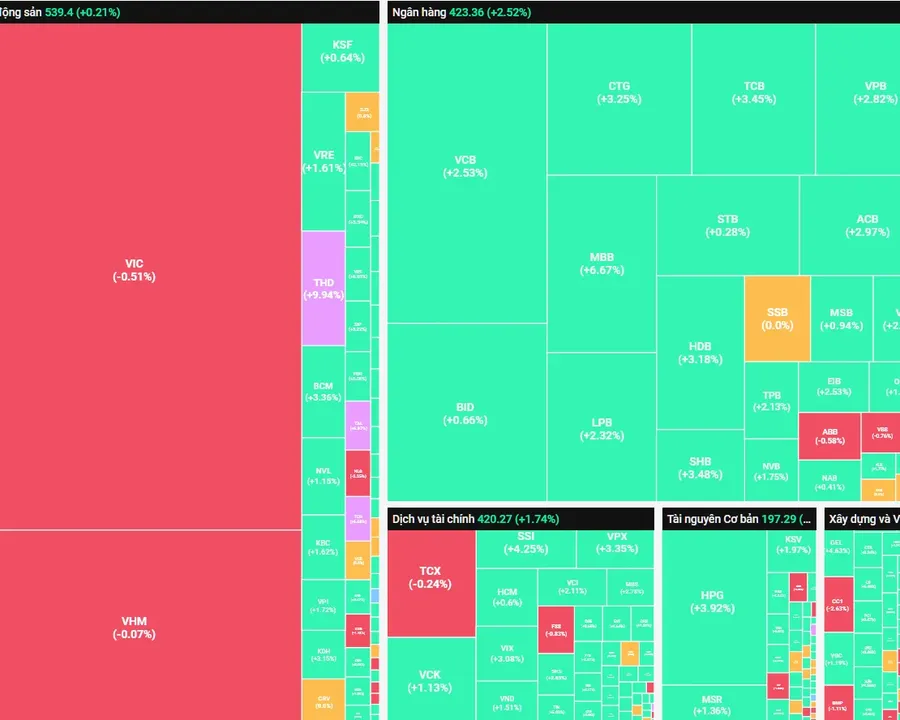
With 266 advances against 82 declines, more than three stocks rose for every one that fell on 3 August. That is constructive for the typical portfolio because buying reached beyond the index heavyweights. Compared with 31 July, when 119 stocks rose and 196 fell, it also shows a much clearer return of buyers after the weekend.
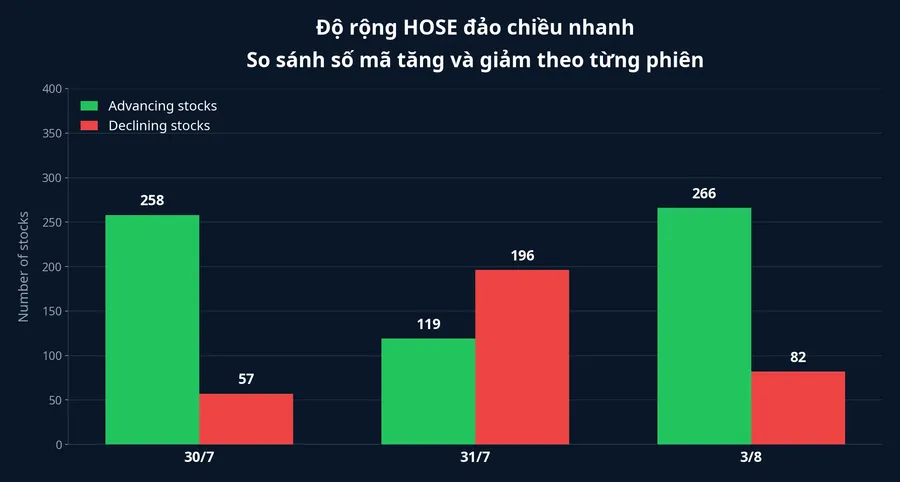
Strong breadth does not, by itself, establish a trend. On 30 July, 258 stocks rose and 57 declined, only for the relationship to reverse the next session. The useful question is therefore not whether 266 advances are positive. They are. It is whether advances can remain dominant in the sessions ahead.
Think of breadth as the number of people rowing a boat. A few powerful rowers can still move it, but a broad crew produces a more convincing motion. To judge how far the boat can travel, investors also need to assess the stamina of that effort: liquidity.
Breadth also keeps the reader from confusing a benchmark return with an investable experience. A portfolio concentrated in a lagging industry can still underperform on a positive index day, while a more diversified portfolio may capture more of a broad move. That is why the indicator is a diagnostic tool, not a promise about any individual holding.
Liquidity tests whether money is participating
Total trading value on HOSE reached roughly VND 19,274 billion, up 1.3% from the previous session, while volume was close to 771 million shares. Order-matching volume was about 9.9% above the 20-session average.Thời báo Tài chính VN When breadth expands while trading exceeds its recent baseline, the rally has better evidence that buyers are participating rather than merely observing.
Total turnover is not identical to the money actively trading on the order book. Order matching was estimated at about VND 16,450 billion, while approximately VND 2,824 billion came from put-through transactions. Put-through deals still matter, but they reveal less about intraday disagreement and the willingness of a wide group of investors to place orders.
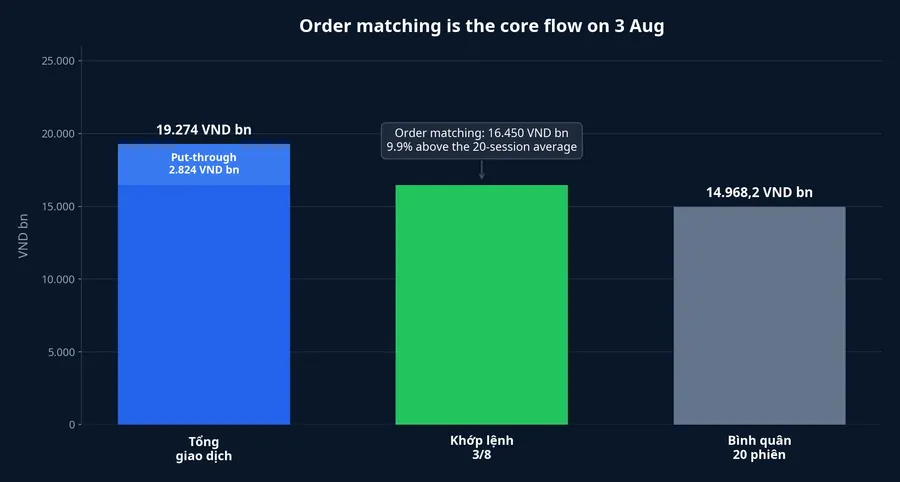
For that reason, new investors should compare order-matching value with recent sessions rather than relying on a single turnover total. Activity on 3 August was above the recent average, but it was not extraordinary. The balanced reading is that demand improved; calling it a new wave of money would require more evidence.
Liquidity also needs to endure, not merely spike for a day. A busy session can reflect bargain hunting, portfolio rebalancing or an isolated block trade. When trading activity holds up and breadth does not narrow in the sessions that follow, the two indicators begin to reinforce one another.
Neither indicator should be read as a trading instruction. Breadth and order matching describe the session that has occurred; they do not settle earnings prospects, valuation or an investor's own risk capacity. Their value is in preventing an overly simple interpretation of an index headline.
Large-cap leadership did not stand alone
The VN30 rose 2.44%, faster than the VN-Index’s 1.56% gain.Thời báo Tài chính VN That confirms the leadership of large caps. FPT, MBB, LPB, HPG and TCB together added about 12.64 points, nearly 47% of the index’s 27.06-point advance. FPT contributed the most at 3.731 points, followed by MBB at 3.159 points.
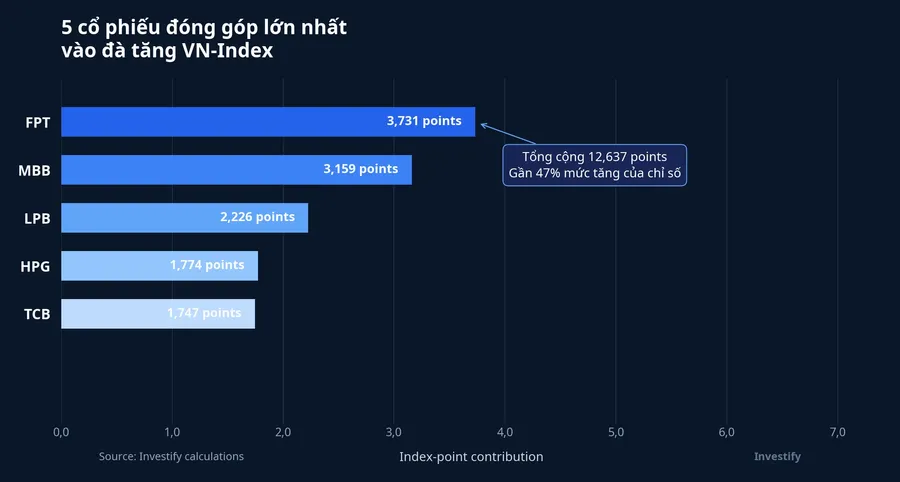
The near-47% share could suggest that a few names pulled the index higher. That is partly true: leadership was material. Yet a pure heavyweight-led session would be unlikely to produce such clearly positive breadth, and the HNX-Index also gained 2.96% on the day.Thời báo Tài chính VN

It is best to read the session in two layers. Large stocks did lead the index higher. At the same time, wider participation meant the market was not only a story about those leaders. The two observations complement rather than cancel each other out.
This distinction matters because leadership can change quickly. A market that depends entirely on a narrow set of names is more vulnerable when those stocks pause. A market where participation accompanies leadership is not immune to a reversal, but its one-day move rests on a broader base.
Foreign flows also form part of the picture. Overseas investors were net buyers of roughly VND 1,060 billion on HOSE, with net buying of VND 524.3 billion in FPT and VND 283.4 billion in HPG.Thời báo Tài chính VN That was tangible support, but one net-buying day cannot establish that the preceding selling trend has ended. Portfolio rebalancing or stock-specific demand are plausible alternatives; the available data do not allocate the cause precisely.
What to monitor after 3 August
The next session does not need a larger gain to validate the rebound’s quality. What matters is whether the structure beneath the headline remains sound. Three signals should be read together rather than used in isolation.
First, advancing stocks need to remain in the majority. A green VN-Index accompanied by a sharp rise in decliners would create a very different portfolio experience. Second, order-matching value should stay above its recent baseline. A gain on lower activity is not inherently wrong, but it provides weaker evidence of broad money participation.
Third, investors should watch whether leadership broadens or contracts. If a few large names continue to climb while other groups stop responding, the benchmark can again look healthier than most portfolios. If leaders remain constructive and breadth stays solid, the rebound earns further support.
The conclusion should remain conditional. The 3 August session passed a one-day test of participation and had supportive trading activity. It has not passed the test of continuity. The next few sessions will clarify whether this is the start of a more durable advance or a short-term recovery after a volatile period.