


USD/JPY fell from 163.48 yen per US dollar on July 30 to 160.57 on July 31. A move of almost 1.8% in a single session is large enough to force the market to reassess the risk of being short yen. Yet the wider picture points to an important distinction: a powerful reaction is not, by itself, a new trend. The interest-rate differential between the United States and Japan remains the more durable force behind the yen.
That distinction matters when reading the late-July move. Official action in foreign exchange can move the price within hours, particularly when investors rush to close a position. The incentive to keep a trade open for weeks, however, comes from the interest-rate carry earned over time. While that incentive remains substantial, the exchange rate can recover after the initial shock.
A sharp move has changed short-term risk
By the numbers, USD/JPY shed 2.91 yen in one session. At July 31, it was about 1.96% below the July 24 high of 163.77. For an investor borrowing yen to own US-dollar assets, this is not a technical detail: repaying the loan requires buying back a more expensive yen.
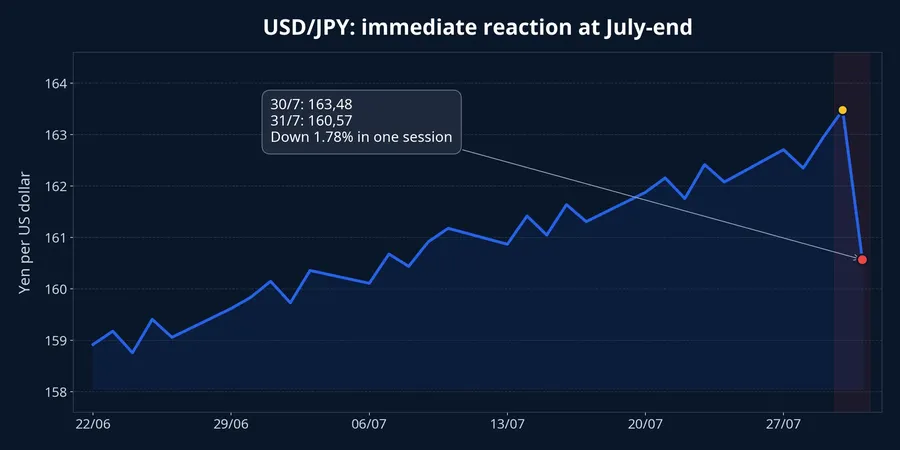
That can start a familiar feedback loop. As the currency moves against them, some short-yen positions are closed. Buying yen to close those positions supports the currency in the near term, especially in thin liquidity. Initial price moves can therefore be larger than the immediate change in underlying economic conditions.
Still, it would be a leap to assign the entire decline to one cause. Position closing, month-end liquidity and policy expectations may all have mattered. The available evidence shows that the market repriced the risk of selling yen; it does not yet identify the contribution of each factor with precision.
What intervention can, and cannot, accomplish
Buying a domestic currency creates a new risk threshold for those selling it. Investors are no longer assessing only the carry and routine volatility. They must also allow for a rapid reversal caused by a large official transaction. That is why a policy signal can influence trading even on days when no official trade is visible.
The signal should not be confused with a known commitment of resources. Japan's Ministry of Finance publishes aggregate intervention amounts monthly, while transaction dates and currencies are disclosed quarterly; data covering late July through late August are scheduled for August 28.MOF Japan Until then, estimates of scale remain estimates rather than evidence of a sustained commitment.
The distinction is practical. One intervention can impose losses on yen sellers and make them step back for a few days. A more durable policy backstop requires the market to believe that action can be repeated. If USD/JPY quickly returns to its pre-shock range without a change in rates or rate expectations, the economic pull has likely remained stronger than the element of surprise.

The rate gap still powers yen-funded trades
The underlying mechanism is straightforward. Investors borrow in a low-rate currency, exchange it for a higher-rate one and hold income-producing assets. The interest differential is the expected compensation, provided currency movement does not consume it. Japan's low rates have long made the yen a natural funding currency for this type of trade.
On July 29, the Federal Reserve kept its federal funds target range at 3.5% to 3.75%.Federal Reserve Two days later, the Bank of Japan decided to maintain its guideline for the uncollateralized overnight call rate at around 1.0%.BOJ Even comparing the lower edge of the US range with Japan's policy rate leaves a minimum differential of 2.5 percentage points.
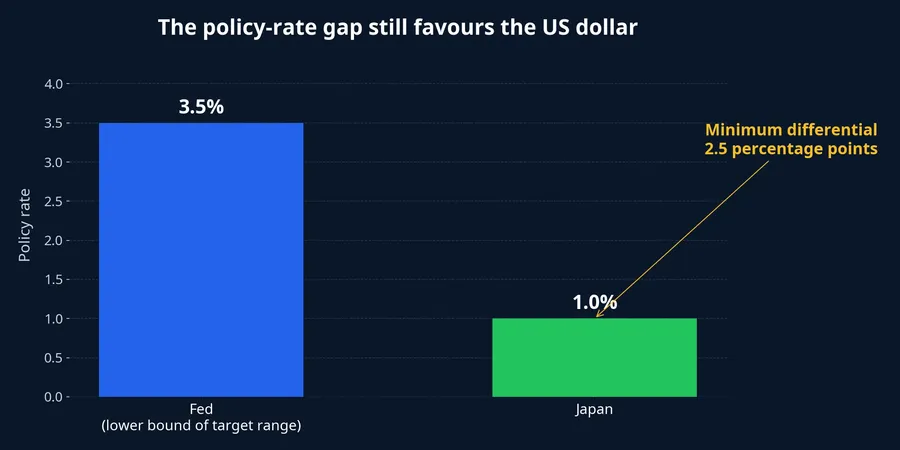
That is why one lower trading session should not be presented as a confirmed reversal. Intervention can raise the cost of holding a short-yen position. But a wide rate differential still provides a clear economic reward for borrowing yen. Capital allocation changes more durably only when the currency shock is large or persistent enough to offset that reward.
Policy rates are not the sole variable. US and Japanese bond yields, expectations for future meetings, market volatility and global risk appetite all influence the decision. But they all return to the same test: does the reward for owning US-dollar assets still exceed the currency risk on the yen loan?
This is also why headlines about intervention deserve a measured reading. A visible official response can change the distribution of near-term outcomes: traders who had treated a weaker yen as a one-way bet now have to budget for abrupt reversals. It cannot, on its own, set the return on a Treasury bill, alter Japanese funding costs or decide how long a portfolio manager is prepared to carry foreign-exchange risk. Those are the channels through which a temporary price shock either fades or becomes part of a broader repricing.
The signals that separate a reaction from a trend
The first signal is the price structure after the decline. A single lower day is less informative than several sessions of lower highs and lower lows in USD/JPY. If the pair holds a lower range when liquidity normalises, the market may be accepting a different equilibrium. If it rebounds quickly, the move is more likely to have been dominated by short-term position closing.
The second signal is a genuine narrowing in yield differentials. Watch not only central-bank language but also bond-market moves and subsequent policy decisions. Lower US yields, higher Japanese yields, or both would give the yen firmer support. If the gap does not narrow, the incentive to rebuild yen-funded trades remains.
The final signal is transmission to risky assets. When yen-funded trades unwind broadly, investors may sell assets bought with that funding to buy yen back. Equities, bonds and Asian markets can then face pressure together. One weak index session is not proof of that mechanism; the pattern must be simultaneous and persist over several sessions.
Why the move matters in Vietnam
Vietnamese investors do not need to treat the yen as a direct trading instrument for it to matter. It is a useful gauge of global risk appetite. A yen rally accompanied by the unwinding of yen-funded positions could make international markets more volatile, affecting capital flows and sentiment across Asia.
The thesis today is clear: the barrier to shorting the yen is higher, but the evidence is not yet sufficient to call a durable yen appreciation trend. That judgment would change materially only if USD/JPY continues to weaken after the short-term effects fade and the US-Japan yield gap narrows at the same time. Japan's intervention disclosure due in late August and subsequent policy signals will test both conditions.
For the next sessions, the monitoring list is deliberately short: whether USD/JPY holds a lower range, whether the two countries' yields converge, and whether volatility spreads across asset classes. None offers an instant answer. Together, they help investors avoid mistaking a sharp reaction for a completed trend.
For a Vietnam-focused portfolio, the practical value of this framework is not a directional trade call on the yen. It is a way to interpret the quality of a global risk move. If the currency stabilises at a stronger level while yield differentials narrow, the probability of broader deleveraging rises. If the pair rebounds while the rate gap remains wide, the late-July move looks more contained. The next data points should clarify which of those paths the market is choosing.