


A contract can spell out the contribution amount, the term and every payment date. It still leaves a more basic question unanswered: what business activity will generate the cash needed to make those payments? Without that answer, signatures and seals prove that a transaction was documented, not that it rests on an operating business.
The case involving Capel Group JSC brings that distinction into focus. On August 1, the Ho Chi Minh City People’s Procuracy completed an indictment prosecuting five defendants for offences related to alleged fraudulent appropriation of assets and money laundering.Công Lý These are prosecutorial allegations, not a final court judgment. Still, the mechanism described in the indictment offers a practical lesson in the limits of a contract when people are invited to contribute capital.
When a contract count does not identify the cash source
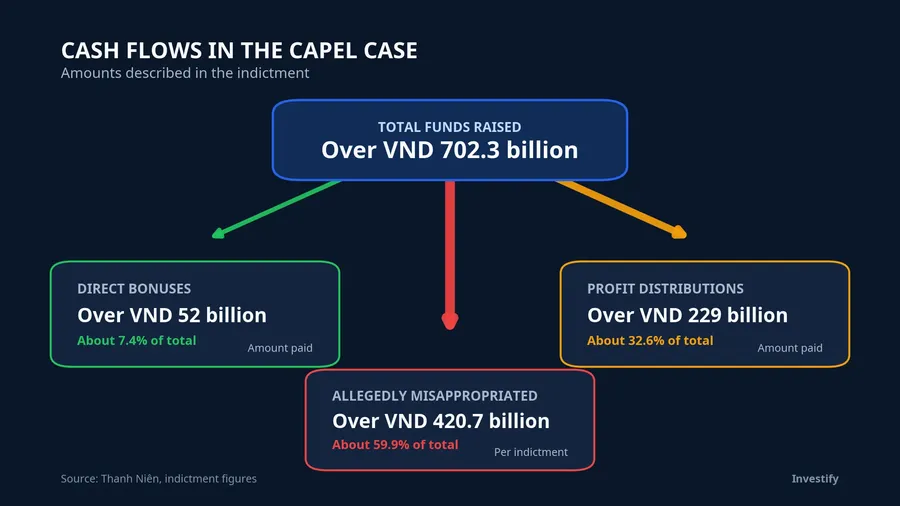
According to indictment details reported by the press, Capel signed 7,959 contracts with 4,837 contributors and raised more than VND 702.3 billion.Dân trí That scale can make an operation look organised and substantial. Yet neither the number of participants nor the thickness of the paperwork establishes revenue, assets or profit.
The indictment states that the company was formed in 2019 but had no actual production or business activity and implemented no investment project, even as it promoted opportunities in real estate, energy, tourism and high-tech agriculture.Công Lý Those facts do not permit anyone to substitute their own verdict for the court’s. They do show why due diligence must start with verifiable operating records rather than a project presentation.
The advertised return was as high as 12.5% per month, or a combined principal-and-profit amount equal to 300% of the initial investment after two years.Thanh Niên Those figures describe a payment promise, not a capacity to generate cash. The more precise a payout schedule is, the more it should be tested against sales contracts, invoices, revenue accounts and financial statements to see whether operating cash flow can support it.
A payment received is not proof of a profitable model
Contributors often treat an on-time early payment as a sign of safety. That is the gap most easily exploited: money arriving in an account does not reveal whether it came from customers, borrowing, asset sales, new capital or funds raised earlier. Only documents showing the source and purpose of each transfer can distinguish operating profit from another kind of payment.
In the Capel case, the indictment describes money from later participants being used for profit payments, bonuses and sales commissions for earlier participants and the sales operation. Thanh Niên, citing the indictment, reported that more than VND 52 billion was paid in direct bonuses and more than VND 229 billion was distributed as profit.Thanh Niên Prosecutors allege that more than VND 420.7 billion was misappropriated.Dân trí
That description explains why an initial run of payments cannot establish sustainability. If earlier obligations are met with new capital, the arrangement can appear normal while participation is still expanding. Once new inflows slow, the same schedule becomes an obligation without a matching operating activity to carry it.

The important discipline is not to claim causation beyond the available record. At a given time, a company may pay contributors from genuine revenue, borrowing or another source, and each possibility requires its own evidence. In this case, the final findings on criminal liability and loss remain for the court.
What a business cooperation contract actually protects
Vietnamese investment law recognises a business cooperation contract as an arrangement in which parties cooperate in business and share profits or products without forming a new economic organisation. A contract signed between domestic investors is performed under civil law. The label itself is therefore neither a warning sign nor proof that a project is operating well. It does not independently establish management quality or the existence of cash flow.
The core contents of a BCC include the business objective and scope, contributions and how results are shared, the timetable, rights and obligations, amendment or termination terms, liability for breach and dispute resolution. These clauses allocate obligations between the parties. They do not independently verify that a project exists, revenue has been earned, managers are using funds as intended or collateral remains available. A strong clause has value only when the contributor can obtain the records needed to enforce it.
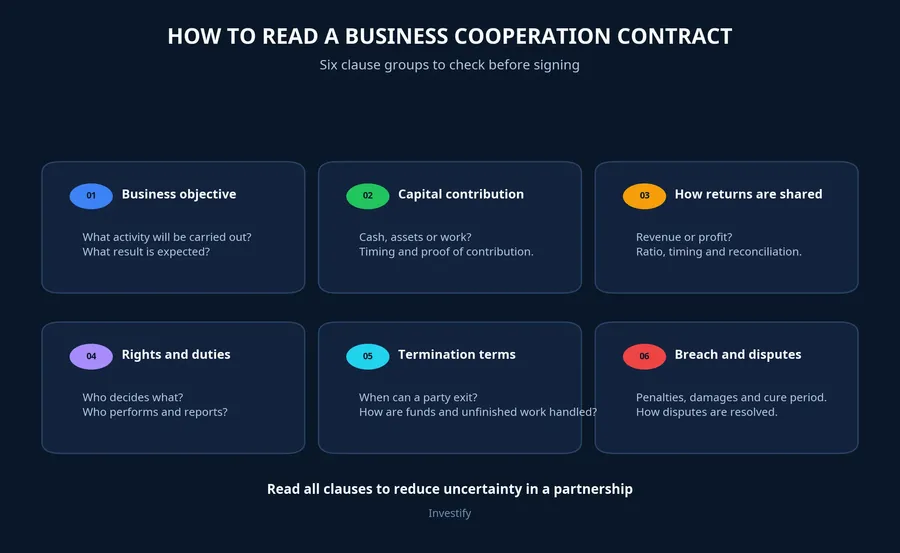
The real risk lies in an imbalance between a promise and the right to test it. An agreement may specify a return for every period, but oversight is thin if the contributor cannot receive regular reports, reconcile supporting documents or enforce collateral when a breach occurs. The key question is not only what a party is promised, but how that party can verify it.
Trace the promised return back to the recovery right
The first task is not to compare the advertised return with another investment product. Ask what activity creates the money: what goods or services does the company sell, which customers pay, where is revenue recorded, and can operating cash flow meet the promised payments? A polished plan cannot replace customer contracts, invoices, revenue statements or financial reports that can be checked.
Next comes the route taken by the capital. The receiving account should match the contracting party, the transfer description should clearly identify the contribution, and the contributor should understand whether funds are managed for a specific project or mixed with operating expenses. Without knowing where the money goes after transfer, it is impossible to tell whether capital is forming assets or servicing mature obligations.
Only then does the recovery mechanism come into view. Does the contributor have a contractual right to periodic documents, access to evidence, agreed audit rights, termination after breach or enforcement of collateral? If a dispute arises, which records prove the transfer and which body will resolve it? These questions cannot eliminate every risk, but they require the return promise to be matched by a right to inspect and a route to recover capital.
Thanh Niên, citing the indictment, reported that 2,074 people had filed reports and sought compensation of more than VND 269.2 billion.Thanh Niên A contract may evidence that a transaction occurred, but recovery also depends on the cash-flow record, assets that remain and the outcome of legal proceedings. That is the gap between a right written on paper and the practical ability to receive money back.
Conclusion: evidence before the promise
The lesson of the Capel case is not that every business cooperation contract should be avoided. It is about sequence: evidence of cash-generating activity, use of capital and a recovery mechanism should come before a return schedule is treated as credible. A contract records those commitments; it cannot substitute for them.
For this specific case, the court must decide the defendants’ liability. For any capital-contribution invitation, the signals worth monitoring are the quality of operating evidence, clearly written oversight rights and the ability to reconcile the cash flows. When returns are calculated down to each period but the source of those returns is described only in slogans, that gap needs to be resolved before funds are transferred.