


A large net-selling figure naturally sounds like market pressure. Yet July 28 offered the missing half of that picture: foreign investors were net sellers of VND 1,978.4 billion on HOSE while the VN-Index gained 11.61 points. That is not a contradiction. The end-of-day statistic combines transactions that can have very different effects on the order book.Tinnhanhchungkhoan
Think of net flow as the cash total for a shop at closing time. It tells us the scale, but not whether selling took place at the counter or whether a large pre-arranged shipment simply changed hands. For a new investor, that distinction matters. It is the difference between responding to a headline and understanding the pressure actually facing quoted prices.
The central point is straightforward: foreign net selling is worth monitoring, but it cannot by itself determine the VN-Index's short-term direction. The useful reading combines trading method, market breadth and the contribution of large-cap shares.
This is a framework for interpreting a session, not a rule that turns any one indicator into a forecast. Foreign flow can matter because it affects supply and demand, but it is only one participant group and one summary measure. A cleaner reading asks several linked questions: was the flow executed on-screen, was buying or selling widespread, and did the largest stocks reinforce or offset that move? The answers can point in different directions, as they did across these two sessions.
Same negative sign, different market outcomes
On July 27, the VN-Index fell 17.10 points, or 1.01%, to 1,669.01. On HOSE, 77 stocks advanced while 239 declined, and foreign investors sold a net VND 741.5 billion. The imbalance in market breadth suggests that the pressure extended beyond a handful of isolated names.SHSTinnhanhchungkhoan
The total net-selling figure was larger on July 28, but the screen looked different. The VN-Index gained 11.61 points to 1,680.62; 189 shares rose and 122 fell. Trading volume rose from 627.27 million to 778.94 million shares across the two sessions, so participation did not disappear during the rebound.
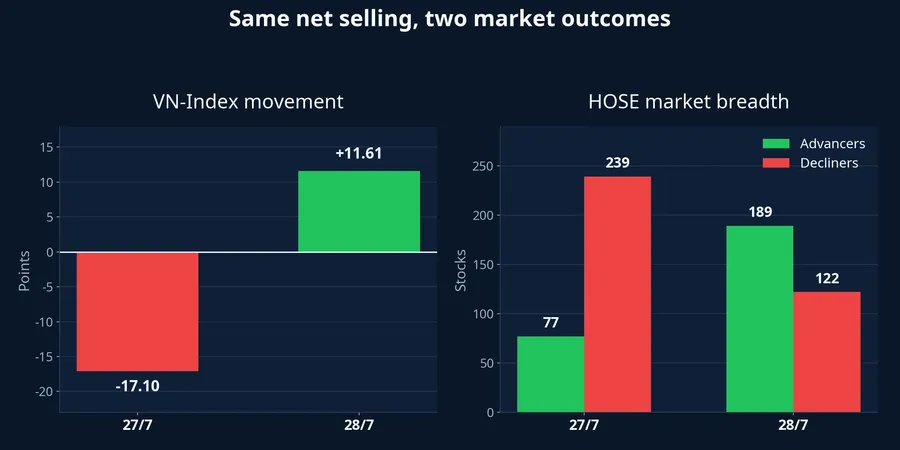
It is therefore imprecise to say the market rose in defiance of foreign flows. A more faithful description is that the index rose on a day when a large transaction made aggregate net selling look more negative than the immediate pressure in order matching. The difference between the two sessions was in the structure and breadth of trading, not merely the minus sign beside foreign flow.
Separate matched orders from block trades
Order matching is the continuous meeting of bids and offers on the screen. Selling through this channel can directly work through price levels. A negotiated transaction, by contrast, transfers a known block between parties at an agreed price. It changes ownership and appears in market statistics, but it does not necessarily create the same strain on the live order book.
That distinction was especially clear on July 28. Foreign investors were net buyers of more than VND 933 billion through order matching. The transaction that turned the total negative was concentrated in VHM: more than 22.2 million shares changed hands through negotiated deals, worth over VND 2,904 billion. Fili reported that this allowed the total to show net selling of nearly VND 1,975 billion even as the matched-order channel was a net-buying one.FiliVietnamBiz
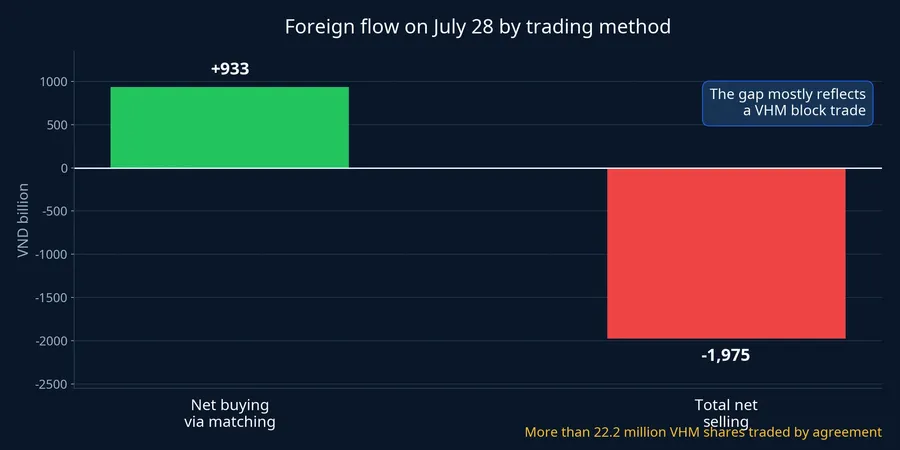
This does not make a block trade irrelevant. A large transfer can signal a portfolio-weight change, affect sentiment and lift total turnover. But when the question is whether sellers are pressing quoted prices during the session, matched-order data is usually closer to the answer than an aggregate total covering every channel.
There is also a boundary to the inference. The VHM transaction alone does not identify the buyer, seller or their motives. The available evidence shows that the negotiated deal explains an important part of the gap between matched-order net buying and aggregate net selling. Any claim about the parties' strategy would require separate evidence.
Breadth tests whether demand is spreading
An index gain does not always mean that most stocks rose. Because the VN-Index is capitalization weighted, a small number of large constituents can move the point total while many other shares decline. Breadth is the necessary cross-check.
On July 27, decliners outnumbered advancers by more than three to one. That setting gives the VND 741.5 billion of net selling more weight because it arrived alongside broad weakness. On July 28, advancers outnumbered decliners and matched-order value on HOSE exceeded VND 13,613 billion. Those figures are consistent with demand appearing across more than one isolated transaction.Nhân Dân
Breadth is not a guaranteed forecast for the next session. It is a quality check on the current move. An index advance with declining shares still dominant may rely on a few pillars. An advance that comes with improving breadth and sustained turnover presents a more convincing picture of demand.
Large caps can change the point total quickly
Large-cap stocks form the final layer of the reading. On July 27, HPG lost 2.16% and MWG fell 6.91%. On July 28, HPG gained 3.19% and MWG added 3.00%; positive contributors together added about 7.03 points to the VN-Index.VTVNhân Dân

The reversal in HPG and MWG does not, on its own, establish the cause of the whole recovery. Demand in banks, securities firms and materials may also have mattered. What the data does establish is that large shares were no longer pulling the index lower as they had the day before. Looking at point contributors tells investors who is supporting an index move.
A short process before reacting to a headline
When foreign net selling makes the news, begin by separating matched orders from negotiated transactions. If most of the value comes from a block transaction in one stock, the total should not automatically be read as broad selling pressure. This matters most on sessions with a large ownership transfer.
Then check breadth and turnover. Weakening breadth alongside net selling through order matching deserves more attention. In contrast, net buying through matching, improving breadth and adequate turnover show that the market is absorbing supply differently from what the aggregate headline suggests.
Finally, check the large-cap point contributors. This is not a method for selecting a share to buy or sell. It answers a better question: is the VN-Index reflecting broad market strength, or mainly the movement of a small group of heavyweights?
The two late-July sessions do not diminish the importance of foreign capital. They show the limit of a combined statistic. In the sessions ahead, the signals to monitor are the share of selling through matching, breadth, turnover and agreement among large caps. When all four deteriorate together, net selling carries more concern. When they diverge, the first step is to investigate the structure behind the number rather than let one headline define the market.