


The State Bank of Vietnam has changed how a portion of State Treasury deposits is counted in the LDR denominator. That is supportive for the balance sheets of state-owned commercial banks, which hold almost all of those deposits. It does not, however, make loans, credit demand or interest income rise overnight. For investors, the right takeaway is a differentiated balance-sheet benefit, not an immediate sector-wide earnings upgrade.
The central thesis is straightforward: Decision 1743 creates a meaningful technical buffer for state-owned commercial banks, particularly listed VCB, BID and CTG. The earnings benefit remains conditional. It needs to be validated by lending to sound borrowers, stable funding costs and asset quality that does not deteriorate.
What changes in the LDR calculation?
LDR measures loans against the deposits included under the regulation. Put simply, it shows how much of a bank's funding base has been deployed into lending. When loans grow faster than the denominator, LDR approaches its limit and balance-sheet expansion becomes more constrained.
Before August 1, banks had to exclude 80% of State Treasury term deposits from the LDR denominator, leaving only 20% eligible for inclusion. The existing framework allows the SBV Governor to set a different ratio for each period.CafeF
On July 30, the SBV issued Decision 1743, reducing the excluded share to 50%. Half of Treasury term deposits can therefore enter the denominator, up from 20% previously. The decision is effective from August 1, 2026 through July 31, 2028, so this is an issued rule rather than a proposal.Thời báo Ngân hàng
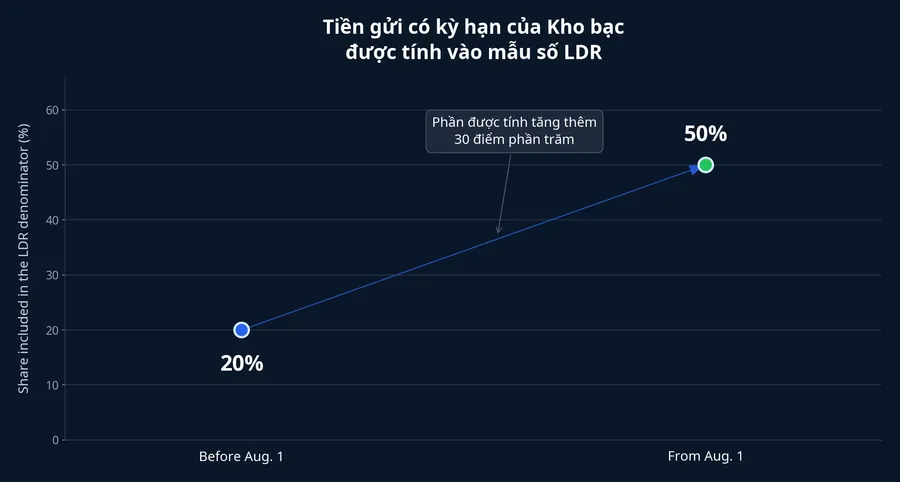
Mechanically, a larger denominator lowers LDR if the loan book is unchanged. That gives a bank more room below the 85% maximum and reduces pressure to raise deposits simply to comply with the ratio. It is a real benefit, but it is first and foremost a funding-structure benefit.
Treasury deposits determine who benefits
The key data point is that Treasury deposits are not evenly spread across the system. At the end of March 2026, State Treasury deposits at banks totalled VND 626,716 billion. State-owned commercial banks held VND 624,167 billion, or 99.59% of that balance.CafeF

That concentration explains why Vietcombank, BIDV, VietinBank and Agribank are the principal direct beneficiaries. Joint-stock banks operate under the same formula, but their denominators barely change if they do not hold Treasury term deposits. The measure should therefore not be read as a uniform easing for the entire banking industry.
For equity investors, there is a second distinction. Agribank may benefit operationally but is not listed. VCB, BID and CTG provide the more direct listed exposure, although the exact benefit still depends on each bank's Treasury-deposit mix and balance-sheet strategy.
The Big Four are approaching, not hitting, the cap
As of March 31, 2026, Vietcombank's LDR stood at 84.54%, VietinBank's at 83.48%, Agribank's at 83.28% and BIDV's at 82.94%. All were below the 85% limit, though the distance to it was narrow.CafeF
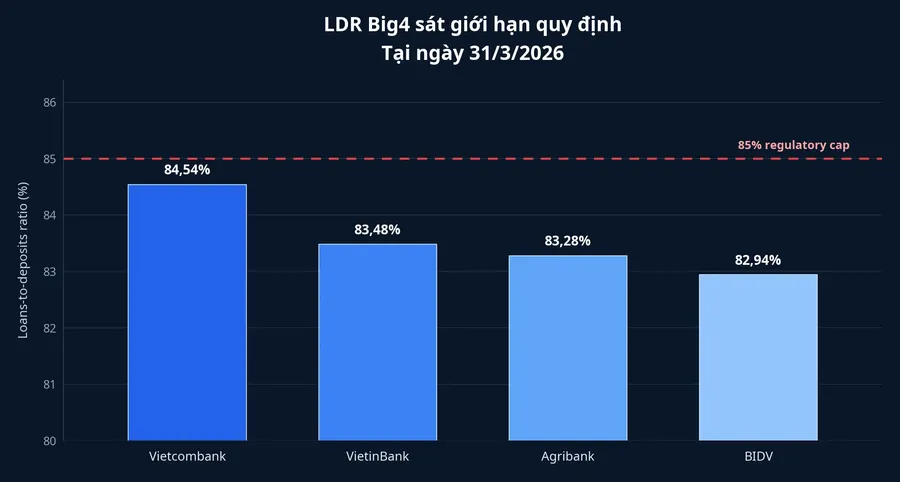
The wording matters. These ratios were approaching the threshold, not hitting or exceeding it. Raising the included share of Treasury deposits can move a bank further below the cap through a technical change in the denominator. It creates more flexibility in managing permitted credit growth; it is not an unlimited lending licence.

The starting LDR gap does not by itself identify the bank that will deliver the largest profit increase. LDR is only one constraint among several. The additional eligible deposit balance, credit-growth allocation, capital capacity and borrower demand determine how much room can become earning assets.
More room does not automatically become credit growth
First, banks remain subject to credit-growth allocations from the regulator. If those allocations do not change, a lower LDR does not itself grant authority to expand loans. The additional buffer chiefly improves flexibility in using the growth capacity already available.
Second, lending needs creditworthy demand. Businesses need viable projects, repayment cash flows and genuine funding needs; household borrowers must also meet underwriting standards. Without qualifying demand, the LDR buffer remains on the balance sheet rather than becoming interest-earning loans.
Third, LDR does not replace capital adequacy or risk control. Every new loan adds risk-weighted assets. A bank under pressure from capital constraints or non-performing loans should not relax underwriting merely because it has more distance from the LDR cap; future provisions could erode the extra interest income.
Treasury deposits also differ from stable retail deposits. The decision requires credit institutions to monitor maturity and size mismatches between these funds and their uses, and to maintain liquidity even if the Treasury withdraws deposits early.Thời báo Ngân hàng Inclusion in the denominator therefore does not mean a bank can comfortably treat the funds as long-term funding for long-duration lending.
NIM is the next confirmation point
The first benefit may appear in funding costs rather than loan volume. With less LDR pressure, state-owned commercial banks may not need to compete as aggressively for deposits. If marginal funding costs decline while lending yields hold, there is a basis for NIM to improve.
The relationship is not one-way. More capacity can intensify competition for high-quality borrowers and push lending rates lower. If asset yields fall faster than funding costs, NIM will not expand even if credit grows. The profit question therefore lies in how banks use the buffer, not in the LDR figure alone.
Joint-stock banks with limited Treasury deposits could see an indirect effect if competition for deposits from state-owned peers becomes less intense. That would be a spillover through the deposit market, not a direct benefit from the denominator change. These mechanisms should not be conflated when comparing bank stocks.
What to watch after August 1
Decision 1743 is conditionally positive for state-owned commercial banks. The thesis is not that earnings rise immediately; it is that their balance sheets gain operating room during the decision's two-year effective period. That is materially different from a story of universal industry easing.
Investors should look to subsequent disclosures for confirmation on credit disbursement, funding costs, NIM and asset quality before treating the technical support as an earnings improvement. Bank results should show not just faster loan growth but lending that remains supported by borrower cash flows and disciplined credit standards. A lower ratio is helpful only when it releases a binding constraint; it cannot compensate for weak demand or a weaker risk profile.
If those indicators improve together, the LDR buffer can become durable profit growth. If they do not, the rule change remains useful, but its value is limited to easing funding-structure pressure. The practical watch list is therefore clear: credit disbursement, deposit pricing, NIM, non-performing loans and provisioning. Quarterly disclosures should make that transition visible. Those signals will tell investors whether the regulatory adjustment has moved beyond arithmetic and into earnings.