

Apple has closed its third fiscal quarter with USD 109.417 billion in revenue, up 16% year on year, and USD 29.789 billion in net income, up 27.1%. Those are strong figures in both scale and growth. But investors should resist compressing revenue, profit and EPS into a single verdict that the business is simply “doing well.” Each metric answers a different question about the company’s health.Apple
The timing makes the distinction more important. Apple Chief Executive Officer Tim Cook is preparing to leave the operating role, while Apple’s incoming Chief Executive Officer John Ternus will take over on September 1. Ternus inherits a business that is selling well, but also a clear test: can the iPhone, services and core earnings all contribute to growth at the same time?Apple
A good quarter does not mean every engine is equally strong
Revenue shows what customers spent with Apple. Net income shows what remains after costs. EPS, or earnings per share, is also shaped by share count and non-recurring income. EPS rose 29% to USD 2.02, which is positive, but that alone does not establish that the quality of growth improved evenly across the business.Apple
Revenue growth does not automatically translate into an equally durable improvement in profit. A quarter can be helped by a favorable product mix, temporarily lower costs or a refund. For newer investors, the useful framework is to separate three layers: product demand, recurring revenue capacity and the share of profit supplied by one-off items.
The iPhone pulled the wider picture higher
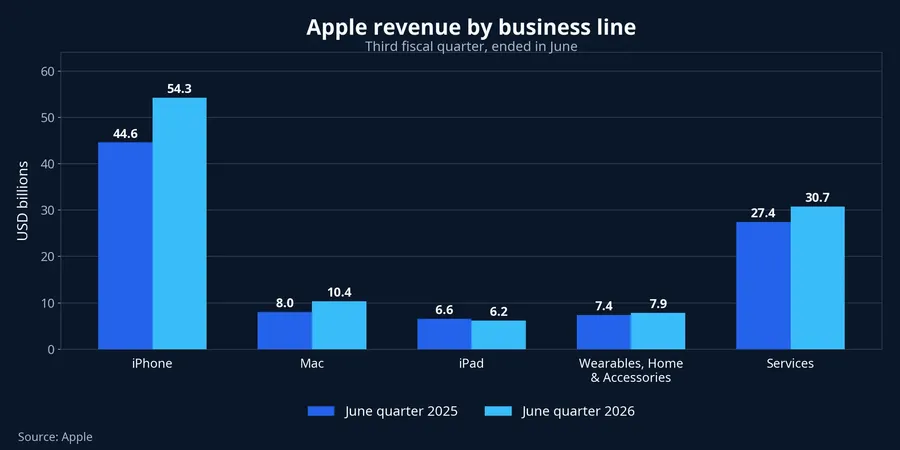
iPhone revenue reached USD 54.252 billion, up 21.7% from a year earlier, and represented about 49.6% of quarterly revenue. When a segment making up nearly half of sales accelerates, it is not a standalone bright spot: it pulls the whole report higher. Device demand is therefore real rather than merely an accounting effect.Apple
Mac revenue also rose 28.7%, from USD 8.046 billion to USD 10.352 billion. Wearables, Home and Accessories rose 6.5%, while iPad revenue fell 5.9% to USD 6.191 billion. Growth was not uniform across the product line. That is not inherently negative, but it limits any claim that the entire portfolio is expanding in lockstep.Apple
Greater China was a meaningful improvement, with revenue up 22.4% to USD 18.816 billion. It is a large and intensely competitive market, so the quarterly result matters. Still, one improving quarter does not prove that Apple has fully resolved pressure from domestic rivals; subsequent quarters will show whether demand is durable or this was a strong point in the product cycle.Apple

Services are the test of earnings quality
Services generated USD 30.739 billion, up 12.1%, a June-quarter record. That is still an enormous business. Yet it was about USD 0.641 billion below the consensus estimate of USD 31.38 billion, giving the market a reason to look beyond the double-digit growth rate.Yahoo Finance
The attention reflects the nature of the segment. Subscriptions, cloud computing, payments, warranties, advertising and platform fees can recur over time rather than depending entirely on a customer’s decision to buy a device in one quarter. The iPhone expands the installed base; services determine how rapidly Apple can generate further revenue from each user.
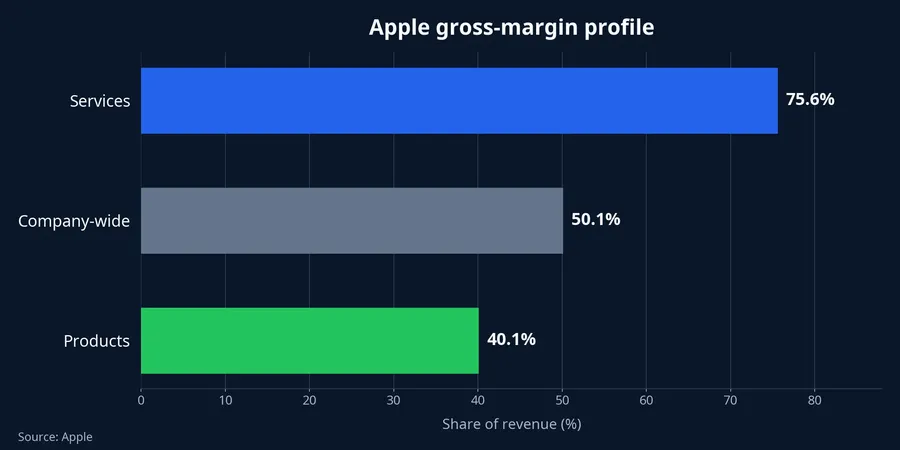
Services carried an approximately 75.6% gross margin, far above the roughly 40.1% margin for products. In other words, a dollar of services revenue normally contributes more gross profit. Slower-than-expected services growth does not negate the iPhone quarter, but it means the business with the highest earnings quality did not grow as quickly as the market expected.Apple
The tariff refund made EPS look brighter
Company-wide gross margin was 50.1%. Apple said a tariff refund contributed about 2 percentage points to that figure. A simple subtraction puts the margin without that effect at about 48.1%; this is an estimate to isolate the one-off item, not a separately reported Apple metric.Apple
The refund also added USD 0.11 to EPS. Excluding it, EPS was approximately USD 1.91, still above the average USD 1.89 forecast but by only about USD 0.02. The key point is not that Apple depended entirely on the refund: core operations still beat expectations. The beat was simply much narrower than reported EPS first suggests, so the full profit increase should not be treated as immediately repeatable.AP
The stock reaction points to a high bar
A report that beats estimates does not automatically produce a positive market response. That does not turn a good report into a poor one, nor does it establish a single cause. When services miss expectations and a tariff refund lifts part of EPS, investors have reason to examine core earnings more closely.
That is an important distinction for newer investors. A share price responds to the gap between reality and what markets had already expected, not merely to whether a number rose or fell. A good report can still be met with selling if the variables most relevant to valuation, here services momentum and margin durability, do not clear a high enough bar.
A solid handover, not the final answer
The next quarter needs to be read against the component-cost backdrop. Apple raised Mac and iPad prices last month, citing a memory-chip shortage linked to demand from the artificial-intelligence boom. Higher input costs could pressure margins once the tariff refund no longer supports results as it did this quarter.AP
The thesis is constructive but conditional: Apple is handing over a powerful iPhone sales engine and core earnings that still exceeded expectations. Component costs and services are risks to monitor, but they do not reverse that conclusion unless services continue to miss expectations or margins weaken materially in coming quarters. The relevant signals are services growth, margin performance excluding one-off effects and whether device demand holds as John Ternus begins his tenure.