


Vietnam's overnight interbank rate fell to 2.5% per year at the close on July 24, down 1.4 percentage points from the previous weekend and to its lowest level since the start of the year. At the same time, the one-month rate stood at 7.3%. Both numbers belong to the interbank market, but they describe very different conditions.VnEconomy
Put simply, banks appear less pressed for cash that must be repaid tomorrow. That does not mean they have secured cheap funding for the months ahead. This is why an overnight-rate decline should not automatically lead borrowers to expect mortgage or business-loan rates to fall at once. Lending rates pass through more gates than a single market quotation.
The central conclusion is straightforward: the available evidence confirms an improvement in very short-term liquidity, but it does not yet establish a lending-rate downcycle. A firmer conclusion requires the move to spread into longer interbank maturities, deposit pricing and, eventually, quotes offered to customers.
What an overnight rate actually measures
On any given day, one bank may have excess cash after taking deposits or completing payments. Another may need funds to settle transactions, meet reserve requirements or square its books. They lend to one another in the interbank market, and an overnight loan is typically repaid on the next business day.
Because its tenor is so short, the rate responds quickly to immediate cash flows. Large payments, government-budget flows, foreign-exchange transactions and open-market operations can each change funding demand within a day. It is a thermometer for current liquidity, rather than a price list for a three-year household loan.
That distinction matters. A thermometer records the temperature at a moment; it cannot by itself say what a bank must pay to retain stable deposits for six or 12 months. Nor should the 2.5% overnight rate be compared directly with a household lending rate and the difference treated as bank profit.
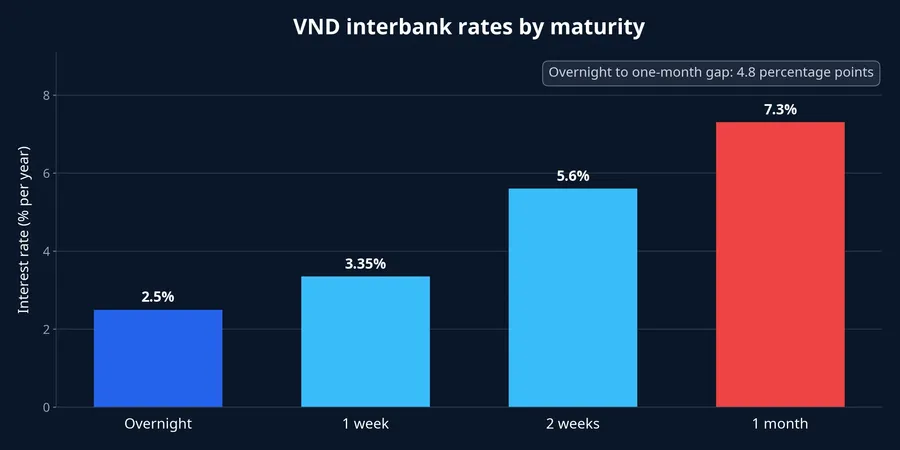
The curve at the July 24 close makes the split visible: 2.5% overnight, 3.35% for one week, 5.6% for two weeks and 7.3% for one month. The 4.8-percentage-point spread between overnight and one month is more informative than the 2.5% headline alone.VnEconomy
When rates rise as maturity lengthens, the market is pricing funding for several weeks more cautiously than funding for one day. This is not proof that lending rates will rise. It is also not evidence that banks can broadly cut the cost of longer-term funding yet.
The distinction is practical, not merely technical. A company rolling short-term cash for a payment tomorrow cares about the overnight market; a family locking in a mortgage cares more about the bank's durable deposit base and the terms written into its contract. The two prices can move in opposite directions for a while without creating a contradiction.
Open-market data resist a simple explanation
The State Bank of Vietnam's collateralised-operation channel during July 20-24 offers a useful reminder. VND 19,000 billion was offered and VND 13,943.89 billion was awarded. In the same week, VND 40,296.60 billion matured, producing a net withdrawal of VND 26,352.71 billion through this channel.VnEconomy
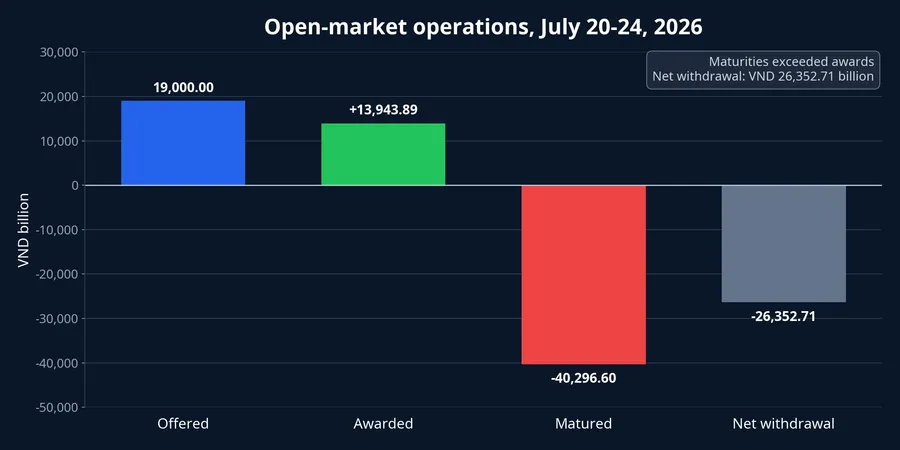
The net withdrawal does not prove that one factor alone caused the overnight rate to fall. Interbank rates also reflect funding needs at individual banks, settlement schedules and the distribution of cash across the system. What the figures do show is that the story cannot be reduced to “inject cash and rates fall” or “withdraw cash and rates rise.”
For newer investors, the safer approach is to separate the signals. Open-market operations reveal one part of liquidity management; interbank rates show the price of funding at particular maturities. Both should be read together, rather than using one weekly operation to infer policy or a multi-month lending-rate trend.
From interbank cash to term deposits
Banks draw on several funding sources, and customer deposits are important for financing longer loans. Overnight borrowing can help manage temporary imbalances, but it cannot fully replace stable funding for mortgages, equipment purchases or working capital. Reliance on short funding for long loans would force banks to keep refinancing their balance sheets.
That makes deposit rates the next link to watch. As of July 23, the average online deposit rate across 36 banks was approximately 6.16% per year for six months and approximately 6.39% for 12 months. The broader level was largely stable from end-June, with only two banks in the survey raising their rates.VnEconomy

Stability does not mean every bank is identical or that deposit rates cannot move. It means the public data do not yet show a broad deposit-rate cut. Until deposit funding becomes clearly cheaper, banks have less room to lower loan rates widely while still covering risk and operating costs.
This also explains why a promotional rate at one institution should not be treated as a system-wide signal. Individual banks may adjust for their own customer mix, maturity needs or competitive position. The broader pattern matters because a sustainable shift in funding costs has to be visible beyond isolated offers.
Contracts create another delay. For existing loans, the next reset date, the interest-rate formula and any initial fixed-rate period determine when a borrower receives a new rate. For a new loan, purpose, collateral, tenor and credit history mean that each application can receive a different quote. One overnight move cannot turn into a new rate for every borrower on the same day.
A lending rate bundles several costs
In plain terms, a lending rate is not the interbank rate plus a fixed mark-up. A bank also has to account for its average deposit cost, operating expenses, expected credit losses and the return needed to sustain the business. Interbank funding directly affects only one part of that structure.
By the end of June, average lending rates for both new loans and outstanding loans remained in an 8.1%-10.5% annual range.VnEconomy The gap versus the overnight rate is not a simple subtraction exercise. The two rates price transactions with different maturities, stability and risk.

Borrowers should therefore read the terms of their own loan: the next reset date, the post-promotional formula and any early-repayment fee. That is how a macro headline becomes information useful for a household budget, rather than a reason to react to an overnight-rate headline alone.
What would change the conclusion
First, low rates would need to persist across several short maturities: overnight, one week, two weeks and one month. If only the very front of the curve falls while the one-month rate stays elevated, temporary cash abundance at certain moments remains the more plausible reading.
Next, six- and 12-month deposit schedules would need to decline at a meaningful number of banks. That is a closer indicator of the cost of stable funding. Only then can subsequent average rates on new lending show whether lower funding costs have reached customers.
The conclusion therefore remains unchanged: overnight liquidity has become less tight, while the evidence is still insufficient to confirm a lending-rate downcycle. In the coming reports, watch the maturity curve, deposit schedules and rates on new loans. A decline in all three would make a complete story.