


During the US session on 27 July, Apple briefly reached a market capitalisation of about US$4.944 trillion, overtaking Nvidia as the world’s most valuable listed company. That is a notable move in share prices, not proof that Apple’s underlying business has suddenly become larger than Nvidia’s.9to5Mac
The more useful reading is that the market is reassessing two ways of monetising artificial intelligence. Apple is trying to make AI add value to devices and services that already have customers. Nvidia sells the computing capacity needed by companies building AI infrastructure. One model begins with a consumer ecosystem; the other begins with servers, processors and data-centre budgets.
The central thesis is straightforward: the market-cap crossover reflects shifting expectations about the quality of future growth, not a verdict on who has won AI. Apple is being rewarded for the prospect of extracting more value from its ecosystem with a more restrained investment burden. Nvidia remains the most direct infrastructure-growth story, but it must show that demand can stand on its own without increasingly complex financing arrangements.

Market capitalisation changes faster than operations
Market capitalisation is simply a share price multiplied by shares outstanding. Apple and Nvidia can therefore swap places in a day even though factories, contracts, engineering teams and operating cash flows cannot change at the same speed. For newer investors, that distinction matters: the market-cap league table is a snapshot of expectations, not an earnings report.
Apple closed at US$336.91, up 1.17% on 27 July, according to Charles Schwab’s end-of-session quote. Nvidia closed at US$196.51, down 4.99%, according to Zacks. A near-5% decline is meaningful for a company valued in the trillions, but one trading session is still too little evidence to declare a turn in profits or chip demand.Charles SchwabZacks
The move should not be forced into a single causal story. Nvidia’s fall may reflect concern about data-centre spending and financing news, but profit-taking and portfolio rebalancing within mega-cap technology are also plausible explanations. A one-day data point cannot reliably apportion the effect of each factor.
Apple puts AI inside an existing ecosystem
Apple does not report a separate revenue line called artificial intelligence. Its approach is to build Apple Intelligence and Siri into products already on sale, with the hope that better experiences encourage device upgrades, deepen customer retention and expand services spending. In practical terms, AI has to make an ecosystem that already generates revenue more useful.

That model has an advantage: Apple does not need to create a standalone AI product and sell it immediately. Customers already have accounts, devices, an app store and connected services. If the features prove useful, the company can capture value at several touchpoints instead of persuading customers to buy computing capacity in discrete cycles.
The financial impact is also harder to observe directly. A better assistant does not automatically become revenue if customers do not upgrade a device, pay more for services or stay in the ecosystem longer. Apple’s challenge is to turn a better experience into visible sales and cash flow, rather than merely a stronger product narrative.
The Week reported that the new Siri relies in part on Google’s Gemini technology. That fact shows that Apple does not control every layer of the underlying technology. Relying on partners may reduce the upfront investment burden while raising dependence on external capabilities.The Week
Nvidia collects revenue at the infrastructure layer
Nvidia occupies a very different place in the value chain. It sells processors, networking systems and software to data centres. When large technology companies, startups or governments expand their computing budgets, Nvidia can recognise revenue before the end application proves its own business model. That makes Nvidia a more direct expression of AI-infrastructure investment.
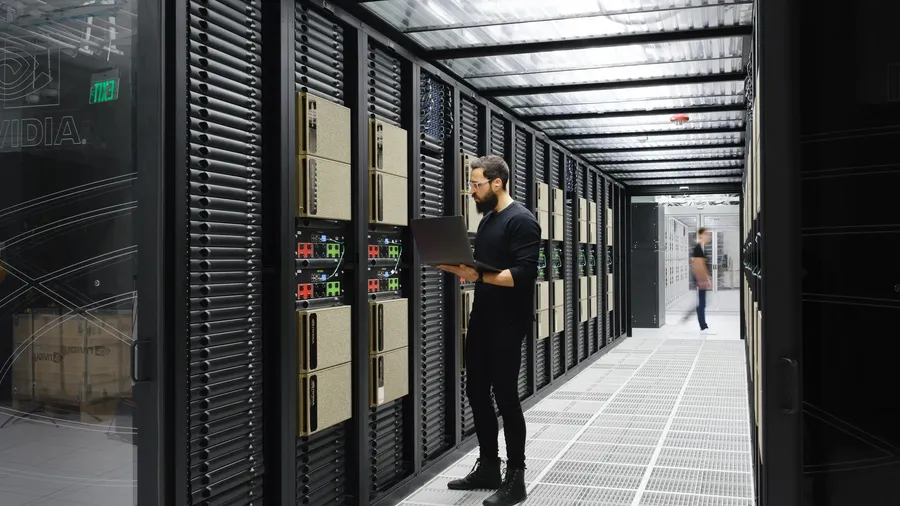
The advantage is clear: infrastructure demand can become orders, revenue and cash flow for the supplier. It is also more exposed to customers’ investment cycles. If buyers cut budgets, delay projects or fail to generate enough revenue from AI services, infrastructure providers are among the first businesses whose expectations the market will test.
A question investors should separate out is the boundary between sales generated by organic customer demand and sales supported by supplier capital. When reports raise the prospect of guarantees or financing, the important checks are the legal status of the arrangement, who bears the risk and whether it is becoming a recurring part of the sales model.

The key risk is the quality of the next leg of growth, not a claim that current demand is fictional. If customers can earn cash from AI services, they have a sound basis to keep buying chips and expanding data centres. If demand increasingly relies on guarantees, cross-investment or new borrowing, the market has reason to apply a more conservative valuation to the same dollar of revenue. Those are different financing mechanisms, even if short-term sales rise in both cases.
Compare the right question before comparing numbers
Apple and Nvidia do not share the same fiscal calendar, and their latest reported quarters also end at different times. Putting quarterly revenue side by side can help show scale and structure, but it cannot establish that one company has overtaken the other. Ignoring the reporting period is an easy way to reach a conclusion too quickly.
For Apple, the question is whether AI features help sustain device and services sales. For Nvidia, it is whether infrastructure investment is supported by customers’ independent ability to pay. Both questions are ultimately about cash flow. One tests the strength of an ecosystem; the other tests the durability of capital budgets.
Nothing in the 27 July session is sufficient to decide which company is the better investment. Investors who value diversified revenue may find Apple’s model easier to understand, but still need evidence that AI benefits turn into operating results. Investors who prefer direct infrastructure growth may find Nvidia more immediate, while accepting greater sensitivity to investment cycles and customer finances.
Conclusion: Read the expectations, not only the ranking
Apple’s market-cap lead over Nvidia on 27 July signals a re-pricing of two sets of expectations. Apple benefits from a story of embedding AI into an already monetised ecosystem with a lighter capital burden. Nvidia faces closer scrutiny over whether the next phase of growth will be funded entirely by customers’ organic demand.
The thesis remains unchanged: market-cap rank is the product of a share price at a moment in time, while the quality of a valuation depends on whether expectations become cash flow. In the next reporting periods, the most useful signals will be Apple’s device and services sales, Nvidia customers’ data-centre spending and any clearer disclosure on guarantees or financing structures. Those indicators will show whether the race is being financed by operating profits or by expectations that require more capital to keep moving.