
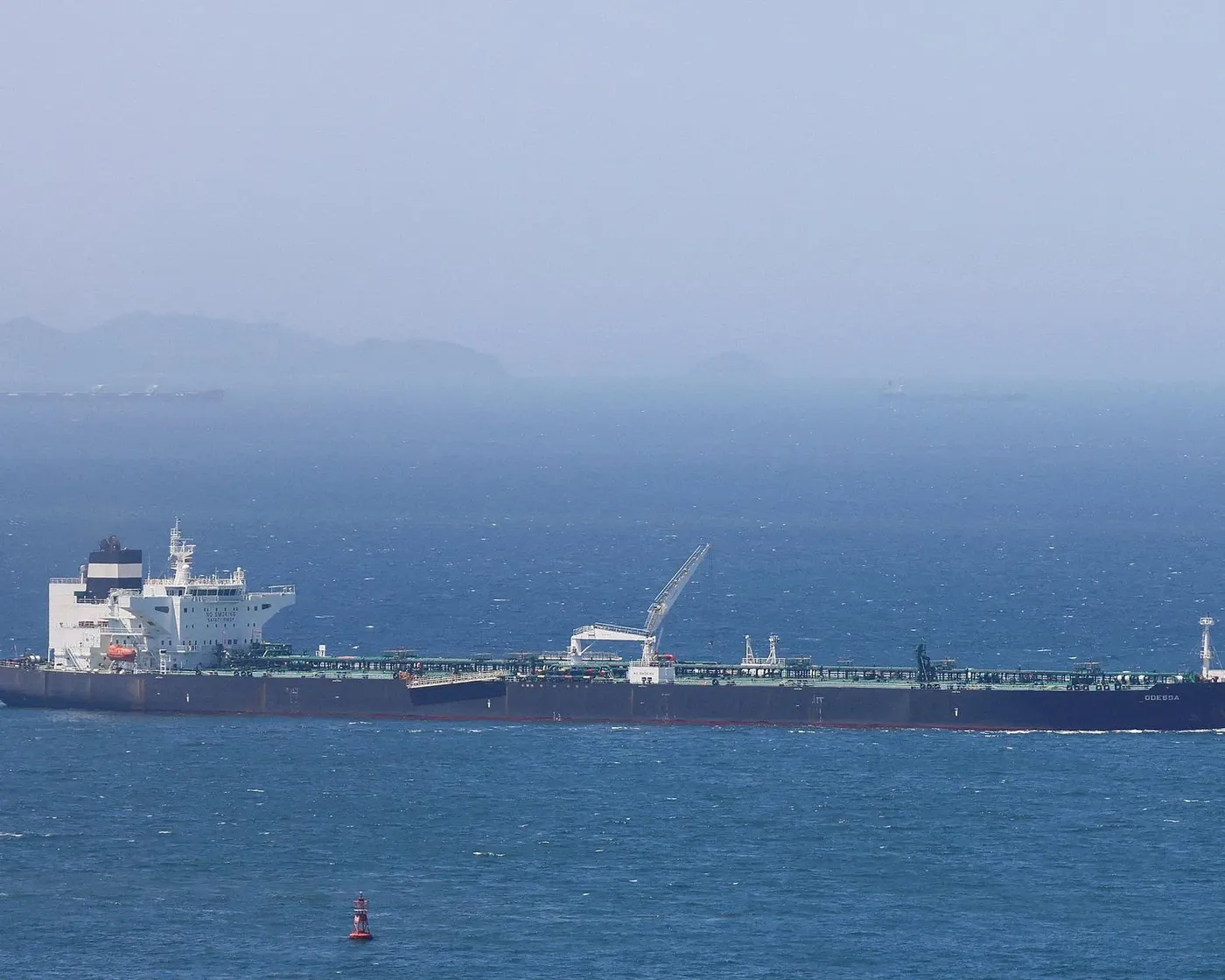

Brent has pulled back after a sharp run-up, but that does not settle the more important question: can oil decline sustainably? In a market governed by transport risk, the price screen captures expectations at a particular moment. Vessel movements through the Strait of Hormuz provide a more concrete answer to whether crude can actually reach buyers on a normal schedule.
The central argument is straightforward. Until traffic through Hormuz recovers consistently and safety arrangements hold, the drop in oil should be read as a narrowing risk premium, not as a confirmed downtrend. For newer investors, that distinction is more useful than attempting to predict the next session's exact price.
What one down day does and does not say
On July 24, Brent futures fell 3.88% to USD 96.78 per barrel. Reuters reported profit-taking after the previous rally, as well as a market response to news that China was pushing to restart talks between the United States and Iran. Even so, Brent was still up nearly 10% for the week. Euronext
Put simply, an oil price usually contains two layers. The first is the physical oil balance: production, inventories and refinery demand. The other is the extra amount buyers are willing to pay against delayed deliveries, higher insurance costs or detoured vessels. When prospects for diplomacy improve, that second layer can shrink quickly, even before shipping operations change.
That is why a red candle on a chart does not, by itself, prove that the logistics bottleneck has been cleared. It shows that the market has reduced the probability of a worst-case outcome. If security conditions deteriorate or vessel traffic worsens again, that premium can return just as rapidly. A lower price can therefore be genuine market information without being confirmation that physical supply has normalized.

The preceding rally is still substantial
Investify's Brent series rose from USD 71.57 per barrel on July 1 to USD 97.72 on July 24, 36.54% above the start of the month. The recent high in that series was USD 100.69 on July 23. Settlement prices for a specific contract can differ from a continuous price series, but their message is consistent: the pullback has only retraced a small part of July's advance.
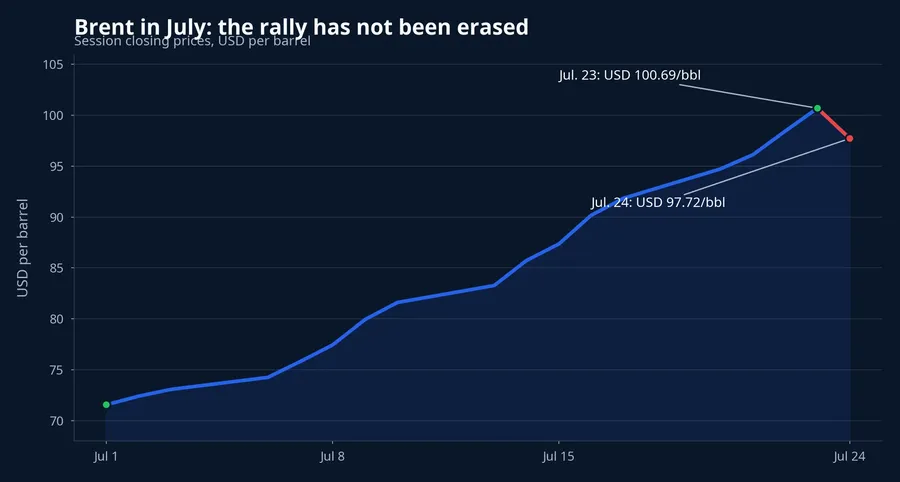
This is why July 24 should not be described as a reversal. A 3.88% move can be meaningful in a single session, yet it needs to be measured against the month's cumulative gain. The larger picture is a market pricing two possibilities at once: tensions may ease, but a vital shipping route has not returned to predictable operating conditions.
Investors should also resist assigning the price move to one headline alone. Profit-taking, futures-market liquidity, hedging positions and changing expectations for negotiations can all matter. The available evidence supports saying that oil fell as diplomatic hopes improved; it does not allow a precise allocation of each factor's contribution.
Hormuz is the physical indicator to watch
On July 26, the United States and Iran entered a second consecutive day without cross-border attacks. That is a more meaningful sign of de-escalation than one lower oil session because it directly reduces immediate security risk. The same report, however, said commercial traffic through Hormuz remained at its lowest point in three weeks. AP
Those two facts are not contradictory. A pause can make an immediate incident less likely. Shipowners, insurers and charterers still need time to assess routing, safety procedures and costs. Sending a commercial vessel through a risky area is not a decision based only on whether the past 24 or 48 hours were free of attacks. The operational decision also depends on whether a ship can be insured, crewed and rerouted if conditions change.
Vessel traffic therefore functions as a lagging but tangible indicator. Negotiation news changes expectations first. Security incidents indicate immediate danger. Regular transits show that the transport system is actually beginning to operate again. These three signals should be read in sequence rather than used as substitutes for one another.
Three scenarios and their conditions
The constructive scenario for lower oil requires vessel traffic through Hormuz to rise persistently over several days, carriers to stop avoiding the route and a sufficiently clear safety framework for insurers and shipowners to accept lower risk. If those conditions emerge together, delivery costs and the geopolitical premium have a basis to fall. A lower oil price would then rest on an improvement in physical flows, not simply on optimism.
The more relevant scenario for now is oil holding at an elevated, volatile range. Military tensions may pause while transit remains impaired. In that state, each negotiation signal can pull prices lower, while fresh evidence of route avoidance or costly insurance can restore the risk premium. The market does not have to move in a straight line.
A more adverse scenario would follow another incident involving commercial vessels, failed talks or tighter constraints on shipping. Reuters has reported very limited Hormuz traffic while shipping risks in the Red Sea remained present. Euronext The problem would then extend beyond barrels produced to on-time delivery, insurance costs and transit times. In that setting, physical availability and effective availability are not the same thing: cargo that cannot move predictably does not offer buyers the same economic security.
The link to inflation and rates
A durable decline in oil matters beyond commodities. It can ease pressure on fuel, transport and input costs for parts of the economy, helping inflation expectations. During the July 24 oil pullback, the US 10-year Treasury yield declined from 4.71% to 4.68%. AP
That does not establish oil as the sole cause of the one-day move in yields. Yields also reflect growth expectations, fiscal policy, bond demand and expectations for the Federal Reserve. The more useful relationship is over time: sustainably lower oil removes one source of inflation pressure, while persistently high oil makes central banks less comfortable with the path toward lower rates.
For Vietnamese retail investors, a Hormuz headline need not become an immediate buy-or-sell signal. The useful lesson is the transmission mechanism. Higher oil can feed into transport, fuel and inflation expectations. A durable easing in oil becomes more credible when transport risk eases too. That is a way to read global news through its mechanism rather than the emotion of a single trading session.
Transport is the confirmation point
The conclusion supported by the current evidence is that Brent remains in a volatile state with a meaningful risk premium, rather than a confirmed sustainable decline. The pause in attacks is a necessary condition for de-escalation. It is not yet sufficient for normal oil flows to resume.
Over the coming days, watch whether Hormuz traffic rises consistently, whether carriers keep using the route and whether the safety arrangement holds. If all three improve, the case for oil staying elevated weakens. Until then, headline-driven pullbacks deserve caution: regular vessel transits are a more reliable confirmation of a durable decline.