

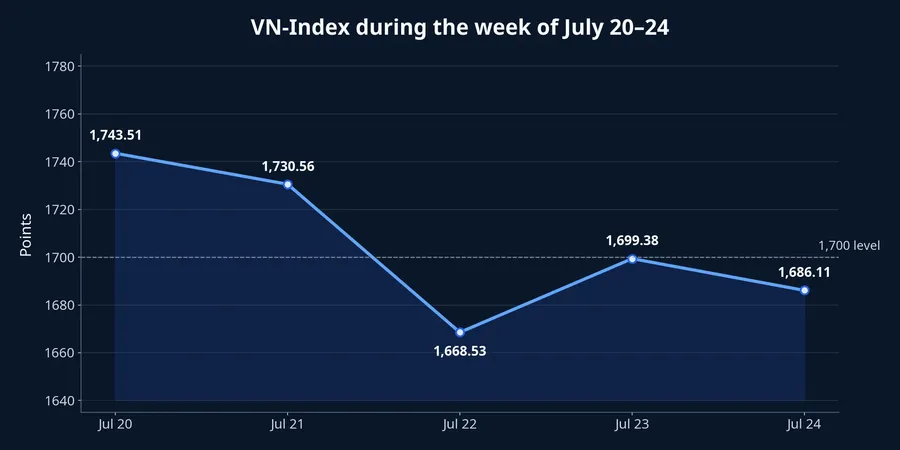
A week can contain both a sharp sell-off and a very fast rebound. Looking only at Friday's close can therefore hide the more useful question for a new investor: who was setting the terms at each stage? For the July 20–24 week, the VN-Index closed at 1,686.11 points, down 5.67% from the prior week and marking its fourth consecutive weekly decline.Nhân Dân
That number does not establish a market bottom, nor does it erase evidence that buying emerged at lower prices. The central conclusion is straightforward: dip-buying appeared, but the week's data do not yet establish a durable base. A different conclusion needs confirmation from market breadth, turnover and the market's capacity to absorb selling.
The opening sessions: sellers dominated the board
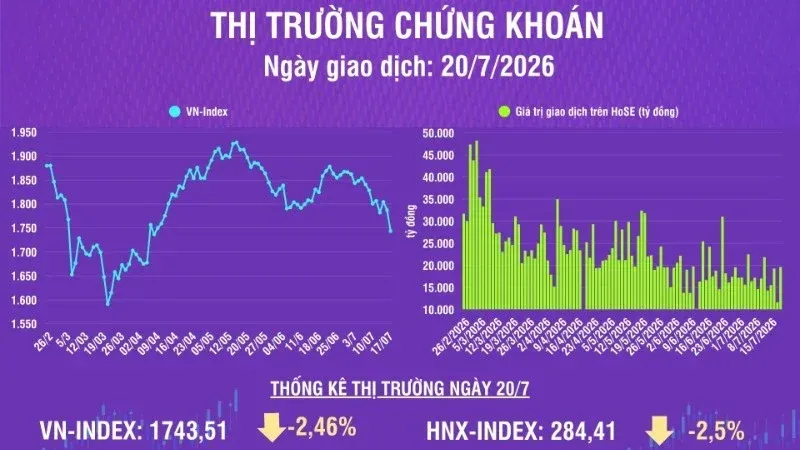
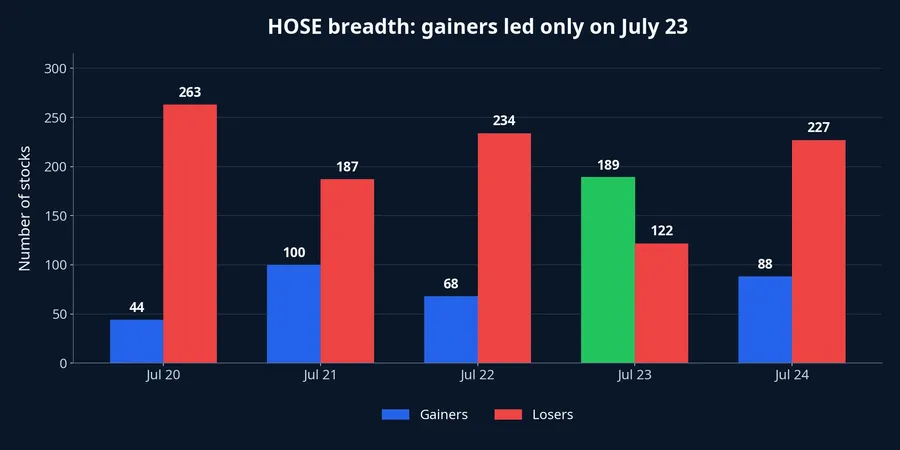
The July 20 session made the case for caution clear. The VN-Index lost 43.94 points, or 2.46%, to 1,743.51. On HOSE, 263 stocks declined, including 33 that hit their daily limit, while only 44 advanced.Nhân Dân
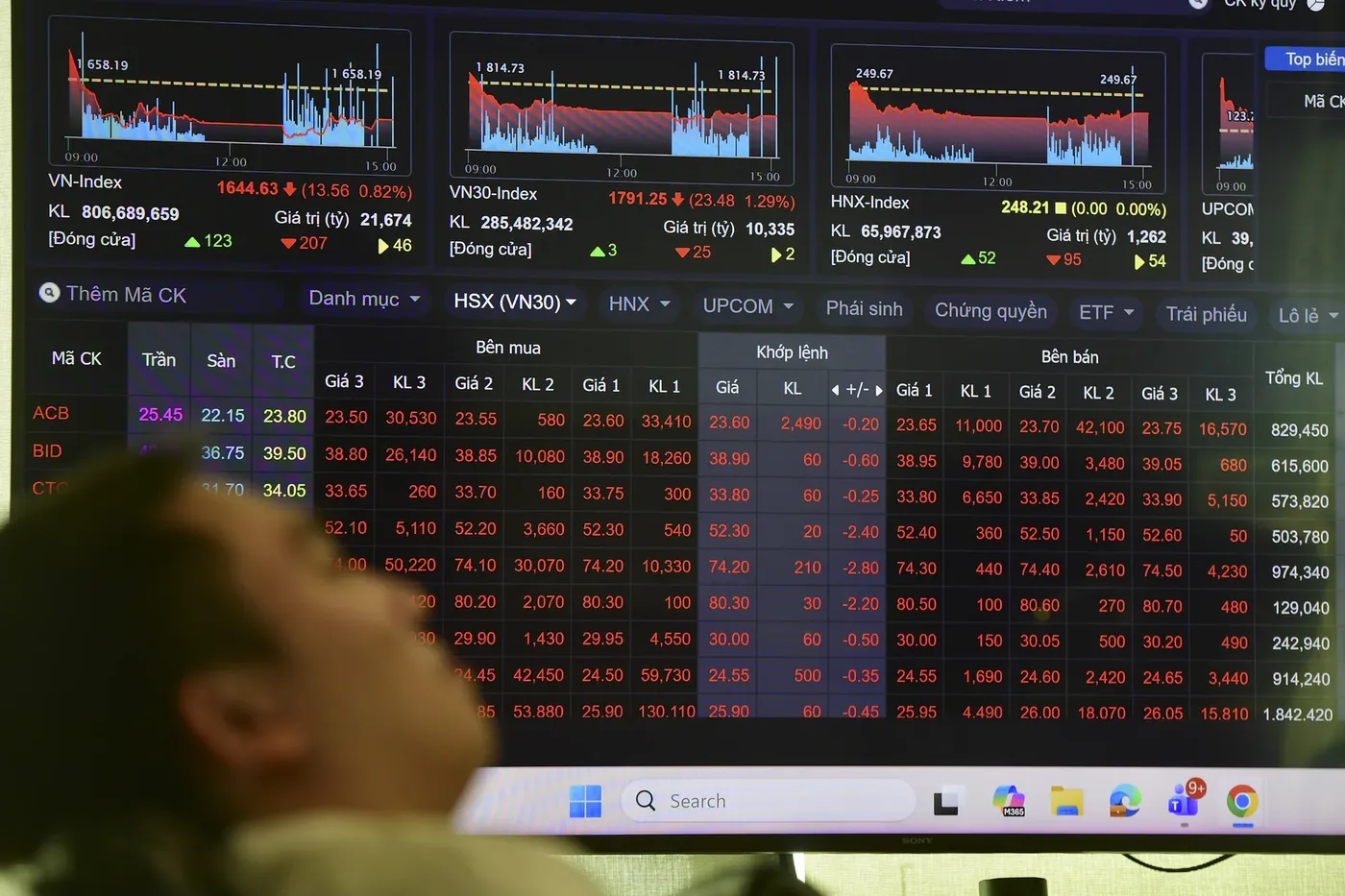
Market breadth is a useful way to count how many participants are moving in the same direction instead of watching only the largest runners. An index can fall heavily because of several big-cap names, but an overwhelming majority of declining stocks signals pressure well beyond a narrow group. Matched volume also rose 105.9% from the preceding session.Nhân Dân Falling prices alongside heavier trading merit attention because more sellers accepted lower execution prices.
This does not tell us why every investor sold, and it should not be used to claim a single catalyst. Breadth instead answers a narrower, practical question: was the weakness confined to an index heavyweight or shared across the board? In a volatile week, that distinction helps readers judge whether a rebound is repairing the broad market or simply lifting a limited group of names.
On July 21, the decline slowed to 12.95 points, or 0.74%, leaving the index at 1,730.56. Yet 187 stocks still fell on HOSE, substantially more than the 100 gainers.Nhân Dân That distinction matters: a slower decline is not the same as a changed trend. Selling may become less intense while the balance on the board remains firmly against buyers.
Midweek: a deep drop with weak breadth
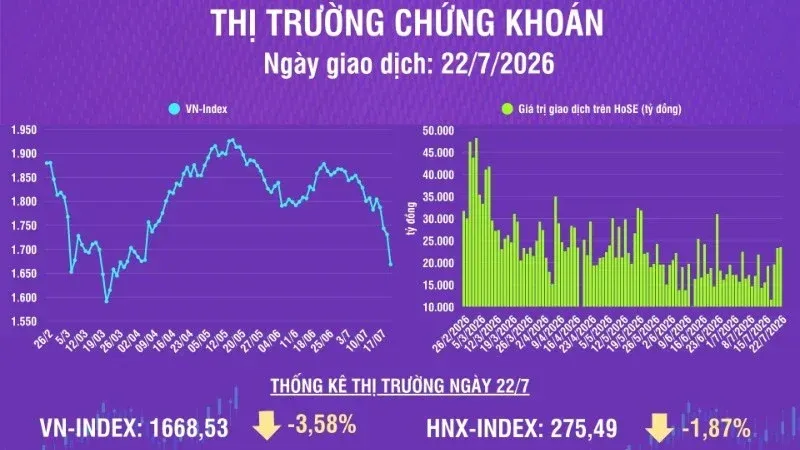
July 22 most clearly illustrated the risk of treating a technical bounce as a solution. The VN-Index dropped 63.03 points, or 3.58%, to 1,668.53. Breadth again leaned heavily negative, with 234 decliners and 68 gainers.Nhân Dân
Matched volume was 47.9% higher than the previous day, while foreign investors were net sellers of VND 1,937 billion on HOSE.Nhân Dân Those facts should not be turned into a single, unproven explanation for the decline. Large-cap moves, deleveraging of margin positions and more cautious sentiment around external news may all have mattered. What the data directly establish is that selling spread across many stocks and occurred on heavy trading.
That point is particularly useful for first-time investors. When prices fall quickly, the feeling that assets have become “cheap” often arrives before there is evidence of durable demand. Lower prices are a condition for buyers to return, not proof that all potential supply has been absorbed. A decision based only on points lost can miss the more important question: how is the wider market behaving?
The rebound: buyers appeared, but did not take control
After three weakening sessions, July 23 delivered a visible response. The VN-Index gained 30.85 points, or 1.85%, to 1,699.38, as 189 stocks advanced and 122 declined on HOSE.Nhân Dân It was the only session of the week in which gainers were in the majority, so dismissing dip-buying would be just as misleading as over-celebrating it.
The quality of a rebound, however, is not contained in a green close alone. Matched volume on July 23 was 9.5% lower than in the preceding sell-off, and foreign investors remained net sellers of VND 489.4 billion on HOSE.Nhân Dân That does not prove the rebound will fail. It does indicate that buyers had not yet demonstrated strength clearly greater than the selling seen a day earlier.
Put simply, dip-buying is like shoppers entering a store after a large price cut. A sturdier equilibrium is present when they keep buying for several days and the store does not have to keep lowering prices to generate transactions. In equities, the comparable signs are positive breadth sustained across sessions, turnover rising with prices and selling being absorbed more effectively as the index recovers.
None of these measures works as a stand-alone signal. Breadth can look better for a day without enough new cash behind it, and a higher turnover figure is only constructive when it accompanies demand rather than another wave of selling. Reading the three together is more useful than treating a round-number level as a verdict on the market.
Friday: 1,700 did not become support
On July 24, the VN-Index fell 13.27 points, or 0.78%, to 1,686.11. Decliners again far outnumbered gainers on HOSE, at 227 versus 88, while transaction value totaled VND 13,898.3 billion, about 30% lower than the previous session.VTV
Lower turnover on a down day has more than one reading. Sellers may have become less aggressive, but buyers may also have been unwilling to pay higher prices after the index approached 1,700. Given the rapid return to negative breadth and the failure to retain the prior day's gains, the latter reading is more persuasive for now.
Foreign investors were net sellers of VND 3,727 billion on HOSE for the full week.Nhân Dân Foreign flows are not the only switch that moves the VN-Index; domestic demand has absorbed foreign selling in other periods. But when net selling coincides with weak breadth and a rebound on lower trading, the three signals together argue against reading one green session as a trend reversal.

Next week: watch the evidence, not the bottom call
The most defensible conclusion now is to wait for confirmation, rather than declare either a bottom or a certain further decline. The picture would improve if positive breadth persists over several sessions instead of appearing once. Turnover should also rise as the index advances, signalling that new money is participating rather than that sellers have merely paused.
The market's ability to absorb continued foreign selling deserves equal attention. If foreign investors keep selling while gainers broaden and prices rise on healthier turnover, domestic demand will have been tested. If the VN-Index rebounds with few gainers, shrinking trading and breadth that quickly turns negative again, the move is better understood as a pause within the correction.
For a new investor, the lesson is not to guess the exact low. One rising session says buyers are present; a stable base requires several sessions of data showing that their demand can persist. Breadth, turnover and the absorption of selling are the three signals worth watching next week. They will give a clearer answer on whether current prices are finding support or only taking a temporary pause.