


One trading session sent three market screens flashing at once: Brent settled at $100.69 a barrel, the US 10-year Treasury yield ended at 4.69%, and major US equity indexes declined. These were not isolated moves. Higher energy prices force markets to reassess inflation risk, and that reassessment makes equity valuations harder to sustain.AP
Still, “oil rose, so stocks fell” is too neat an explanation. Tesla and Alphabet both came under pressure after earnings, a particularly important development for a technology-heavy index such as the Nasdaq. The useful lesson from July 23 is to separate two layers: the broad shock to rates and costs, and company-specific questions about operating performance.
Three market screens moved together
Brent rose sharply and recorded its first settlement above $100 since May 22. In the same session, the Dow Jones Industrial Average fell about 1.0%, the S&P 500 lost 1.2%, and the Nasdaq declined 2.2%. The 10-year Treasury yield touched 4.71% intraday before ending at 4.69%.CBS NewsAP
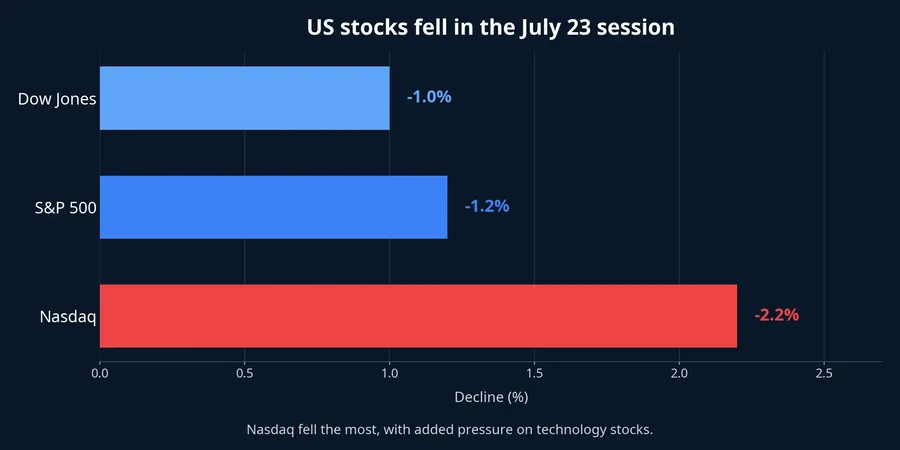
The gap in performance matters. A deeper Nasdaq fall does not, by itself, prove that oil hurt every technology company more severely. It shows that investors sold rate-sensitive shares aggressively while also responding to adverse news concentrated in large technology businesses.
Put simply, oil is an economic input, not merely a quote on a market screen. When it becomes more expensive, transport companies, airlines, logistics providers, chemical producers and many manufacturers face higher fuel bills. They have two difficult options: raise prices to recover costs, or hold prices and accept thinner margins.

The effect reaches beyond a company income statement. Higher fuel costs can lift the price of travel, delivery and some goods. If households spend more on energy, less of their budget may remain for other goods and services. Investors therefore assess not only oil-consuming businesses, but consumer purchasing power and each company's ability to pass costs through to customers.
From oil to inflation, then to yields
The transmission usually begins with expectations. Markets do not need to wait for a new inflation print before reconsidering the outlook. If investors fear that oil will stay expensive, they may see a lower probability of inflation easing. The prospect of monetary easing then becomes less certain, and bond investors may demand a higher yield to offset the risk that future cash flows lose purchasing power.
This is a common point of confusion for newer investors: bond prices and yields move in opposite directions. When investors sell bonds, bond prices decline. Because the contractual interest payment is unchanged, the return calculated against the new, lower purchase price rises. A higher 10-year yield in this session did not mean that the Federal Reserve had changed its policy rate.
The market was instead pricing a more uncertain path for interest rates. CBS News, citing CME FedWatch, reported a 36% market-implied probability of a Fed rate increase at the July 29 meeting, up from about 11% a week earlier. That is a probability inferred from futures prices, not a Fed announcement or commitment.CBS News

One high-oil session is not enough to establish that inflation will remain elevated. What matters is how long prices stay high, how much cost reaches retail prices, and what subsequent inflation data show. Those links need to be tested; a one-day move cannot establish a policy decision.
Higher yields change the price of equities
An equity valuation is not based only on this year's revenue or earnings. Today's price also reflects the present value of cash a company may generate years from now. To convert future cash flows into a present value, markets use a discount rate. Government bond yields are an important component of that rate.
Think of two alternatives. When government bonds offer a higher yield, investors have a more attractive lower-risk return available to them. For a share to retain the same price, its expected profit, growth, or compensation for additional risk needs to be sufficiently compelling. If those inputs are unchanged while the baseline yield rises, the price investors are prepared to pay for the share typically comes under pressure.
Growth shares are often more sensitive to this mechanism. More of their value rests on profits expected further into the future, so even a small change in the discount rate can materially alter present value. This is a broad valuation mechanism, however, not a formula for allocating every percentage point of a stock's one-day move.
Tesla and Alphabet added a separate layer of pressure
Company news on July 23 was too important to ignore. Tesla fell 14.5% after its latest quarterly profit missed analysts' expectations. Alphabet fell 7.1% despite beating revenue and profit expectations, as investors focused on its expanding investment bill; its quarterly capital spending was nearly $45 billion, double the prior-year level.AP
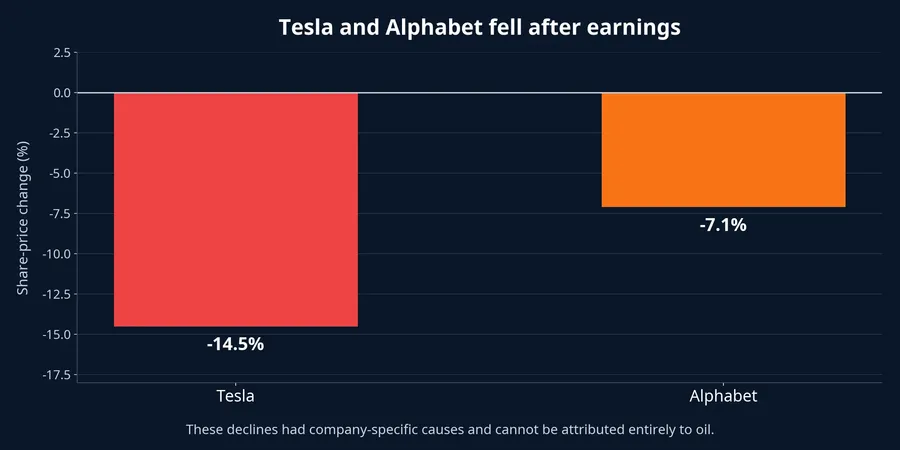
Those reactions illustrate two different market questions. For Tesla, the focus was current profit falling short of expectations. For Alphabet, investors were weighing whether heavier investment will generate commensurate future growth and cash flow. Both are company-specific issues, not direct effects of oil prices established by the available evidence.
Because Tesla and Alphabet have large market capitalizations, their moves can noticeably pull on an index. That is a useful reminder that an index decline does not mean every sector or company fell for the same reason. The available sources do not provide an attribution analysis that would quantify the respective contributions of oil, yields and individual earnings reports to the Nasdaq's decline.
Reading a session with multiple causes
The core conclusion is that oil above $100 made market valuation conditions more difficult through the inflation and yield channels. The company-specific developments at Tesla and Alphabet do not negate that conclusion. Instead, they help explain why pressure on the Nasdaq may have been greater than a pure oil narrative would suggest.
In subsequent sessions, watch Brent, the US 10-year Treasury yield and the post-earnings response of technology shares together. If oil and yields ease while technology remains weak, earnings and capital-spending concerns may be carrying more weight. If selling broadens while oil and yields remain elevated, the inflation and discount-rate channel becomes more persuasive. That is how a multi-cause market story can be separated into signals that can be tested.