


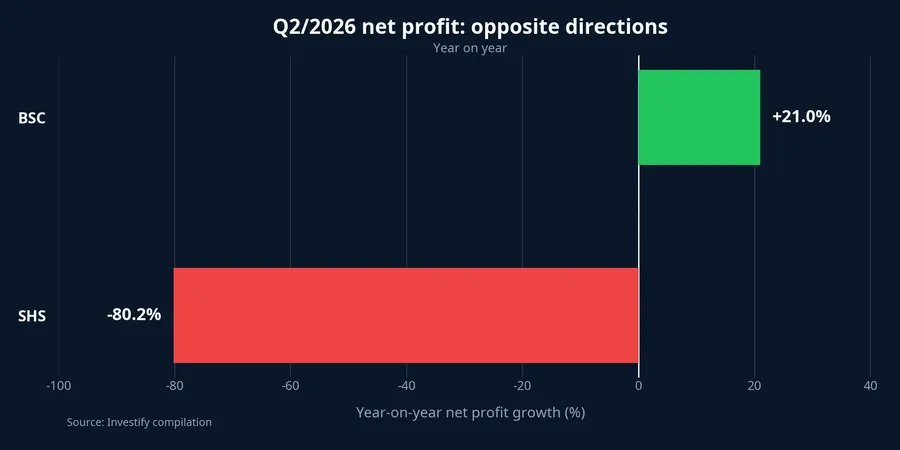
Two securities firms can operate in the same active market and still produce very different results. In Q2 2026, BSC's net profit rose 21% year on year to VND 123.2 billion, while SHS reported VND 75.8 billion, down 80.2%.Thời báo Tài chính VNBáo Đầu tư
That does not automatically make BSC a better business than SHS, or the reverse. It is a useful reminder that a headline growth rate is the result of income streams with very different characteristics. For a first-time investor, the starting point is to separate proprietary investment, lending and brokerage income. Then compare lending income with funding costs before judging how repeatable the profit may be.
A profit percentage is the start, not the verdict
Net profit is the figure left after costs and tax. A 21% gain or an 80.2% decline should therefore prompt a reader to open the financial statements, not deliver an investment verdict. Two firms may both expand margin balances, yet one may earn from a more income-oriented investment book while the other takes an adverse mark-to-market move. The label “securities firm” does not reveal that internal structure.
Think of the income statement as a cashier with several drawers. Brokerage collects fees from client transactions. Lending collects interest on loans and receivables, but must also cover the interest paid to fund those loans. Proprietary investment can include dividends, interest income, realised gains on sales and fair-value remeasurement. That last component, FVTPL, is usually the most sensitive to market moves.
The central point is straightforward: Q2's profit gap primarily reflects the sensitivity of each income mix, not enough evidence to rank the two stocks over the long run. The next reports should show whether the proprietary-investment components and funding costs are changing direction.
BSC had support from two major income streams
BSC recorded Q2 operating revenue of VND 616.8 billion, up 22% year on year.BSC Its two largest lines were FVTPL income at VND 248.5 billion and interest on loans and receivables at VND 242.5 billion. They rose 29% and 53%, respectively, from a year earlier.Thời báo Tài chính VN When both major streams improve, the profit base is broader than one built on a single exceptional item.
BSC's proprietary book also needs to be read by composition, rather than by the FVTPL label alone. At quarter end, its FVTPL portfolio had a fair value above VND 6,535 billion, up 46% from the start of the year. Bonds accounted for more than 70% and certificates of deposit nearly 15%.Thời báo Tài chính VN The increase in FVTPL income was driven mainly by dividends and interest, which rose from VND 2.7 billion to VND 63.4 billion.Thời báo Tài chính VN
In plain terms, the bond and deposit-certificate weighting suggests that part of the portfolio is designed to generate income rather than rely entirely on daily equity-price movements. This does not remove risk: interest rates, credit quality and leverage still matter. It does help explain why BSC's FVTPL gain was not simply a bet on equities rising or falling during the quarter.
Brokerage tells a more restrained story. BSC's brokerage revenue fell 8% year on year to roughly VND 78 billion.VietnamBiz Profit growth does not mean every division improved. Operating costs also fell 12% to VND 215.5 billion, contributing to the overall result.Thời báo Tài chính VN
SHS shows why proprietary investment cannot be skipped
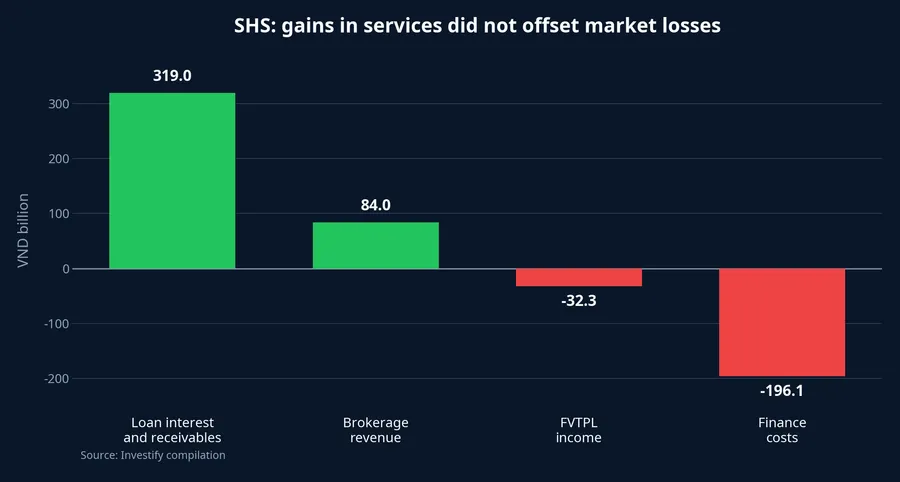
At SHS, client-facing lines did improve. Interest on loans and receivables was nearly VND 319 billion, up 109% year on year, while brokerage revenue exceeded VND 84 billion, up nearly 18%.Báo Đầu tư Reading only those lines could lead an investor to expect higher profit. Financial statements, however, are not a simple addition of the favourable lines.
SHS recorded a VND 32.3 billion FVTPL loss, against a gain of more than VND 417 billion in the prior-year quarter.Báo Đầu tư It did realise VND 694.3 billion of gains from asset sales, 4.5 times the prior-year figure, but the portfolio's market remeasurement moved in the opposite direction.Báo Đầu tư These facts are not contradictory: one is a realised gain from selling, while the other reflects the portfolio's value on the reporting date.

This is the FVTPL mechanism worth remembering. A firm can record a gain when an asset's value rises without selling it, and must record a loss when that value falls. “Proprietary investment” by itself is therefore too vague. Look for dividend and interest income, realised gains on sales, and whether the fair-value remeasurement is positive or negative.
Funding cost is the second layer. SHS's financial expenses climbed to VND 196.1 billion, 3.73 times the prior-year level, largely due to borrowing interest versus VND 52.5 billion a year earlier.Báo Đầu tư Growing loan balances can add income, but the retained benefit narrows if the cost of funding grows quickly. That is why a “margin growth” headline should not be treated as automatically positive.
A simple framework for new investors
First, compare like with like. Put pretax profit beside pretax profit, or net profit beside net profit; do not mix the two and infer which business is more efficient. Next, split FVTPL into realised sales gains, fair-value remeasurement, and interest or dividend income. All three sit within investment results, but they say different things about cash realisation and market sensitivity.
For lending, place interest income beside interest expense, the growth of liabilities and the size of the asset base. A loan balance says how much has been lent; it does not reveal the margin left after funding costs. For brokerage, rising revenue is normally encouraging evidence of client activity, but one quarter alone does not establish a durable market-share or income trend.
Finally, this comparison should not be turned into a stock-price forecast. Q2 shows BSC supported by lending and an income-generating portfolio, while SHS was more affected by proprietary-book remeasurement and financial expenses. That conclusion would change only if later reports show a clear shift in FVTPL components, funding costs or portfolio composition. Those are the signals to monitor, rather than one striking growth rate.