
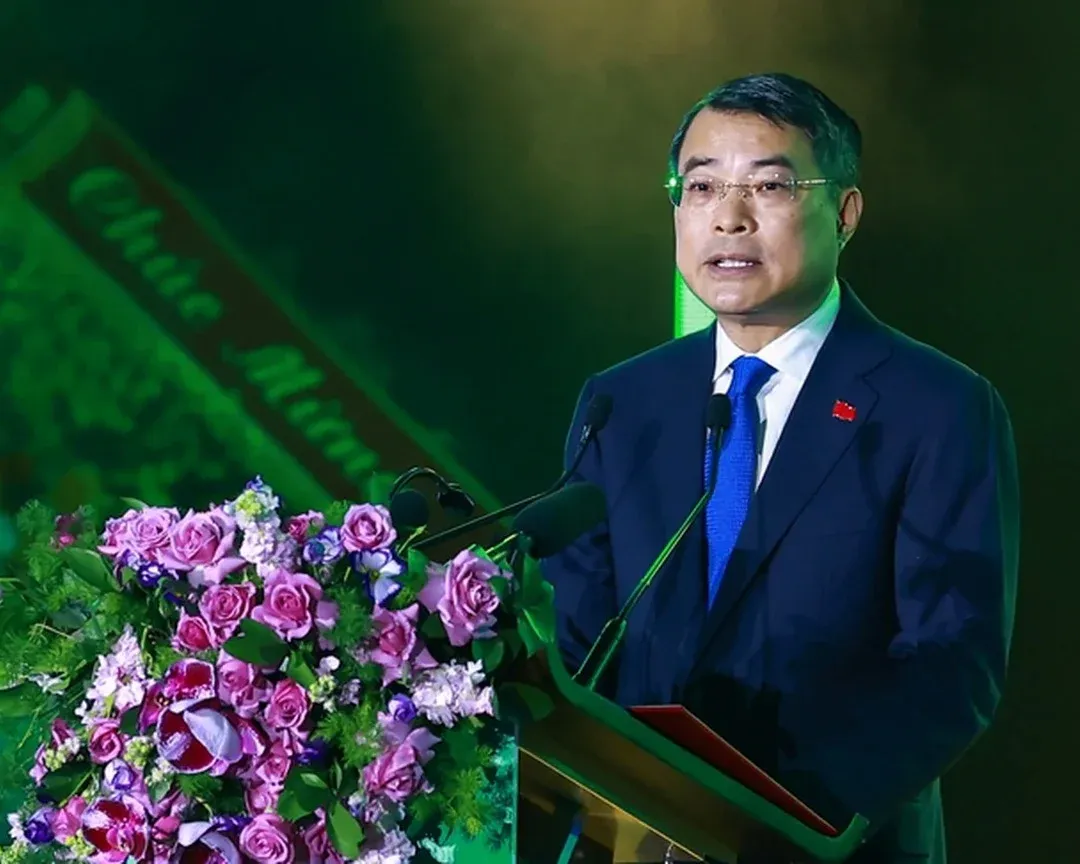

On the morning of November 27, at the ceremony marking 30 years of Vietnam's securities industry, Prime Minister Lê Minh Hưng used the end of his speech to "provide additional information to delegates and to domestic and international investors." According to the full text, he said Vietnam has made "very strong" commitments and has "essentially concluded negotiations on a reciprocal, fair and balanced trade agreement with the United States." The two sides are now finishing technical issues before signing, and "the applicable tariff will be much lower than the maximum the US side has just announced."Báo Chính phủ
It was the third time in three days that the Vietnamese side has spoken on the same subject, and the furthest-reaching. For anyone holding shares of companies that export to the US, the easiest way to see where things stand is to place this remark on its timeline. What follows does exactly that, and each step records only what was said, at the level of the person who said it.
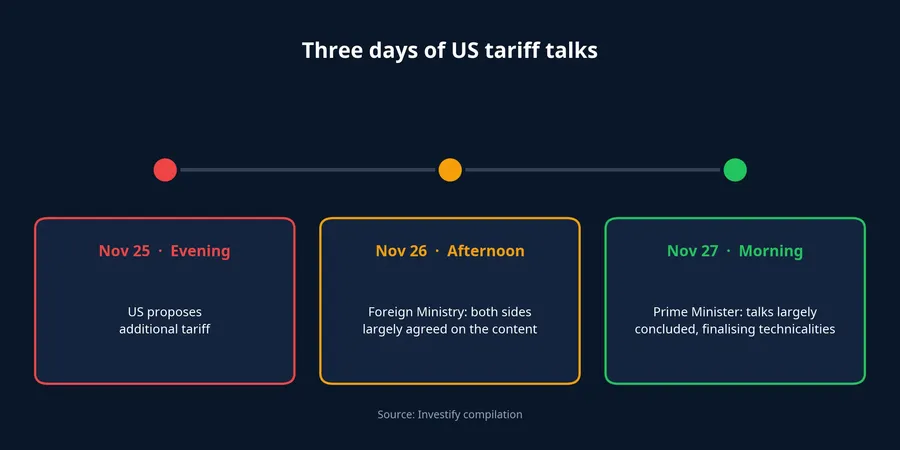
Evening of November 25: the US proposal
On the evening of November 25, Vietnam time, the Office of the US Trade Representative (USTR) published preliminary findings in its Section 301 investigation into overcapacity in manufacturing. Vietnam is one of 14 economies covered in this round. The additional tariff USTR proposed on Vietnamese goods is up to 35%. In a statement a few hours later, the Ministry of Industry and Trade said the rate could fall to 20% if the two countries reach a Reciprocal Trade Agreement.VnExpress
The ministry stressed that this is only a proposal, "not yet in effect and not yet formally applied." From that very evening the condition for a lower rate was clear: a signed agreement.
Afternoon of November 26: a sharp market drop and two ministry briefings
On November 26 the VN-Index fell 57.77 points, or 3.42%, to close at 1,629.68, with 273 decliners against only 40 advancers on HoSE. That same day, at the Ministry of Industry and Trade briefing, Deputy Minister of Industry and Trade Lương Hoàng Thái said Vietnam is running two tracks with the US in parallel. The first is full participation in the investigation: providing information, filing rebuttals, attending the hearing. The second is negotiating the agreement, where Vietnam "has put forward commitments at the highest level possible," including "commitments without precedent."VnExpress
At the same briefing, Mr. Thái raised a detail that has received little attention. Since July the US has been collecting a 12.5% additional tariff on Vietnamese goods under a separate investigation into forced labor. According to him, the US side "has also not decided whether these two tariffs are cumulative or combined." Securities firm SHS records that the 12.5% rate took effect on July 24, 2026 and is charged on top of the most-favored-nation (MFN) tariff.SHS
On the talks themselves, Foreign Ministry spokesperson Phạm Thu Hằng said the two sides "have essentially agreed on the content," with "only a few technical issues left to discuss and clarify before the negotiation is completed."VnExpress
Morning of November 27: from "agreed on content" to "concluded negotiations"
Put the two statements side by side and the progress is visible. On the afternoon of November 26, the Foreign Ministry said the content had been essentially agreed, with a few technical issues to resolve before the negotiation was completed. On the morning of November 27, the head of government said negotiations had essentially concluded, and the remaining technical work was for signing. The Prime Minister is also the first on the Vietnamese side to speak about the final tariff as a direct comparison with the US proposal: much lower than the maximum.
This is still a statement from the Vietnamese side. The agreement has not been signed, and the Prime Minister gave no specific rate. "Much lower than the maximum" does not equal any particular number, 20% included.
In the middle of the November 27 morning session, the VN-Index was around 1,646, up about 1% from the previous session. That is an intraday figure, not a closing price. The gain could come from several directions, including bargain buying after a deep drop, so this article does not treat the speech as its cause.
Milestones still ahead
Between now and a final tariff rate, the story still has to pass through these milestones:
- Signing of the agreement. No date yet. The signed text will be the first place to state a specific rate and how it interacts with the 12.5% already being collected.
- Deadline for comments to USTR: January 5, 2027.SHS
- Public hearing from January 25, 2027, where the Ministry of Industry and Trade will present its position and answer US questions.VnExpress
- USTR's final decision, in February 2027 at the earliest and by March 11, 2027 at the latest. According to the Ministry of Industry and Trade, the rate would then be lower than proposed if USTR judges that bilateral talks have made significant progress.
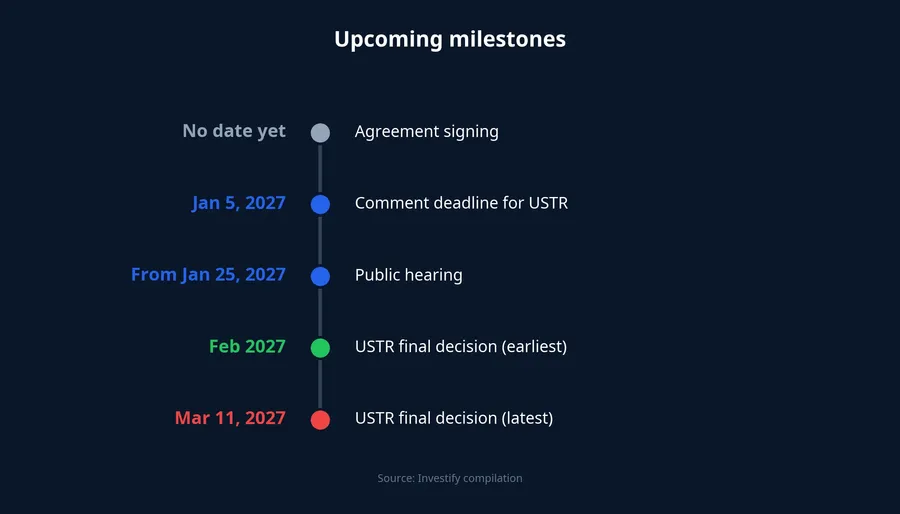
So the November 27 remarks touch only the first milestone. The rest remain on the US side's calendar.
The number to compare is the neighbors' rate
For exporters, the absolute tariff is only half the story. The other half is what competitors pay in the same US market.
In SHS's summary of the USTR proposal, Thailand, Malaysia, Indonesia and Cambodia all get 18%. India is at 17% if it reaches a deal, while the EU, Japan and South Korea are at 15% including MFN tariffs. Vietnamese goods, even at 20%, still carry MFN tariffs on top.SHS Securities firm TCBS, in its November 26 market note, made the same point: 20% is still higher than the 18% proposed for Bangladesh and the four ASEAN countries above.TCBS
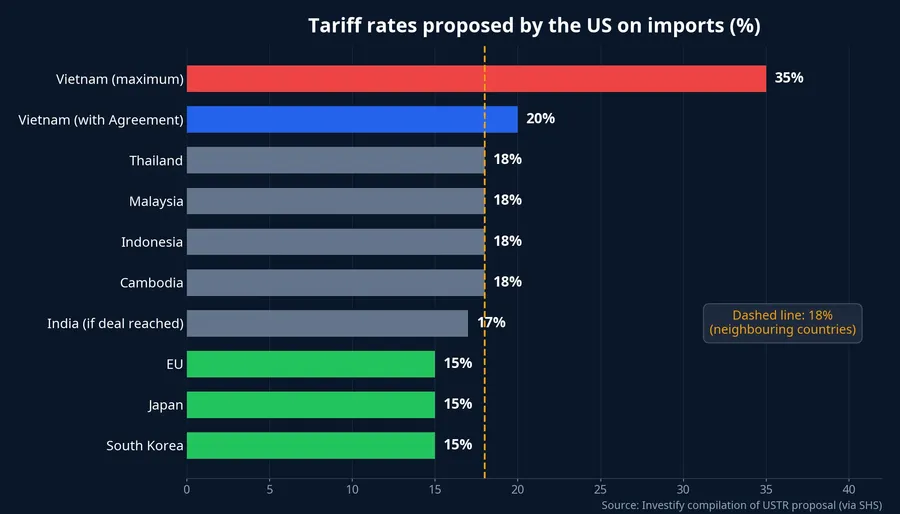
So once the text is signed, the most useful question is where its number sits relative to 18%. A rate below 20% would narrow or close the gap with neighboring countries. A rate of exactly 20% leaves the gap in place.
SHS also offers a notable calculation. If 20% replaces the 12.5% now being collected, total additional tariffs on Vietnamese goods rise 7.5 percentage points from today but match the 20% reciprocal tariff of 2025. That calculation rests on SHS's reading that the new tariff replaces the old one, while Mr. Thái said the US side has not decided how to count them. This is the second detail to look for in the signed text.
Which sectors bear the final number most
The US is Vietnam's largest export market, at USD 159.4 billion in the first 10 months of this year,VnExpress or 32.0% of export turnover according to TCBS.TCBS But not every sector is hit equally by the proposal. SHS groups them as follows:SHS
- Textiles and footwear bear the full MFN tariff plus 20% or 35%. Textile exports to the US reached USD 15.4 billion in 10 months. SHS names TNG, MSH, TCM and VGT.
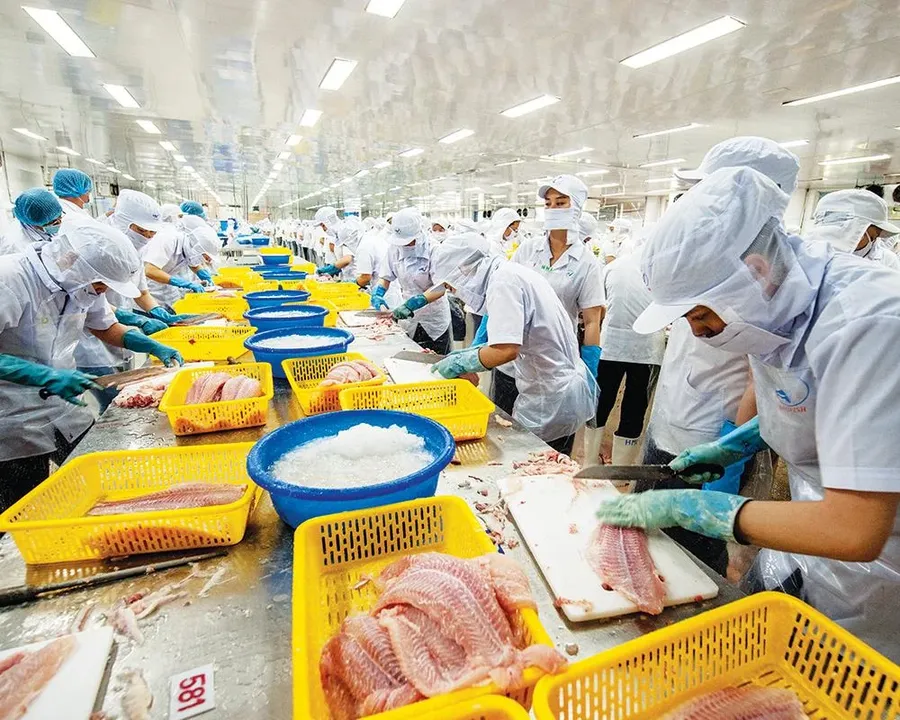
- Seafood such as shrimp, pangasius and tuna also face the full proposed rate because it is not on the exemption list. SHS names VHC, ANV, FMC and MPC.
- Part of the wood sector, such as upholstered wood and kitchen cabinets, falls under Section 232 tariffs and does not face the new proposed rate. Furniture outside this group does. Wood and wood product exports to the US reached USD 7.6 billion in 10 months.
- Electronics, about 33.5% of exports to the US, with semiconductors excluded. This group is mostly FDI companies and affects industrial-park stocks indirectly.
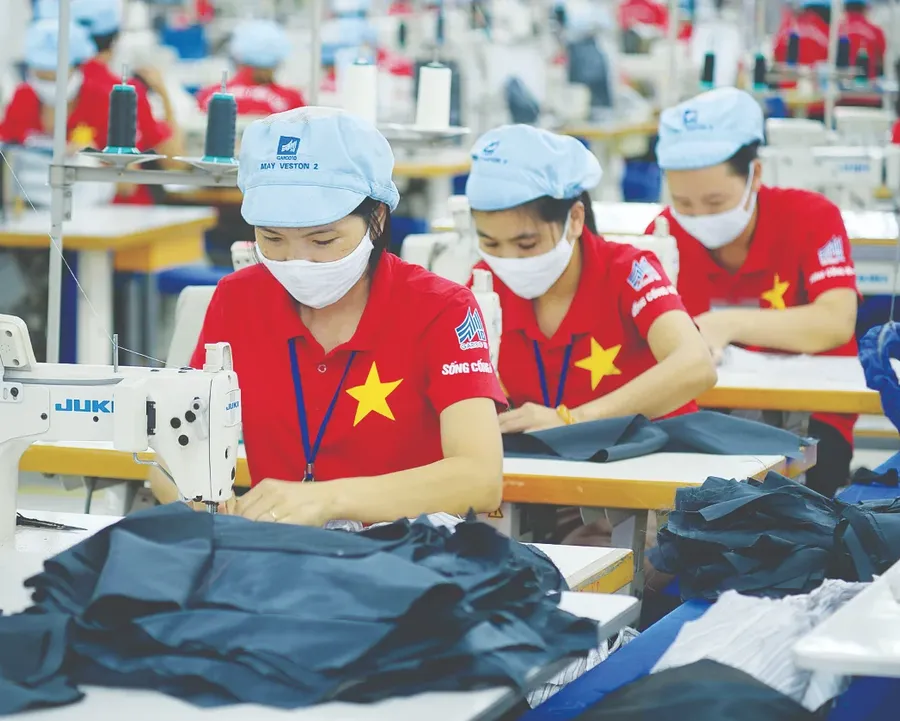
According to SHS, risk is concentrated in textiles, footwear and seafood, because these groups bear the entire gap between scenarios. For them, the difference between 18%, 20% or another figure in the signed text goes straight into selling prices and 2027 orders.
What has changed and what is still pending
After the morning of November 27, the branch with an agreement is no longer an equal possibility alongside the branch without one, at least by the word of the head of government. For holders of export stocks, the question has moved from "whether there is a deal" to more specific points: when it is signed, what rate the text states, and whether that rate replaces or adds to the 12.5% already collected.
The signed agreement will answer the last two. USTR's final decision, by March 11, 2027 at the latest, will show how the US side writes that number into its tariff schedule. For textiles, footwear and seafood, the benchmark to hold next to that number is the 18% faced by Thailand, Indonesia, Malaysia and Cambodia.