


On the morning of Nov 25, 2026, at the Vietnam Impact Investing Forum, Mr. Vu Tri Thuc, Deputy General Director of the State Capital Investment Corporation (SCIC), laid out the direction for the next five years: keep selling stakes in small, scattered companies, then concentrate money and people on a handful of large, well-run ones. For anyone holding shares in a company where SCIC is a shareholder, the practical questions are which group the company falls into, and whether anything changes in their account when SCIC sells.
The policy leaves SCIC with a clearly split portfolio. Below: the figures SCIC itself cites, the plan it has issued, and the recent auctions that show how hard selling state capital can be.
Two Decades of Divestment: The Numbers SCIC Cites
According to Mr. Thuc, SCIC has taken over about 1,086 companies handed down by ministries and localities since its founding.CafeF Counting new investments, it has sold, divested or restructured its stake in about 1,070 companies, raising roughly VND 56,000 billion.Nguoi Quan Sat The average sale price was roughly 4.1 times the investment value.Vietnam Finance
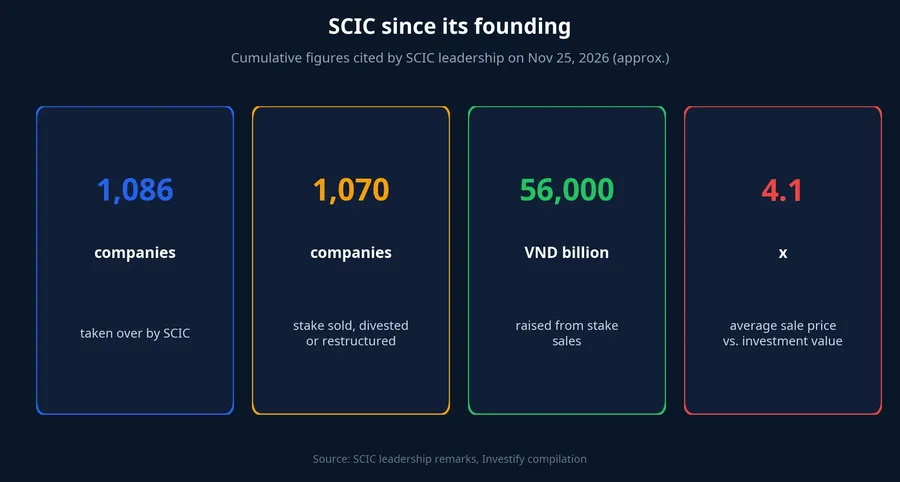
These are cumulative figures cited by SCIC leadership at the forum, covering the period since founding. They are not figures from audited financial statements. Mr. Thuc presented the results as evidence that SCIC's divestment work has become more professional, and said SCIC helped write into law several rules such as block-lot auctions, deposits and escrow for foreign investors.
The 2026–2030 Direction: Fewer Companies, More Resources for Each
SCIC said it will follow the Politburo's Resolution 79/NQ-TW on the state economy to restructure more aggressively, especially on divestment. What stands out in Mr. Thuc's remarks is that the resources being concentrated are not only money. "When SCIC sells stakes in small, scattered companies, it uses the human resources, specifically the governance capacity from those companies, to focus on governing the large ones," he said.Vietnam Finance In other words, representatives who now sit on the boards of small companies would be moved to large ones.
SCIC is drafting criteria for choosing investments, with these main elements:
- Sectors: infrastructure, especially seaports; green and clean energy; science and technology, innovation and digital transformation.
- Capital preservation and growth: projects must offer returns commensurate with risk.
- Impact on the environment, society and sustainable development, not just financial performance.
- Drawing in more private capital and domestic and international institutional capital. Mr. Thuc said investment funds, state funds included, currently account for only about 3% of the capital.CafeF
- Transparency and disclosure, aiming at OECD governance standards.
SCIC used to sit in thousands of companies because they were handed to it, not because it chose them. The new criteria set conditions for staying: a company must be large, in a priority sector, and profitable. SCIC's war chest has also grown. On Aug 11, 2026, it raised charter capital from VND 19,000 billion to VND 50,000 billion, all of it state budget capital.StockBiz
The Portfolio Has Been Split in Two Since August
The Nov 25 remarks were not SCIC's first on the portfolio. According to Tin Nhanh Chung Khoan on Aug 13, 2026, the 2026–2030 capital restructuring plan issued by SCIC places 21 companies in a group to keep investing in and holding, and 66 companies in a group slated for a sale of the entire stake.Tin nhanh chung khoan VietnamFinance cites SCIC's Decision 129/QD-DTKDV of Aug 10, 2026, which amends and supplements the restructuring plan for this period.VietnamFinance
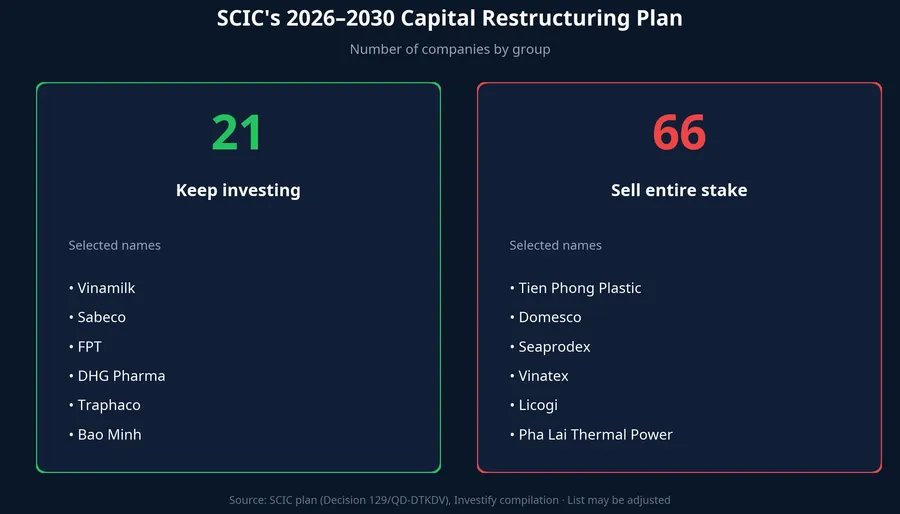
The hold group includes SCIC Investment One Member Co., Ltd. (SIC, 100% owned by SCIC), Vinamilk, Sabeco, FPT, DHG Pharma, Traphaco, Bao Minh, Vietnam National Reinsurance, Song Da Corporation, Vietnam Pharmaceutical Corporation, Trang Tien and Vietnam–Oman Investment. This is where SCIC says it will focus people and money.
The full-exit group includes Tien Phong Plastic, Domesco, Seaprodex, Vietnam Steel Corporation, Vinatex, Licogi, Pha Lai Thermal Power, Vietnam Construction Consultancy Corporation, and many local companies. SCIC notes the list may be adjusted as business conditions and the market change.
Most of the 66 are not new names. By VietnamFinance's cross-check on Aug 20, 2026, 58 of the 66 were already on the list of 74 companies SCIC had to fully exit under Decision 690/QD-TTg of Jul 17, 2024, covering the period through the end of 2025.VietnamFinance Going the other way, FPT, once slated for full exit under Decision 690, has moved to the hold group.
At the government level, Decision 2054/QD-TTg of Oct 27, 2026 approves the 2026–2030 plan to restructure state capital in enterprises.Government Portal That document applies to enterprises the State holds directly. It is not an annex listing the 66 companies in which SCIC holds stakes.
Selling the Rest Is Not Easy
Nearly 90% of the divestment list is old business, because being named in a plan does not mean there is a buyer. Recent auctions show it.
Seaprodex (ticker SEA, UPCoM) is the clearest example. SCIC put all 79.2 million shares, equal to 63.38% of capital, up for block auction at a starting price of VND 8,509.1 billion, about VND 107,400 per share.Tin nhanh chung khoan Bidders had to put down a 10% deposit, about VND 850.9 billion, and the sale was open to domestic investors only.Dan Tri The Sept 29 and Nov 2, 2026 sessions were both called off because no one registered.

The stake in Can Tho Export Agricultural Food Co. (Mekonimex) followed the same path. In 2017, SCIC offered more than 10.8 million shares, equal to 98.31% of capital, at a starting price of VND 11,610 per share, and the sale failed. In late 2025, the same stake was offered at VND 27,256 per share, and the January 2026 session again drew no registrations.VietnamFinance VietnamFinance explains that the transfer price of state capital must be reset through a valuation process at each point in time, so the next round is not necessarily cheaper than the last.
The other side of the picture is stakes that sold, and sold high. On Oct 24, 2025, SCIC's nearly 88% stake in Viettronics (VEC) drew four bidders. Geleximco Group won at 2.66 times the VND 964 billion starting price, a total of more than VND 2,562 billion. It was the third auction, after two failed ones.CafeF
When SCIC Sells, What Do Minority Shareholders See?
A block auction sells only SCIC's own shares. The number of shares in a minority shareholder's account does not change, and the lot's starting price is not the price at which a minority shareholder can sell. A session runs through a series of public milestones: the auction notice with starting price and rules, the registration and deposit deadline, the bid submission deadline, the auction at the exchange, then the winner's payment window.
The real change is in the shareholder structure and who runs the company. At Viettronics, after Geleximco became the controlling shareholder, the company replaced its Chairman and General Director in November 2025. At the June 2026 annual general meeting, Viettronics added 12 new lines of business, many well removed from its traditional electronics operations.CafeF That is one case, not a rule, but it shows minority shareholders trading a state shareholder for a private one with its own plans.

When a lot does not sell, SCIC stays and the lot waits for the next round. At Seaprodex, besides SCIC, Ngan Hiep Real Estate JSC holds 24.03%, Redwood Investment JSC holds 8.44%, and minority shareholders hold only about 4.15%.Tin nhanh chung khoan In companies like this, minority shareholders' voice at the shareholder meeting barely changes whether or not the lot sells. What changes is who holds the controlling seat.
For the hold group such as Vinamilk, Sabeco and FPT, SCIC has no plan to leave in this period. According to Mr. Thuc, this is where SCIC wants to raise governance quality using the team pulled back from small companies.
Signals to Watch
The direction is clear: SCIC has chosen to shrink its portfolio to a small group of large companies, and the pace depends on whether the 66 find buyers at the prices SCIC sets. The Seaprodex and Mekonimex files show this step can stretch across many rounds, while Viettronics shows that when a buyer does appear, the price can land far above the starting level.
The next session is already scheduled. According to Bao Dau Thau on Nov 25, on Dec 9, 2026, SCIC will auction its entire lot of more than 4.94 million Tra Bac (Trabaco) shares, equal to 45.68% of capital, at a starting price of VND 327.61 billion, about VND 66,300 per share. It is a re-offer after the session planned for January 2026 was halted at SCIC's request.Bao Dau Thau
For anyone holding shares in a company where SCIC is a shareholder, the first step is to check whether it sits in the group of 21 or the group of 66 in the plan as issued. After that, the auction notice on HoSE or HNX is the document that shows the company's lot has come up, with its starting price and deposit. Whether the Trabaco session draws deposits, and how far the winning price lands from the starting price, will show whether the 66 can be sold at the prices SCIC sets or will drag on over many rounds, as Seaprodex has.