


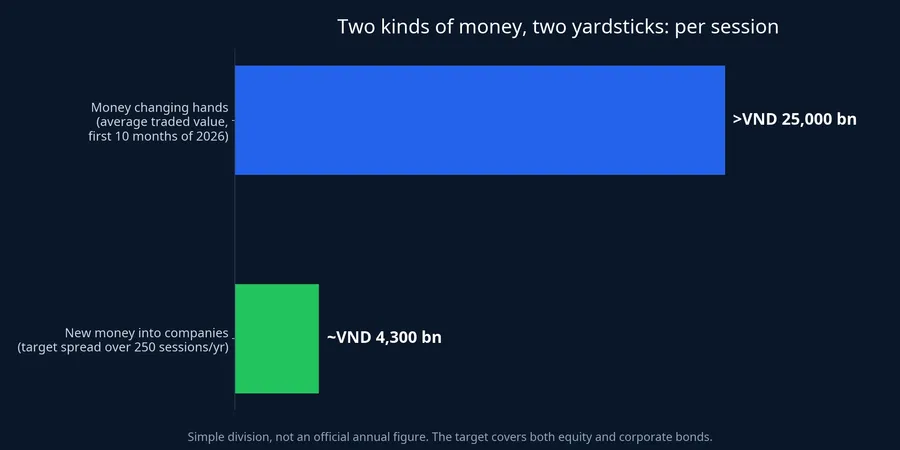
On the morning of November 27, speaking at the ceremony marking 30 years of Vietnam's securities industry, Prime Minister Lê Minh Hưng asked the sector to aim to raise about VND 5.4 quadrillion (VND 5.4 million billion) in medium- and long-term capital over 2026–2030. Spread evenly over five years, that is about VND 1.08 quadrillion a year. With roughly 250 trading sessions a year, it works out to about VND 4,300 billion of new money per session.
The number itself is not new. According to press reports, the target already sits in the Master Plan for Reforming Vietnam's Financial Market, approved under Decision 1413/QĐ-TTg of July 27, 2026. What stands out on November 27 is how the Prime Minister placed it next to two other demands: rely less on bank credit, and build a base of long-term buyers. This piece moves from the number down to the mechanics, to answer the question of anyone holding or about to buy shares: where does that VND 1 quadrillion-plus a year go, and who puts the money up?

Three priorities, and where the number sits
According to the full text of the remarks republished by CafeF, the Prime Minister asked the finance and securities sectors, together with ministries and agencies, to focus on three groups of tasks.
The first is institutions: implementing the amended Securities Law and the financial market Master Plan, reviewing foreign ownership rules, and improving trading, settlement and disclosure. The third is infrastructure: modernizing trading, settlement, clearing and supervision systems to international standards.
The VND 5.4 quadrillion sits in the second group. The stock market is to become the economy's main channel for medium- and long-term capital, gradually easing "excessive dependence on bank credit". Two 2030 targets go with it: equity market capitalization at 120% of GDP and outstanding bonds at no less than 58% of GDP. The Prime Minister also asked to "accelerate equitization and state divestment tied to listing", to make it easier for eligible private and foreign-invested companies to list, and to "have breakthrough solutions to develop investment funds, pension funds and professional institutional investors".
That second group has two halves. The supply side, new securities coming to market, is given numbers and specific tasks: VND 5.4 quadrillion, equitization, divestment tied to listing, bringing private and foreign-invested firms to the exchange. The long-term buyer side is, for now, a request for "breakthrough solutions".
New money is not the same as traded value
Anyone who watches the price board knows another big number: average traded value of more than VND 25,000 billion per session in the first ten months of 2026. Next to that, VND 4,300 billion a session sounds small, about one-sixth.
But the two figures measure different things. VND 25,000 billion a session is money changing hands between investors: one sells, another buys, and the company receives nothing. VND 5.4 quadrillion is money going straight into companies through IPOs, follow-on share offerings and corporate bonds. Thời báo Tài chính Việt Nam made the same point on November 23: better liquidity does not mean traded value turns into new capital for businesses.Thời báo Tài chính
To see how large VND 1.08 quadrillion a year really is, set it against the new money that has actually reached companies. According to Nguyễn Quang Thuân, Chairman of FiinGroup, the equity channel raised about VND 150,500 billion in all of 2025, including initial public offerings.Thời báo Tài chính That is less than one-seventh of the yearly average the target implies.
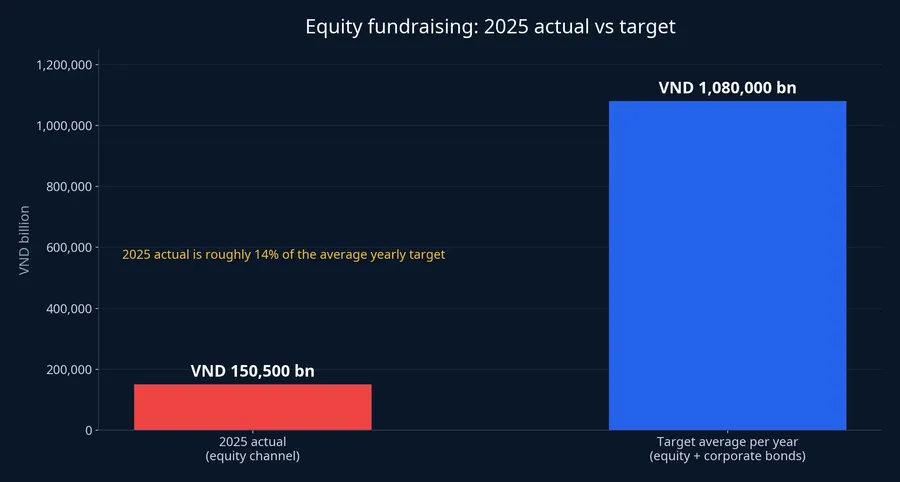
The VND 5.4 quadrillion target does not fix a split between shares and corporate bonds, so the comparison shows only one thing: if the equity channel keeps its 2025 pace, most of the yearly total would have to come from corporate bonds, or equity fundraising would have to grow several times over.
On the bond side, VIS Rating puts outstanding corporate bonds at the end of October 2026 at about VND 1.534 quadrillion, equal to 11% of GDP.Thời báo Tài chính FiinGroup gives VND 1.48 quadrillion for the same date, down 0.1% from the previous month. FiinGroup also expects principal and interest due on corporate bonds in 2027 to reach VND 394,100 billion, up 28.9% from 2026.CafeF Part of each year's new bond issuance will go to repaying old debt, so the new money that actually reaches operations is smaller than the headline issuance.
120% of GDP and VND 5.4 quadrillion are different goals
Equity market capitalization is now close to VND 10.8 quadrillion, or more than 82% of GDP.Người Quan Sát The 2030 goal is 120%.
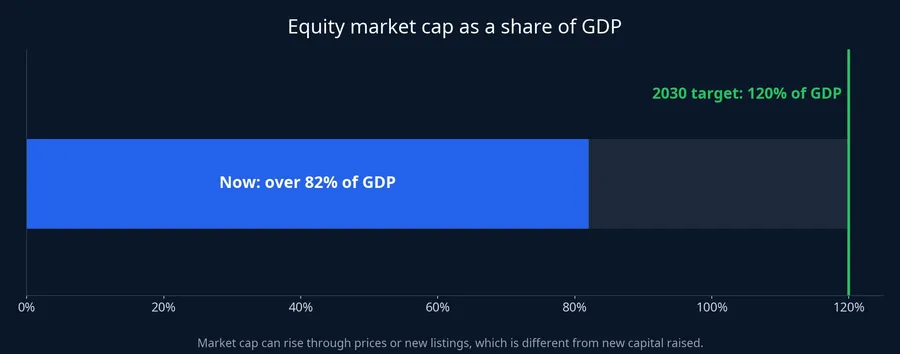
The two targets are easy to blur together, yet they measure different things. Market cap can rise without a single dong reaching companies, simply because listed share prices go up. It also rises when large new companies list through equitization or divestment, even if existing stocks stand still. The VND 5.4 quadrillion is reached only when someone pays for newly issued securities. So placing equitization, divestment tied to listing and the listing of private and foreign-invested firms in the same priority points to a direction: the market grows partly by adding supply, not only through price.
Why bank credit comes into the picture
The Prime Minister stated the aim as reducing dependence on bank credit for medium- and long-term financing, toward a more balanced and resilient financial system.
The mechanism is straightforward. Banks take deposits that are mostly short-term and lend to projects that need capital for years. When a company raises long-term funds through shares or bonds, the maturity risk moves from the bank's balance sheet to whoever holds the securities. In exchange, buyers earn dividends, bond interest or price gains, and carry the accompanying risk. For savers, nothing changes right away. It only signals that over the next five years, the economy's new long-term capital is expected to flow more through the stock market and less through the bank counter.
The long-term buyer side
The supply side has been given numbers; the buyer side decides whether the target is reached. More than VND 1 quadrillion a year has to come from someone: individual investors, foreign investors, and institutions that hold money for the long run, such as investment funds, pension funds and insurers. The Prime Minister singled out investment and pension funds because they have steady inflows over many years and are less likely to sell when markets swing.
Some pieces are in place. The amended Securities Law was passed by the National Assembly on November 13, 2026 and takes effect on March 1, 2027. According to State Securities Commission leaders, the regulator is drafting the implementing decrees and circulars. On the household side, Decree 253/2026/NĐ-CP, effective July 1, 2026, allows contributions to supplementary pensions, voluntary pensions and life insurance to be deducted when computing income tax, with a combined cap of VND 3 million a month, up from VND 1 million.
These are useful pieces, but not yet the "breakthrough solutions" the Prime Minister asked for. How pension and investment funds grow to scale, and how fast, will have to wait for the guidance documents under the amended Securities Law.
Two ways to read it for current shareholders
More new supply can be read in two directions, and the available data cannot yet pick one.
In the first reading, many offerings at once pull money away from listed stocks, and shareholders of companies that need capital face follow-on issues that dilute their stakes. In the second, large companies and new sectors coming to market make it more attractive to domestic funds and foreign investors, especially after Vietnam formally entered the FTSE GEIS global index on September 21, 2026. Good supply can pull in new money rather than just redistributing old money.
Both readings meet at one condition: whether new long-term money arrives as fast as new supply.
Conclusion
On the supply side the thesis is fairly clear. The target points toward a market with more new securities in the coming years: follow-on offerings, equitization, divestment tied to listing and corporate bonds. For shareholders, a sensible frame is to treat this as a period with more offerings, and to read each one through two questions: what the proceeds will fund, and where the offer price stands against the market price.
The demand side cannot be called yet. Whether long-term buyers are enough to absorb that supply depends on documents that have not been issued. That does not change the view on supply; it only determines whether the market digests it quickly or slowly. The nearest date to watch is March 1, 2027, when the amended Securities Law takes effect along with its accompanying decrees. The provisions on investment and pension funds will show how the long-term buyer side is to be built.