

On the evening of 27 November 2026, Vietnam's Ministry of Finance said Moody's had raised the government's long-term local- and foreign-currency issuer rating from Ba2 to Ba1, with a Stable outlook.VnExpress On Moody's scale, Baa3 is the lowest investment-grade rung,VnExpress so the government is exactly one notch short.
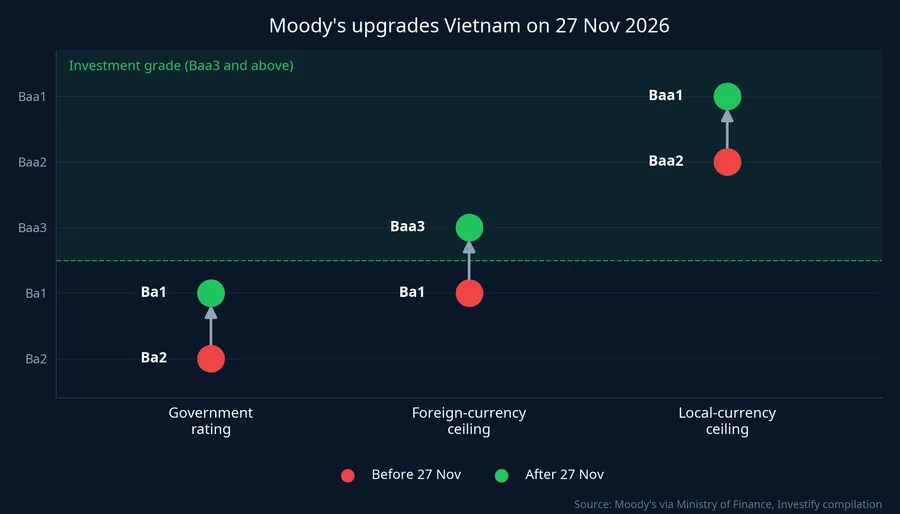
Most headlines stopped at Ba1. But in the same round Moody's changed two other lines: the local-currency ceiling went from Baa2 to Baa1, and the foreign-currency ceiling from Ba1 to Baa3.Người Quan Sát The second line means the cap on foreign-currency debt of entities based in Vietnam now sits inside investment grade, even though the government itself does not. This piece explains how the two kinds of rating differ, who benefits first, and what the last notch depends on.
A sovereign rating and a country ceiling are different things
A sovereign issuer rating is Moody's opinion on whether the state will repay its debt on time. Foreign lenders and bond buyers look at it when pricing government debt.
The country ceiling is something else. It is the highest rating Moody's will normally give to debt issued by entities based in the country, including the strongest bank or company. The foreign-currency ceiling captures one more risk: in a crisis the state might restrict the conversion or transfer of foreign currency abroad, leaving a company with cash unable to repay dollar debt. That is why a ceiling can sit above the government's own rating, and in Vietnam's case it does: the foreign-currency ceiling at Baa3 is one notch above the government's Ba1, and the local-currency ceiling at Baa1 is three notches above.
Before 27 November the foreign-currency ceiling was Ba1. Every foreign-currency debt of a Vietnamese entity, however strong, was capped below investment grade. With the ceiling at Baa3, a sufficiently strong bank or company now has room, in principle, to have its foreign-currency debt rated investment grade.
"In principle" matters. A ceiling is only an upper bound. Each bank's actual rating is still assigned separately by Moody's, based on its standalone credit strength and the government support the agency assumes it would receive if needed. A bank whose standalone strength sits below investment grade does not get pulled up just because the ceiling moved.
What Moody's based the decision on
Moody's named better governance through institutional reform as the main driver of the upgrade.Đầu tư Tài chính Per the agency, the process accelerated from late 2024 through a leaner administration, a stronger judiciary, anti-corruption work and digitised public services. It says Vietnam's governance indicators now come close to those of some higher-rated countries.Znews
On the economy, the agency cited real GDP growth of 9% in the first nine months of 2026, above the 8% for all of 2025.Người Quan Sát Registered FDI over ten months rose 74% year on year, increasingly concentrated in semiconductors, advanced electronics and high technology.VnExpress
On fiscal policy, Moody's projects government debt rising from about 30% of GDP in 2026 to about 35% by the end of the decade as Vietnam spends more on infrastructure.Đầu tư Tài chính It still considers that moderate, given high nominal growth and prudent debt management, and says Vietnam's fiscal metrics are better than those of many peers at the same rating.VnExpress
These factors do not carry equal weight. Moody's calls governance the main driver. Growth and fiscal metrics are the base: GDP grew 8% in 2025 and the rating still stayed at Ba2, so the deciding factor was institutional change.
The first upgrade in more than four years
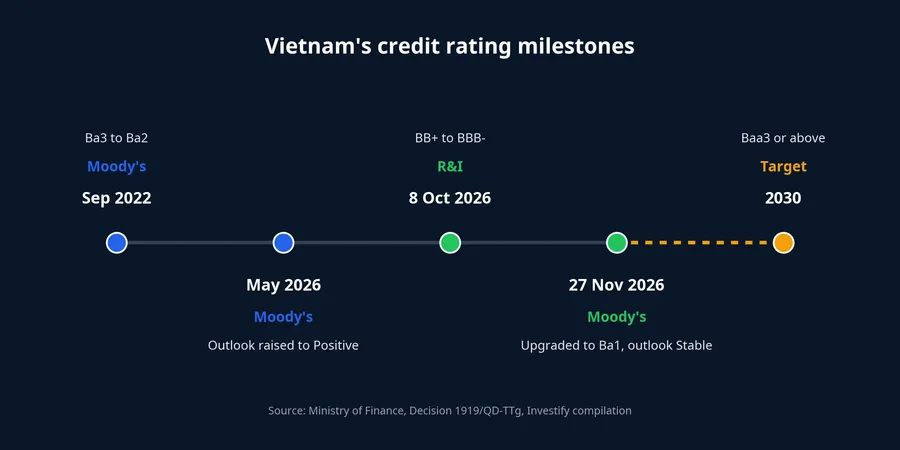
According to Vietnam Finance, this is the first time in more than four years that Moody's has upgraded Vietnam's sovereign rating.Vietnam Finance The previous one came in September 2022, from Ba3 to Ba2. In May 2026 the agency moved the outlook from Stable to Positive while keeping Ba2. This time, alongside the move to Ba1, the outlook went from Positive back to Stable.
A Stable outlook is not a negative signal. A Positive outlook usually foreshadows an upgrade; once the upgrade has happened, a return to Stable means Moody's sees supporting factors and risks balancing at the new level. It also means the next step, to Baa3, has not been signalled in advance.
Another agency got there first. On 8 October 2026, Japan's R&I raised Vietnam from BB+ to BBB-, investment grade.Vietnam Finance For the three big agencies, Moody's, S&P and Fitch, the government's target in Decision 1919/QĐ-TTg of 2 October 2026 is at least Baa3 at Moody's or BBB- at S&P and Fitch by 2030. The same decision caps government debt at 50% of GDP, well above the roughly 35% Moody's projects for the end of the decade.
Who benefits first
The most direct beneficiaries are entities that borrow in foreign currency.
The government. A higher rating usually comes with a lower risk premium when issuing international bonds or borrowing from foreign institutions. Vietnam Finance sees the upgrade opening the way to international capital at more competitive cost,Vietnam Finance just as Vietnam needs large funding for high-speed rail, airports and energy. How much cheaper it gets will only show up in the next borrowing or issuance.
Large banks and companies that borrow abroad. This is the group the Baa3 ceiling touches. For entities with strong enough standalone credit, the old Ba1 ceiling used to cap their ratings; the new one leaves a notch of headroom. If Moody's upgrades some banks or companies in the coming period, that is when the new ceiling moves from paperwork to real borrowing costs.
The buyer base widens, but not yet. Many pension funds, insurers and international bond funds have strict rules on the credit quality of portfolio assets.Vietnam Finance These investors can usually buy only investment-grade debt. That door opens most clearly once the government itself is placed in investment grade by the major agencies, which at Moody's is one notch away.
Holders of domestic bonds, bond funds and bank shares feel a more indirect effect. Domestic dong-denominated government bonds are driven mainly by policy rates, banking-system liquidity and demand from local banks and insurers; the international rating is one input, not the deciding one. For banks, the benefit runs through the price of funds raised abroad, while most funding is still domestic deposits. So a home or business borrower would feel it only if that cost of funds fell and stayed lower for long enough.
What the last notch depends on
Moody's named what Vietnam still needs to improve: the quality and transparency of data, the quality of the regulatory framework and the effectiveness of monetary-policy management.Đầu tư Tài chính It also pointed to credit growth and leverage in the financial system. In other words, the same pace of lending that helps the economy grow fast is something the rating agencies watch as a risk.
This upgrade rests mainly on institutions and governance, and the last notch will be decided in the same place: more transparent data, a clearer monetary-policy framework, and credit growth without leverage ballooning alongside it. High GDP growth helps hold the rating, but on its own it is not enough to lift it.
Signals to watch
The thesis here is that the most valuable change on 27 November is the Baa3 foreign-currency ceiling, because it removes a cap on private-sector foreign borrowing, while the government's Ba1 still falls short of investment grade. That view only changes if Moody's upgrades no Vietnamese entity over the next several quarters, in which case the new ceiling stays on paper.
The earliest signal is Moody's rating decisions on individual Vietnamese banks and companies in the coming weeks. If any entity is upgraded to just below or to the Baa3 ceiling, the new ceiling is starting to bite. The second is the pricing of the government's and large banks' next international borrowing or bond issue. The longer-dated one is the moves of S&P and Fitch, the other two agencies in the Decision 1919 target.
For individual investors, the sensible reading is that this shifts the baseline for the whole economy's cost of capital over several quarters, not that it is a catalyst for a single trading session.