

VN-Index closed the 26 November session at 1,629.68, down 57.77 points or 3.42%. It is the lowest close since 24 March 2026, when the index finished at 1,614.77. A loss of nearly 58 points in one session is also the largest since 22 July, when the index fell 62.03 points.
The full-day figure hides the more important detail: the afternoon is where most accounts took the hit. This piece walks through the session stage by stage, because each stage hurt a different group of stocks.
The open: below the reference level from the first order
The reference level was the 25 November close of 1,687.45. It was also the first session after the US Trade Representative (USTR) proposed an additional tariff of up to 35% on Vietnamese goods. The tariff is still only a proposal and is not yet in force.
The index opened at 1,670.75, almost 17 points under the reference. The session high was just 1,677.93. At no point did VN-Index get back to the previous close.
The morning: selling concentrated in large caps
At the lunch break VN-Index stood at 1,661.41, down 26.04 points. Morning selling fell mainly on a handful of large caps in the Vingroup and banking groups, while foreign investors were still small net buyers.
At that point the index sat inside the 1,650-1,670 zone that Vietstock calls the old July 2026 low. By closing data, the July low was 1,668.53, recorded on 22 July.
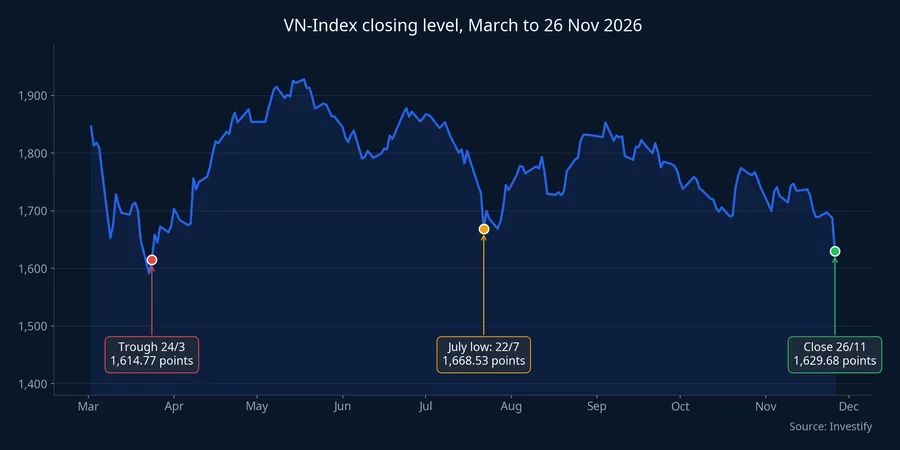
The chart shows where the session left the index: below the July low and only about 15 points above the 24 March trough.
The afternoon: selling spreads to mid caps
From 1,661.41 at the lunch break to 1,629.68 at the close, the afternoon took roughly 31.7 points, more than the 26.04 of the entire morning. At one point the index touched 1,622.08 before edging up late in the session.
Unlike the morning, the afternoon decline was no longer confined to a few large names. At the close HoSE had 303 decliners against only 48 advancers, including 16 stocks at the daily floor and 7 at the ceiling. Matched volume reached about 809.5 million shares, well above the 544.7 million of 25 November. Turnover on HoSE was VND 16,044 billion, 7.19% above the 20-session average. Selling came with higher liquidity, but not an extreme spike.
The stocks that closed at the floor spanned several sectors:
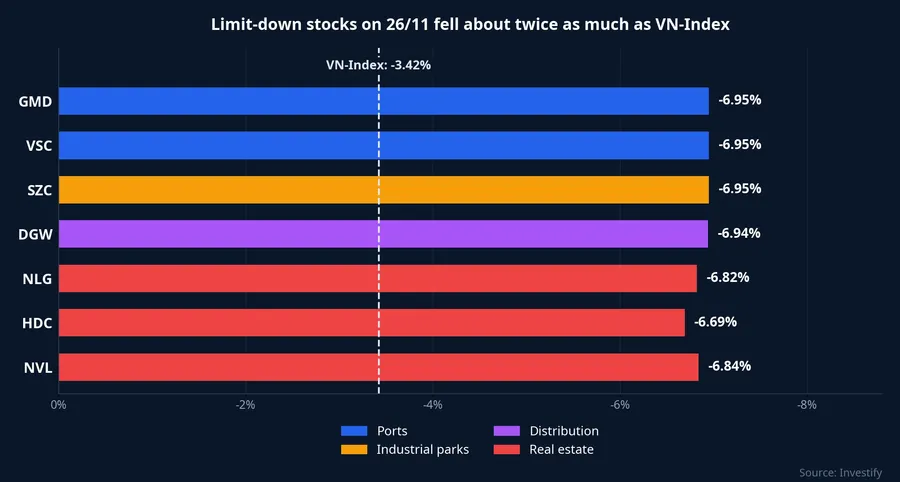
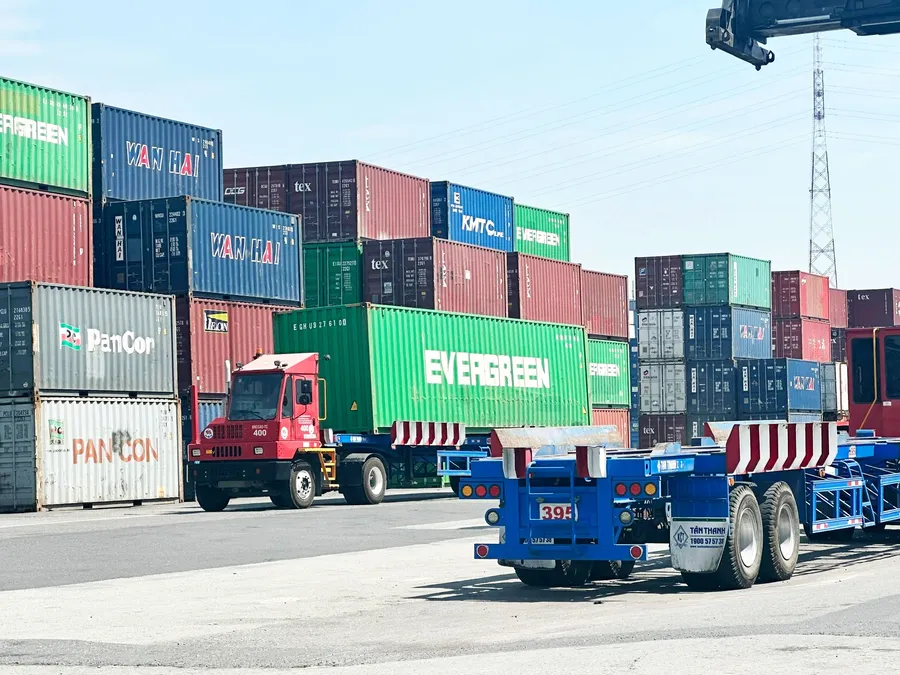
- Ports: GMD fell 6.95% to VND 48,850 and VSC fell 6.95% to VND 12,050. These two had the largest traded value among floor-locked stocks, about VND 207 billion and VND 174 billion. VSC matched nearly 14 million shares, about four times the previous session.
- Industrial parks: SZC (Sonadezi Chau Duc) fell 6.95% to VND 17,400.
- Real estate: NLG fell 6.82% to VND 21,850 and HDC fell 6.69% to VND 11,150. NVL fell 6.84% to VND 8,850, just VND 10 above its floor, with more than 19 million shares matched.
- Distribution: DGW (Digiworld) fell 6.94% to VND 36,200.
HDC and HHP had already hit the floor on 25 November (down 6.64% and 6.92%), so 26 November was their second straight floor session. Among large caps, banks fell harder in the afternoon: TCB lost 5.07% and LPB lost 6.02%. Only a few stocks stayed green, such as KLB up 5.05%, MCH up 1.54% and MSB up 0.92%.
Where this leaves shareholders
For a portfolio tracking the index, the session cost about 3.4% of value. Holders of floor-locked stocks such as GMD, VSC, SZC, NLG, HDC or DGW lost close to 7% in a single session, roughly twice the index's decline.
For investors holding these names on margin, collateral fell nearly 7% while the loan stayed the same, so the account's margin ratio dropped faster than the price. Two consecutive floor sessions, as with HDC and HHP, add up to a loss of about 13%.
The region moved the other way
On the same day most major Asian indices closed higher or flat. Japan's Nikkei 225 rose 0.9%, Hong Kong's Hang Seng rose 1.3%, Korea's KOSPI rose 0.3% and Shanghai was flat. Only Thailand's SET fell, by 0.6%. VN-Index's 3.42% drop was far deeper than any index in the group.
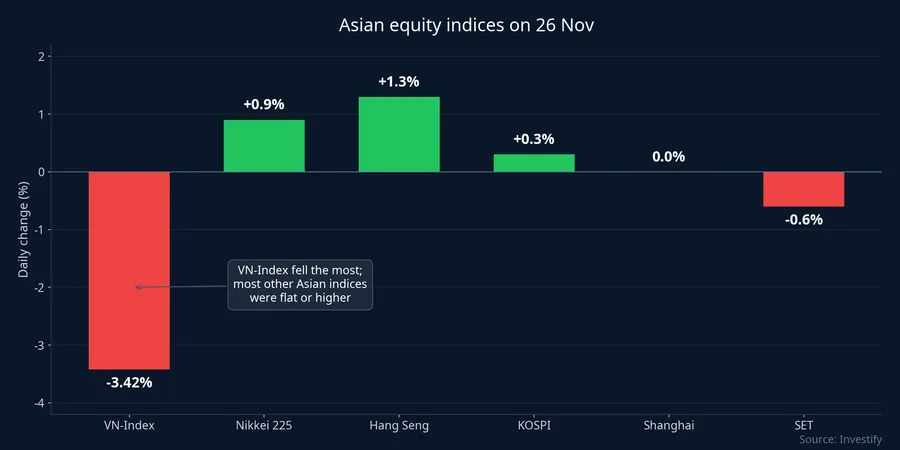
That gap suggests 26 November was a Vietnam-specific episode, not a regional sell-off. Still, the decline cannot be pinned on a single cause.
The first explanation is the US tariff proposal. Nguoi Quan Sat links the wave of selling to it, which fits with Vietnam being a direct recipient of the proposal. The second is internal pressure: the index had already slid over several sessions from 1,746.90 on 11 November, and some mid caps had been at the floor since 25 November. Price action leans toward the tariff proposal as the trigger, with the breadth of the afternoon selling suggesting domestic sentiment amplified it. This is a reading of price behavior; no data separates the contribution of each factor.
Foreign investors: net buyers in the morning, net sellers for the day
Over the full session, foreign investors net sold VND 188.01 billion on HoSE, with VND 2,012 billion bought and VND 2,200 billion sold. The direction reversed from the morning, when they were still small net buyers.
Even so, that net selling equals only about 1.2% of HoSE turnover of VND 16,044 billion, and is far below the nearly VND 5,700 billion of net selling on 25 November, most of which came from a VIC negotiated block. At this scale, most of the selling on 26 November came from domestic investors.
Two signals to watch
The thesis: 26 November was not just a points drop driven by a few large caps. Selling spread into mid caps in the afternoon, on rising liquidity, with domestic sentiment amplifying the tariff news. What remains open is whether this was a one-off reaction or the start of a longer sell-off, and two data points will answer that.
The first is market breadth in the coming sessions: the number of floor-locked stocks on HoSE against the 16 of 26 November, together with foreign flows. If floor counts shrink while foreign investors are not heavy net sellers, selling has stopped at mid caps. If floor counts rise, selling is spreading.
The second is the final US tariff on Vietnamese goods. The 35% or 20% level is still a USTR proposal, per FireAnt. The document that fixes the rate will show whether ports and industrial parks, which are tied to exports, are being priced on real risk or on worry.