
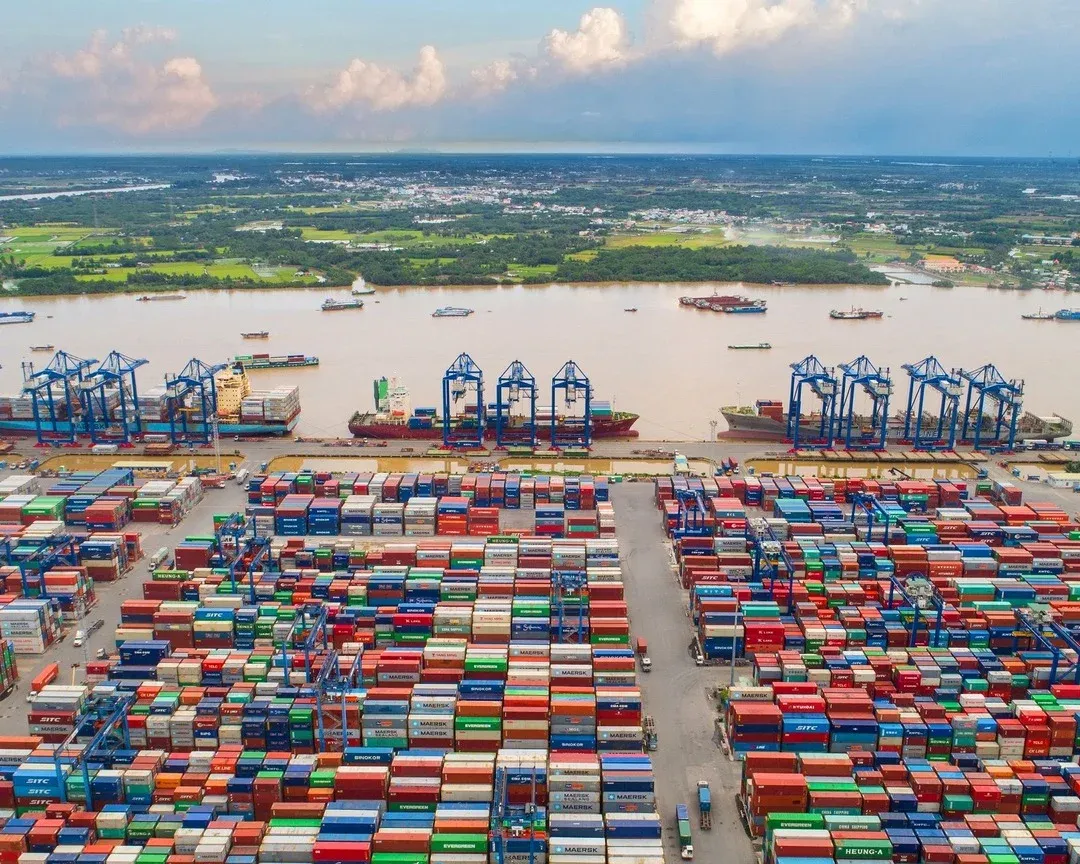

At the end of the morning session on November 26, the VN-Index was down 26.04 points, or 1.54%, at 1,661.41.Index.vn What stands out is less the size of the drop than how widely it spread and who was selling. Foreign investors were almost on the sidelines. The pressure came from domestic investors.
It was the first session after the Office of the US Trade Representative (USTR) released, on the evening of November 25, its preliminary findings in the Section 301 investigation into overcapacity. Under them, Vietnamese goods could face an additional tariff of up to 35%.VnExpress This piece does not retell how the proposal works. It looks for its fingerprints in the morning's trading data.
All figures below run to the end of the morning session at 11:30. Trading resumes at 13:00, so these are not closing prices.
Selling spread across almost the whole exchange
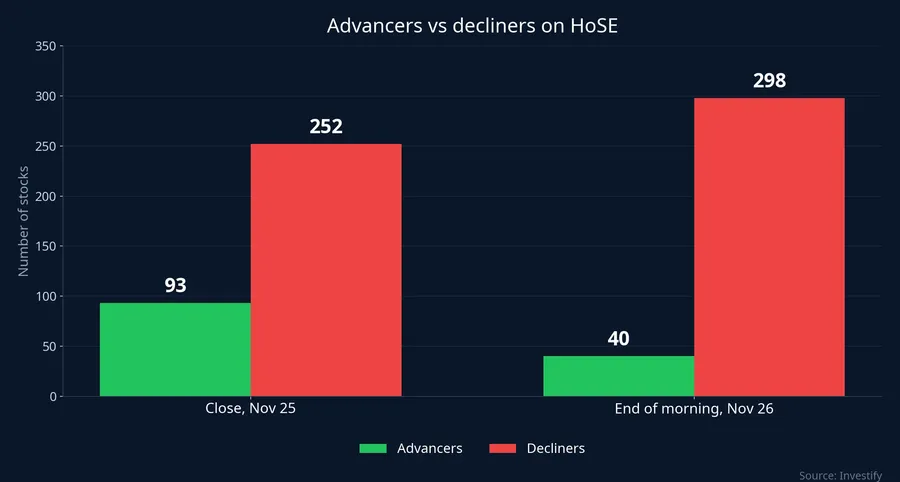
By the lunch break, HoSE had 298 decliners against only 40 advancers, more than seven stocks falling for every one rising.Index.vn At the close on November 25 the count was 93 advancers and 252 decliners, so breadth deteriorated sharply overnight.
The VN30 basket lost 22.65 points to 1,755.93. The HNX-Index, by contrast, rose 1.20 points to 228.66, which shows the pressure was concentrated on HoSE, home to most large-cap stocks.Index.vn
Matched value on HoSE reached VND 6,701 billion in the morning. Index.vn estimates that at this pace, full-day liquidity would run about 25% above the 20-session average. That is a half-session extrapolation, so treat it as a signal only: sellers were willing to trade at lower prices rather than wait.
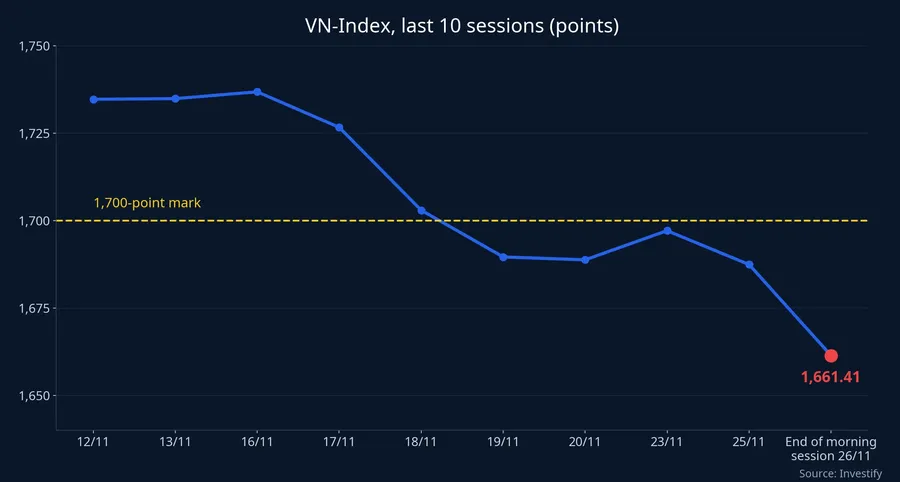
The chart shows the market did not fall from a peak in a single morning. The VN-Index closed at 1,697.14 on November 23, still short of 1,700, then dropped 9.69 points to 1,687.45 on November 25. This morning pushed it to its lowest level in the last 10 sessions.
Points lost concentrated in Vin stocks and banks
The two Vin-group stocks took the largest share: VIC removed 4.19 points and VHM 1.87 points, about 6 points in total.Index.vn Báo Đầu tư Chứng khoán also reports that VIC and VHM together took away nearly 6 points.Đầu tư Chứng khoán
VIC fell just 1.06% to VND 242,800. But with a market capitalization near VND 1.9 quadrillion, even a mild dip takes several points off the index. VHM lost 1.80% to VND 60,000.
Banks fell harder in percentage terms. TCB dropped 2.66% to VND 20,150 and LPB 3.52%. Across the sector, banks lost 1.44% and real estate 1.21% in the morning. Point contributions for individual stocks other than VIC and VHM differ between sources depending on how weights are computed, so this piece relies only on the roughly 6-point figure for the two Vin stocks.
On the upside, VNM, KLB and FPT propped up the index, but their combined contribution was under 1 point. KLB rose 5.50% and VNM added 0.21 points.
Foreign investors nearly on the sidelines
On HoSE, foreign investors bought VND 1,150.7 billion and sold VND 1,139.0 billion, a net purchase of VND 11.7 billion.Index.vn Inside that near-balanced total they were still selective: net sales of TCB at VND 65.5 billion, VIC at VND 37.6 billion and NLG at VND 30.1 billion, against net purchases of the FUEVFVND fund certificate at VND 53.7 billion and FPT at VND 38.2 billion.
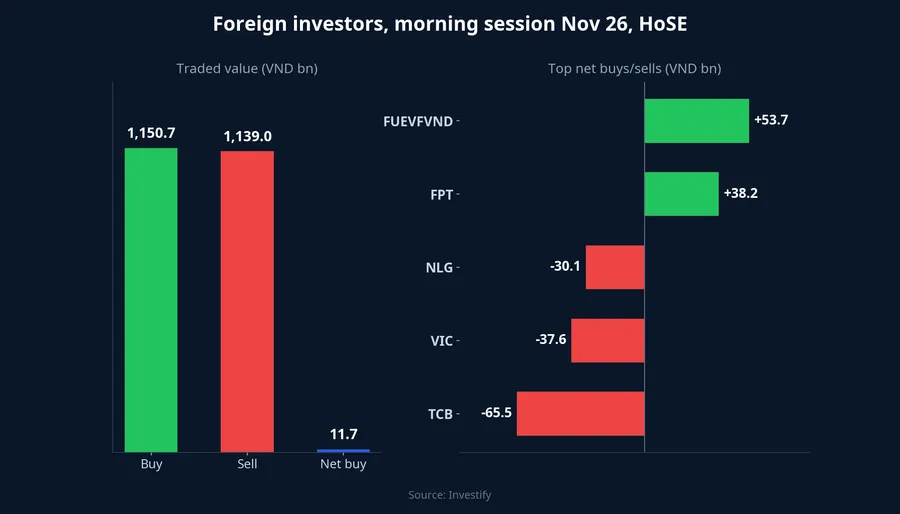
The logic is simple. Every share sold has a buyer, so what pushes prices down is whichever side is willing to cut its price to get matched. When foreigners trade back and forth around balance, the pressure dragging nearly 300 stocks lower sits with domestic investors. This also differs from November 25, when foreign net selling of almost VND 5,700 billion came mostly from a single negotiated block of VIC.
Exporters fell hard, but carry little weight in the index
If the tariff news were the main force, companies that sell heavily to the US should have taken the most direct hit. The US is Vietnam's largest export market, at USD 159.4 billion in the first 10 months of the year, according to the Statistics Office.VnExpress
The morning data shows some export stocks did fall more than the index: TCM (Thanh Cong Textile Garment) lost 3.74%, VHC (Vinh Hoan) 2.30% and PTB (Phu Tai) 2.26%. Transportation dropped 3.34%, including port operator GMD at 4.57%. Ports and exporters move together, since cargo volume depends on outbound orders.
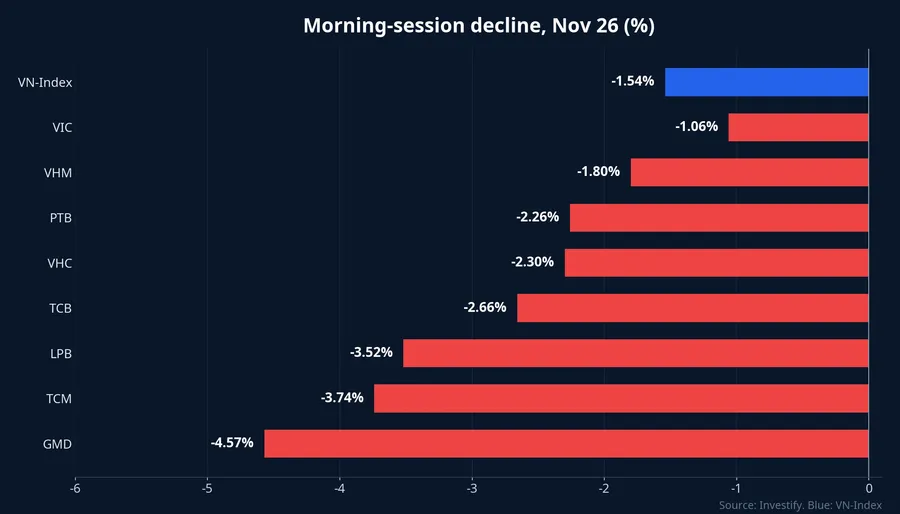
However, these stocks are small. TCM has a market capitalization of about VND 1,700 billion and VHC about VND 10,200 billion, far too small next to VIC to turn the VN-Index. So most of the points lost came from banks and Vin-group stocks, whose revenue is mainly domestic.
Index.vn's sector table paints a similar picture. The four steepest declines were industrials (-2.91%), retail (-2.69%), insurance (-2.47%) and telecoms (-2.38%).Index.vn Retail, insurance and telecoms all depend on domestic spending. The most reasonable reading is that the tariff news acted as a sentiment trigger, while the selling spread as broad de-risking rather than targeting exporters.
The tariff news is not the only explanation
The data does not allow the whole decline to be pinned on the tariff proposal. At least two factors are in play.
Timing fits. This was the first session after the USTR release, so it is tempting to link the two. But coincident timing is not proof of causation.
The market was already weak. Báo Đầu tư Chứng khoán noted that on November 25 the VN-Index had already slipped below its 10- and 20-session moving averages on falling liquidity.Đầu tư Chứng khoán Buying power was already thin before the tariff news arrived. The same source reports Asian equities were positive that morning, so this was not a region-wide sell-off.
The evidence leans toward a combination: a market that was already soft, and tariff news that tipped domestic investors into selling together. The available data is not enough to separate each factor's contribution.
The final tariff rate is still undecided
The 35% rate remains a proposal. In its press release on the evening of November 25, the Ministry of Industry and Trade said the rate could fall to 20% if Vietnam and the US reach a reciprocal trade agreement, and stressed that the proposal "does not take effect immediately and is not yet formally applied".VnExpress The USTR also proposed exempting 2,121 products at the 8-digit HS level.
According to the ministry, the USTR opens a public hearing from January 25, 2027, before finalizing the rate, how it applies and the exemption list. A final decision could come as early as February 2027 and no later than March 11, 2027. The ministry said it will take part in the hearing, submit a written rebuttal of the preliminary findings and push to complete the negotiations.
That means the morning of November 26 reflects worry, not damage. The final rate, 35% or 20%, together with the exemption list, is what will show how much Vietnamese exporters actually lose.
What to watch
Over the next few months, the gap between export stocks and the banks and Vin-group names is the easiest gauge to read. If negotiation and hearing news keeps pushing textiles, seafood, wood products and ports down well beyond the rest, the market is genuinely repricing tariff risk. If banks and Vin-group stocks keep leading the decline, the main story is domestic sentiment and thin buying power, with the tariff news as the trigger.
On foreign flows, the VND 11.7 billion net purchase shows they have not reacted strongly to the tariff news. A large net sale through regular matched orders, rather than a negotiated block, would signal that the worry has reached foreign capital.