
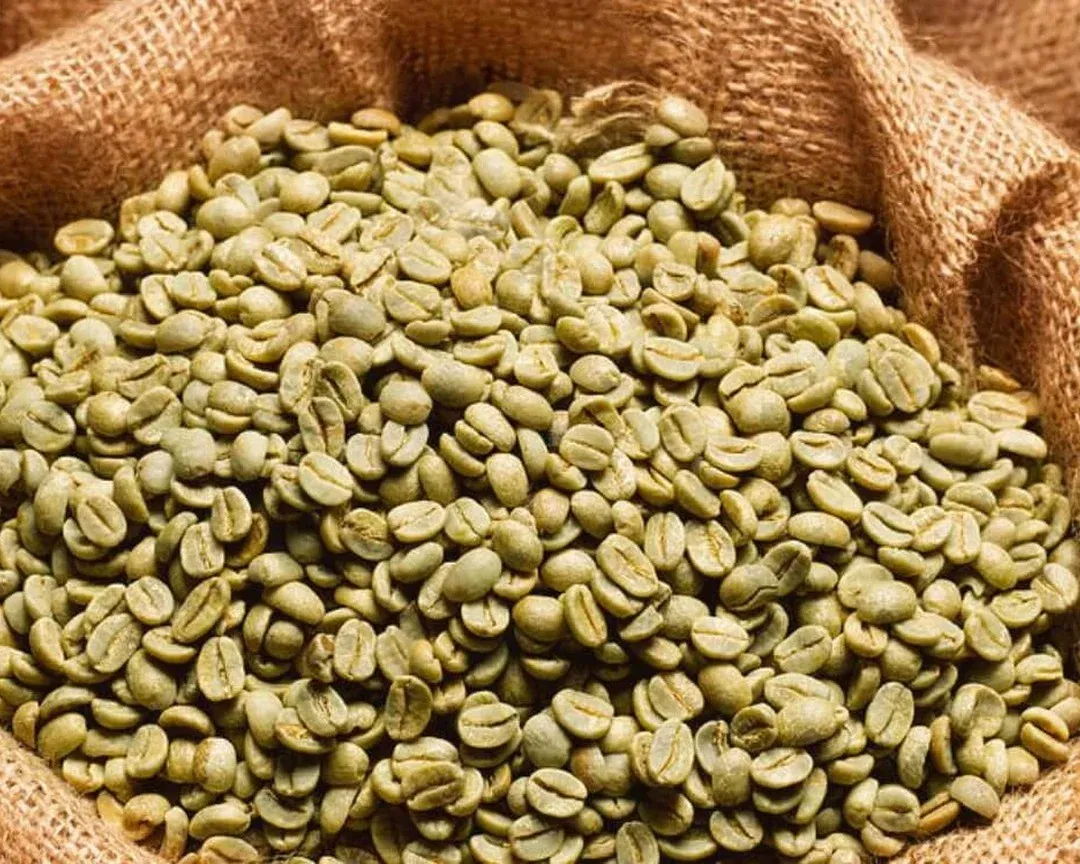

Vietnam's coffee, tea, pepper and cashews appear in the annex of goods the United States proposes to exempt from its new tariff. Fish, shrimp, apparel and footwear have no line in that annex.
That is what the source document shows. The Office of the US Trade Representative (USTR) published it on the evening of November 25, 2026 (Vietnam time) for its Section 301 investigation into excess capacity. On the afternoon of November 26, the Ministry of Industry and Trade held a press briefing and set out the steps the US side still has to take. Read together, the two sources let a holder of Vietnamese export stocks answer two questions: which group does the company's product fall into, and when will the final tariff be known.
The US timetable: no new tariff before February 2027
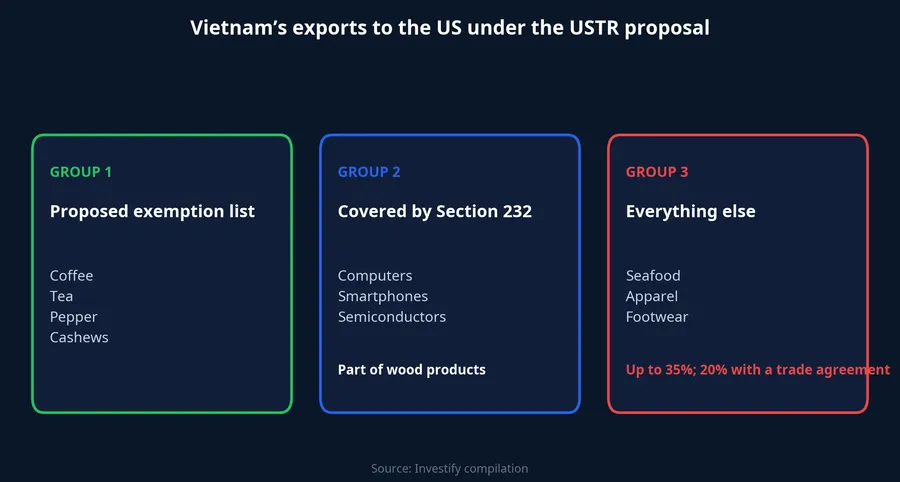
At the briefing, Mr. Chu Thang Trung, Acting Director of the Trade Remedies Authority at the Ministry of Industry and Trade, said USTR expects to open a public hearing from January 25, 2027. Under US rules and practice, a final decision could come as early as February 2027 and no later than March 11, 2027.FireAnt The ministry stressed that the proposed tariff is one step in a US legal process and is not yet in effect.
The USTR document sets an earlier date that the briefing did not mention: written comments and requests to speak at the hearing are due January 5, 2027.USTR The US law firm Kelley Drye summarizes the same two dates, January 5 and January 25, 2027.Kelley Drye In the comment section, USTR asks directly which products should be kept in or taken out of the tariff scope. In other words, the current exemption list is a proposal and can still change.
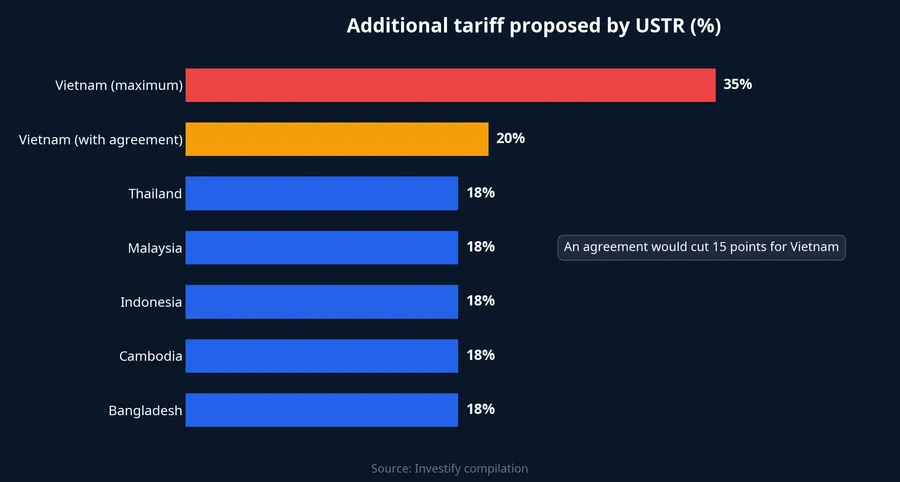
On the rate, the USTR document proposes an additional tariff of up to 35% on Vietnamese goods, excluding exempted products.USTR According to the ministry, that rate could fall to 20% if the two countries reach a Reciprocal Trade Agreement, and it may also be adjusted to account for existing Section 301 and Section 232 duties.FireAnt
Group one: goods named in the exemption list
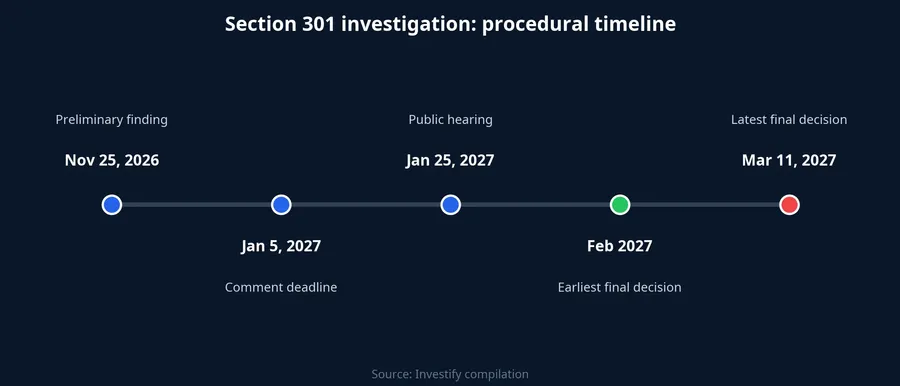
USTR proposes an exemption list of 2,121 products at the 8-digit HS level.FireAnt The annex of the source document includes green and roasted coffee, green and black tea, pepper and cashews.USTR Deputy Minister of Industry and Trade Luong Hoang Thai also said at the briefing that the proposed exemption list includes some tea and coffee products, and that exporters of these goods will face a different risk-management picture from other exporters.Vietstock
The annex states the shared rationale for this group: goods the US does not grow or produce in sufficient quantity, inputs whose taxation could cause shortages in the US market. Coffee and pepper are textbook examples.
For shareholders, this group is best placed through March 2027. That position rests on a proposal, though. The list is only fixed when USTR issues its final decision.
Group two: electronics, computers and goods already under Section 232
The second group works through a different mechanism. The USTR document exempts goods already subject to Section 232 duties from the new tariff, including aluminum, steel, copper, cars and parts, wood products, patented pharmaceuticals and semiconductors.USTR The annex also names computers and smartphones.
Mr. Thai used computers and electronics as his example: they fall under the Section 232 investigation and currently enjoy a 0% import tariff.Vietstock In his view, if the US keeps its current policy, these products are expected to avoid the additional Section 301 tariff when the measure formally takes effect.
Wood furniture sits between the two groups. Wood products already under Section 232 are proposed for exemption, while ordinary wooden tables, chairs, beds and cabinets have no line of their own in the annex. The research team at FinSuccess assesses the new policy as having almost no impact on wood furniture, steel, aluminum and rubber, because most of these goods are already under Section 232 or exempt under Section 301.Người Quan Sát Furniture makers therefore need to check each product code rather than draw one conclusion for the whole sector.
Group two's weakness differs from group one's. Its advantage depends on the US leaving Section 232 policy unchanged, a decision that sits outside this investigation.
Group three: everything else, waiting on negotiations
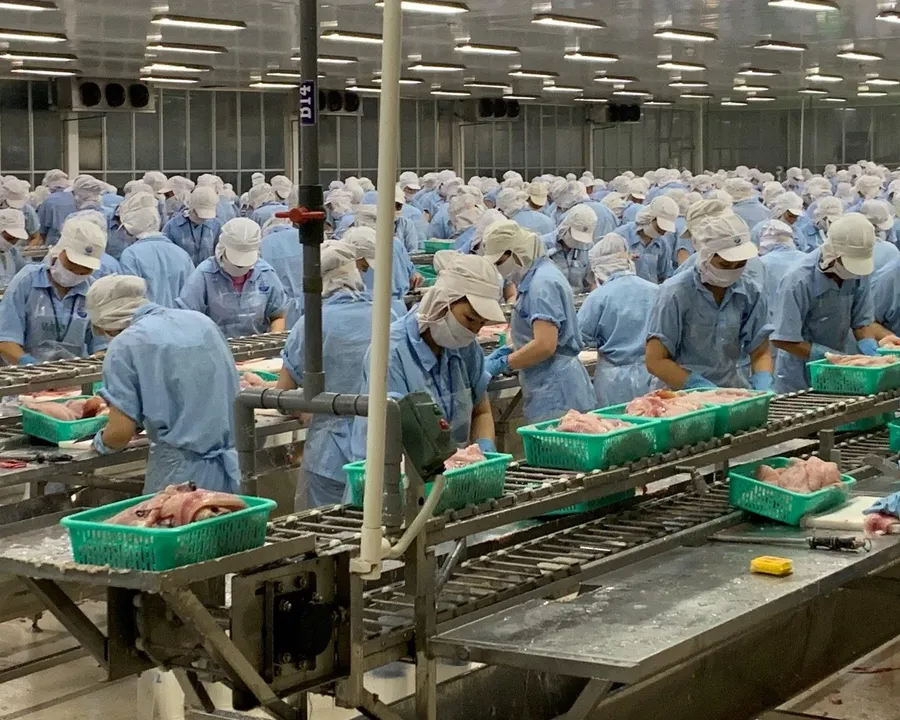
The USTR annex has no line in the chapters on fish, shrimp and squid, or in the apparel and footwear chapters of the tariff schedule.USTR Under the current document, these goods fall within the proposed maximum of 35%, or 20% if the two countries sign a Reciprocal Trade Agreement.
This is a large group. According to TCBS, the US accounted for 32.0% of Vietnam's exports in the first 10 months of 2026.TinNhanhChungKhoan FinSuccess ranks textiles, yarn and footwear as the two most negatively affected sectors, because they are targeted directly and taxed across the board. For seafood it sees a neutral effect: pangasius may gain an edge over Chinese tilapia, while shrimp faces a slight disadvantage against India and Indonesia.Người Quan Sát
Even the good scenario for this group has limits. TCBS notes that 20% is still higher than the 18% USTR proposes for Bangladesh, Cambodia, Indonesia, Malaysia and Thailand.TinNhanhChungKhoan Kelley Drye's summary also lists 18% for those five countries.Kelley Drye For textiles specifically, TCBS notes that the wait for a decision overlaps with order negotiations for the second half of 2027.
In the November 26 session, textile and seafood stocks fell by more than the VN-Index's 3.42% drop: TNG lost 6.63%, MSH 5.56%, TCM 5.44%, ANV 5.08% and VHC 4%. At the other end, wood stock PTB gained 4.53%. A single session reflects many forces at once, from general sentiment to company-specific news, so it is not enough to say the market has repriced by product group. Still, the decline in textiles and seafood matches where those two sectors stand in the USTR document.
Vietnam's two channels
According to Deputy Minister Luong Hoang Thai, Vietnam is working two channels.Vietstock
The first is the investigation procedure. The Ministry of Industry and Trade has prepared its comments for the US side, will take part in the public hearing, and is coordinating with industry associations, especially the American business associations in Vietnam, to supply information to the investigating authority. This channel mainly affects the scope of the list: which product lines are added to or removed from the exemption.
The second is negotiation of the Reciprocal Trade Agreement. Mr. Thai said Vietnam has offered commitments equal to, or even above, those in the free trade agreements it has joined, but the agreement's content still needs review and agreement by both sides. This channel decides the rate for group three: 35% or 20%. According to the ministry, a Government Resolution on the master plan for managing the trade surplus and avoiding international trade risks for 2026–2030, issued on November 21, 2026, together with the negotiation outcome, will be the basis for the US to consider a rate below the maximum.FireAnt
Which group stands better
Through March 2027, the ranking is fairly clear. Group one (coffee, tea, pepper, cashews) is best placed, because it is named directly in the annex and carries an economic rationale the US itself gives: it does not produce enough. Group two (computers, phones, semiconductors, wood goods under Section 232) comes second, because its advantage rests on Section 232 policy, which can change independently of this investigation. Group three (seafood, textiles, footwear) carries the most risk, and its outcome depends almost entirely on the negotiating table.
Two things could reverse this ranking. The first is the exemption list after the January 5 comment deadline and the hearing from January 25, 2027: if product lines are added or removed, a company's position shifts with them. The second is the Reciprocal Trade Agreement: if it is signed before the final decision, the gap between group three and the other two narrows markedly, though 20% would still sit above the 18% of neighboring countries.
The first task for a holder of export stocks is to match the company's main product against the USTR annex. After that, USTR's final decision, no earlier than February and no later than March 11, 2027, will show which list and which rate actually apply.