
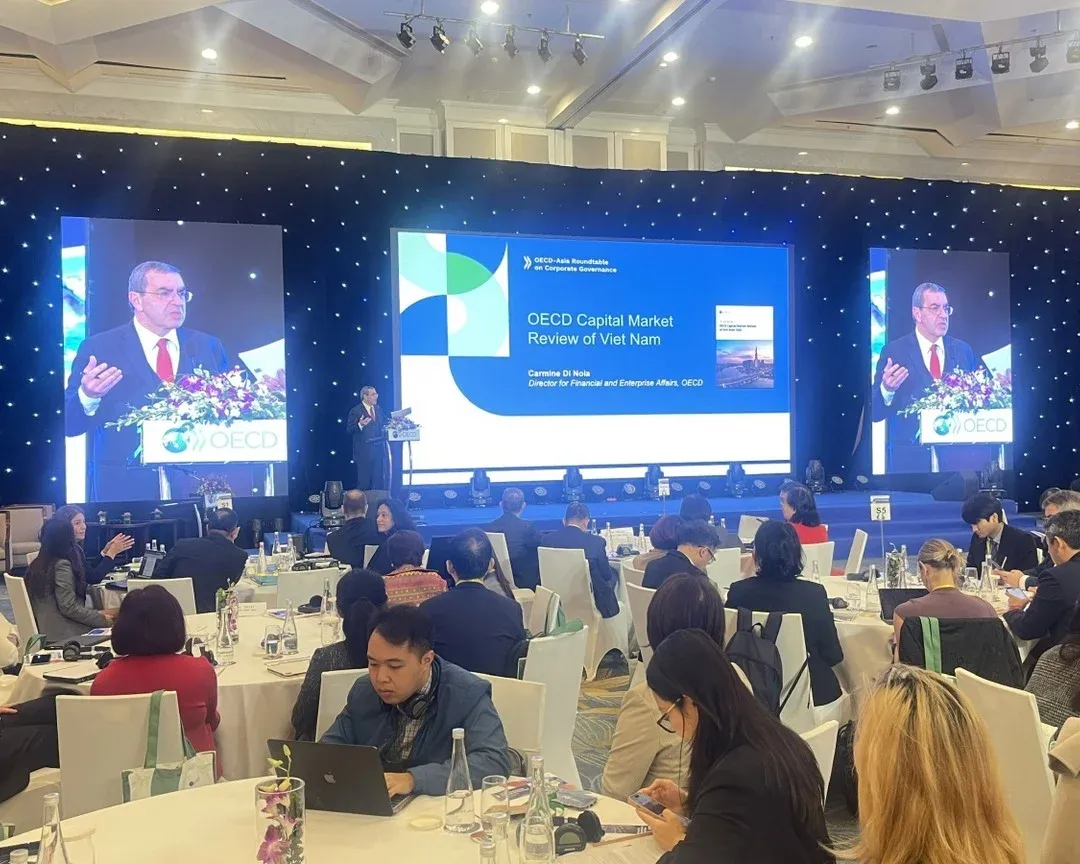

On the morning of 26 November in Hanoi, the OECD released its Capital Market Review of Viet Nam, the first comprehensive assessment of the country's capital market by the organisation. For anyone holding shares, a few lines on boards of directors matter more than the market-cap targets. Among companies in the VNX index, only 13% have a nomination and remuneration committee, and only 3% of those committees are chaired by an independent director.Thời báo Ngân hàng
From there, the OECD recommends raising the share of independent board members to at least one-third, phasing in a requirement for listed companies to report on how they apply corporate governance principles, and tightening oversight of related-party transactions. This is a recommendation from an international body, not a rule. But it lands exactly where minority shareholders have the least say: who gets nominated to the board, who decides executive pay, and who reviews contracts between a company and firms tied to insiders.
The framework behind the report
The report was released at the 2026 Asian Roundtable on Corporate Governance, co-hosted by the State Securities Commission (SSC) and the OECD as part of events marking 30 years of Vietnam's securities industry.Tạp chí Tài chính Carmine Di Noia, the OECD's Director for Financial and Enterprise Affairs, presented it. According to him, listed-equity market capitalisation has reached 75% of GDP and corporate bonds about 10% of GDP, both well short of the government's targets of 120% and 25%.Thời báo Ngân hàng
The recommendations fall into five areas: strengthening investor confidence, helping companies access equity capital, diversifying corporate bonds, broadening the investor base, and internationalising the capital market.Tạp chí Tài chính This piece focuses on the first, because it touches minority shareholders' rights most directly.
The biggest money sits farthest from the decision table
In the OECD's presentation, retail trading accounts have nearly tripled since the end of 2021. Individuals account for about 80-85% of trading value in recent years according to Thời báo Ngân hàng, while Tạp chí Tài chính reports the same metric at about 80%.Thời báo Ngân hàng At the other end, domestic institutional investors' assets are only about 26% of GDP.Tạp chí Tài chính
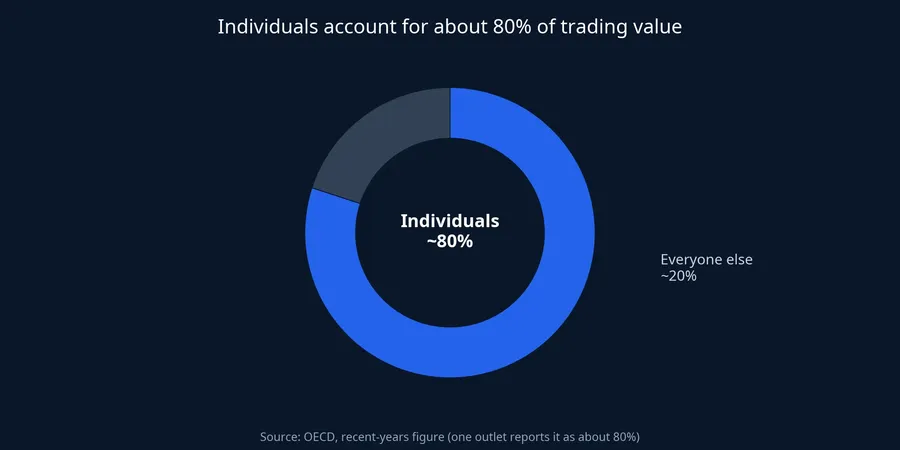
Side by side, the two numbers show a mismatch. Individuals generate most of the daily trading, yet most hold a tiny stake in any single company. Boards are elected at shareholder meetings in proportion to shares held, so large shareholders usually decide most of the seats. Minority shareholders can vote, but their ballots rarely change the outcome.
In that structure, independent directors are meant to represent shareholders' common interest. They do not run the company and have no financial ties to management or large shareholders. Non-executive directors are different: they hold no executive title either, but may have been put there by a major shareholder. The distinction matters, because a board full of non-executives can still speak only for large holders.
Audit versus nomination and remuneration committees: who reviews what
The report separates two types of board committee, and the picture differs sharply between them.
An audit committee reviews financial statements, internal controls and related-party transactions. Among VNX companies, 21% have one, mostly chaired by an independent director.Thời báo Ngân hàng In that group, the person overseeing the books is mostly independent.
A nomination and remuneration committee prepares candidate lists for the board and management and proposes pay. Only 13% of companies have one, and only 3% of those committees are chaired by an independent director. Multiply the two rates and, out of 1,000 companies in the index, only about 4 have a nomination and remuneration committee led by an independent (13% × 3% ≈ 0.4%, Investify's calculation from OECD data).
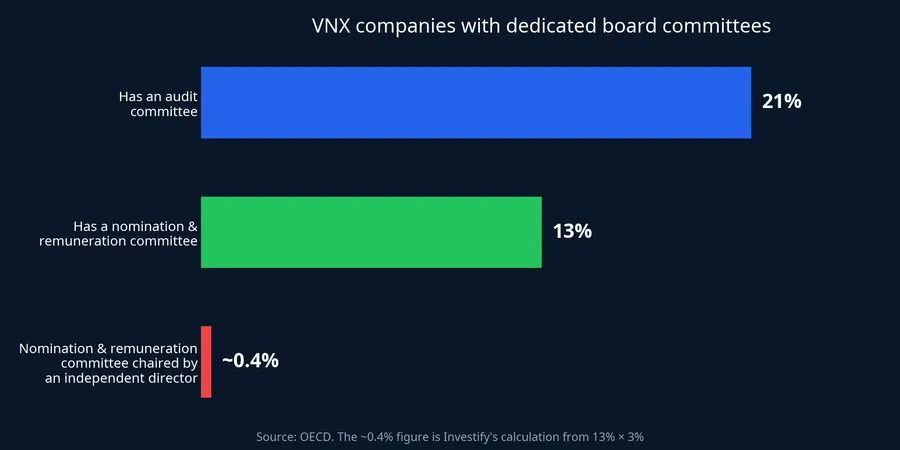
In other words, at nearly all companies in the index, nominations and pay decisions do not pass through a committee headed by an independent. The board still discusses them and shareholders still approve what falls under their authority, but there is no prior review led by someone outside the interests involved.
These figures need reading within their scope. They cover companies in the VNX index as presented by the OECD, not all listed companies. Lacking a committee is also not a violation, since current rules do not require every company to form both types.
A committee with an independent chair is not the only safeguard either. The Enterprise Law still requires certain large related-party transactions to be approved by the shareholders' meeting or the board, with interested shareholders barred from voting, and board remuneration is set by shareholders. Mr. Di Noia himself called Vietnam's Corporate Governance Code a necessary but insufficient condition, with enforcement the decisive step.Thời báo Ngân hàng An independent director is only worth something if they actually use their authority.
Current rules versus one-third: the gap sits in mid-sized boards
Decree 155/2020/ND-CP, which guides the Securities Law, currently sets minimum independent members by board size: boards of 3-5 need at least 1, boards of 6-8 need at least 2, and boards of 9-11 need at least 3.Đầu tư Chứng khoán Set against the OECD's one-third, the gap shows clearly at certain board sizes.
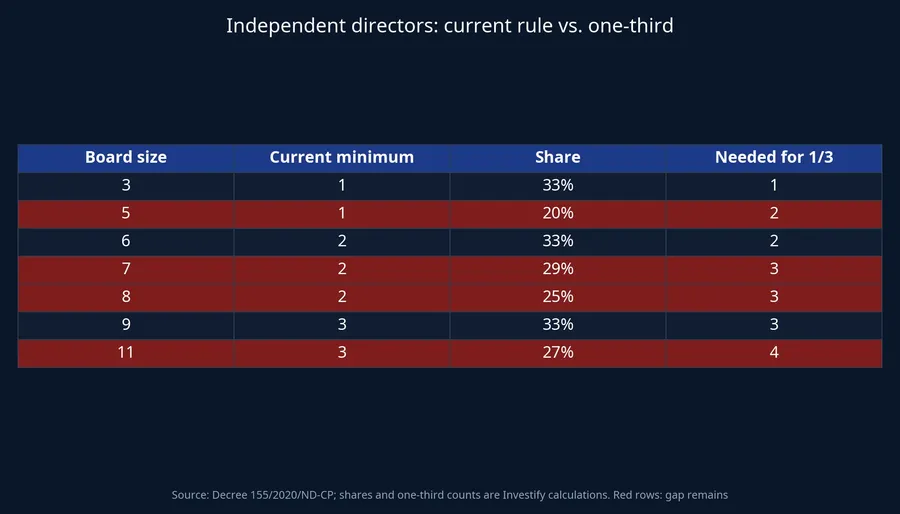
For boards of 3, 6 or 9, the current minimum already equals one-third. The gap lies in boards of 5, 7, 8 and 11. A 5-member board today needs just 1 independent, or 20% of seats, and would need 2 to reach one-third. An 8-member board needs 2 now and would have to go to 3.
That is the mechanism that gives the OECD's recommendation real weight. Adding an independent seat on a 5-member board is not just one more person: the independent bloc goes from 1/5 to 2/5 of seats, enough to form a committee with two independents instead of one lone voice. For companies, the consequence is finding more qualified candidates, re-electing at the shareholder meeting, or replacing a seat currently filled by a major shareholder's pick.
The OECD's proposal is tied to a "comply or explain" mechanism: companies are not forced to follow every principle, but if they do not, they must disclose why to shareholders. The OECD recommends phasing in a requirement for listed companies to report on applying governance principles under this mechanism.Thời báo Ngân hàng For minority shareholders this is an information change: instead of guessing why a board lacks a nomination committee, they would read the company's own explanation in the annual report.
Beyond the board: fund taxation, social insurance and post-IPO waiting time
Several other recommendations touch individual investors' money, if more indirectly. The OECD proposes tax incentives for long-term saving and balancing tax obligations between investing through funds and holding bank deposits or government bonds.Thời báo Ngân hàng If adopted, people investing through fund certificates would no longer be at a tax disadvantage versus savers. It would also help channel more money to domestic institutional investors, exactly where the report says the base is thin.
The report also proposes gradually widening investment options for Vietnam Social Security and shortening the time between the end of an IPO and the start of trading.Thời báo Ngân hàng On internationalisation, it restates a review of sector foreign-ownership limits, early launch of omnibus trading accounts, and a faster timeline for mandatory IFRS.
What the Ministry of Finance said
In his opening remarks, Deputy Minister of Finance Nguyen Duc Chi said governance quality in Vietnam has improved but remains uneven across companies, with disclosure still limited at some public companies.Tạp chí Tài chính He said that early in 2026 the Ministry of Finance and the SSC, together with the International Finance Corporation (IFC), issued the Vietnam Corporate Governance Code 2026, applied on a comply-or-explain basis.

Going forward, Mr. Chi said, the Ministry will focus on three directions: raising board effectiveness at public companies and encouraging a bigger role for independent members; greater transparency, gradual IFRS adoption and tighter management of conflict-of-interest transactions;CafeF and better governance at state-owned enterprises. On the OECD report, the Ministry and the SSC will study and adopt the recommendations that fit Vietnam's circumstances.Tạp chí Tài chính
The two sides point the same way: a bigger role for independent directors and tighter control of conflict-of-interest transactions. The difference is degree. The Ministry says "encourage", while the OECD puts down a specific number: one-third.
Assessment: who gains, who must change
If the one-third level and comply-or-explain reporting are written into regulation, minority shareholders gain the most directly. They get no extra votes, but they get more people on the board who sit outside large shareholders' interests, and more information on whether a company is following the principles or explaining why not.
The companies most affected are those with boards of 5, 7, 8 or 11 sitting at today's minimum, and those with no nomination and remuneration committee. For them, the biggest change is how the board is elected and how power is split among committees. The risk in this scenario is enforcement: add an independent seat and, if its occupant does not use the authority, minority shareholders only get one more name in the annual report. That is why the comply-or-explain reporting recommendation matters as much as the one-third figure.
The recommendation becomes an obligation only once it is written into an amendment of the decree guiding the Securities Law. That document will show whether one-third applies, from when, and with what transition. Until then, next season's shareholder meeting documents are where holders can read the answer today: how many board members there are, how many are listed as independent, and whether the company has a nomination and remuneration committee.