
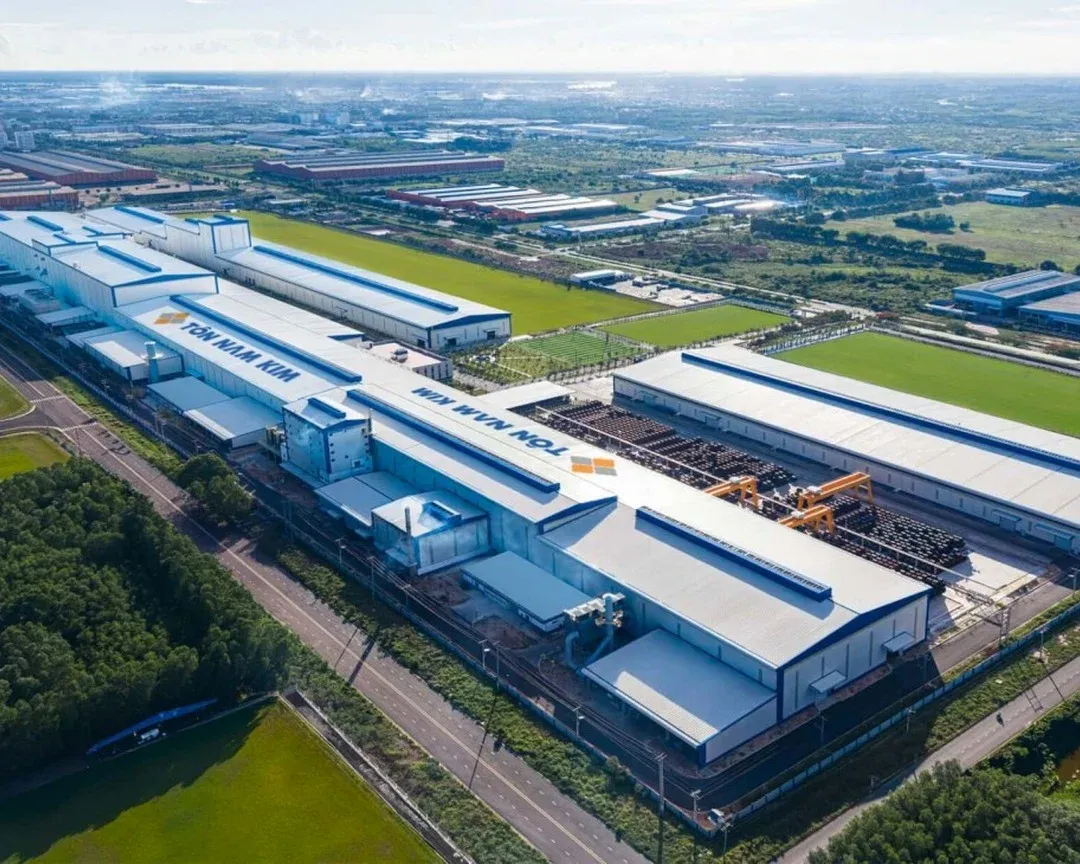

On 23 November 2026, Thép Nam Kim Joint Stock Company (ticker NKG, listed on HoSE) released documents for an extraordinary general meeting of shareholders scheduled for 12 December in Ho Chi Minh City. Two main proposals work together. The first asks shareholders to let Thép Nam Kim contribute more cash to Tôn Nam Kim Phú Mỹ Co., Ltd., the legal entity that holds the Phu My coated steel plant. The second asks to absorb that company into Thép Nam Kim in 2027 and/or 2028.
The operating backdrop is favorable: nine-month consolidated pre-tax profit reached VND 373.20 billion, about 93% of the full-year target. At a glance, the proposal reads like "another VND 1,500 billion poured into the plant." Read closely, the cash moves from Thép Nam Kim to a company it owns outright, so on the consolidated accounts it adds nothing to the group's assets. What the 12 December vote really settles is which entity holds the plant and its debts, and how much freedom the board of directors gets to choose the source of the money.
What shareholders are asked to approve
According to the meeting documents, the board asks shareholders to approve raising Tôn Nam Kim Phú Mỹ's charter capital from VND 2,700 billion to as much as VND 4,200 billion, meaning up to VND 1,500 billion of new cash. Thép Nam Kim would fund the entire increase and keep 100% of the subsidiary's charter capital. The maximum increase equals 55.6% of current charter capital.
The proposal states the purpose as serving the Nam Kim Phu My roofing-sheet steel plant project and/or topping up working capital. The board asks for the right to decide the actual amount, the funding source and the timing of the contribution, either in one go or in several tranches depending on its finances and cash flow.
The same meeting would also approve in principle transactions between Thép Nam Kim and Tôn Nam Kim Phú Mỹ worth 35% or more of consolidated total assets, including cumulative deals over 12 months that reach that threshold. They may cover sales and purchases of goods, borrowing and lending, capital contributions, investment, and transfers or leases of assets. With consolidated total assets of more than VND 20,021 billion at 30 September 2026, the 35% threshold is roughly VND 7,000 billion. This is the framework for cash moving between the two entities before any merger.
On personnel, the board proposes removing Mr. Võ Hoàng Vũ, Standing Vice Chairman of the Board of Thép Nam Kim Joint Stock Company, from the 2025–2030 board following his resignation letter dated 4 September 2026.Tin nhanh chứng khoán If approved, the board would have four members, with no replacement elected.
The gap between charter capital and project cost
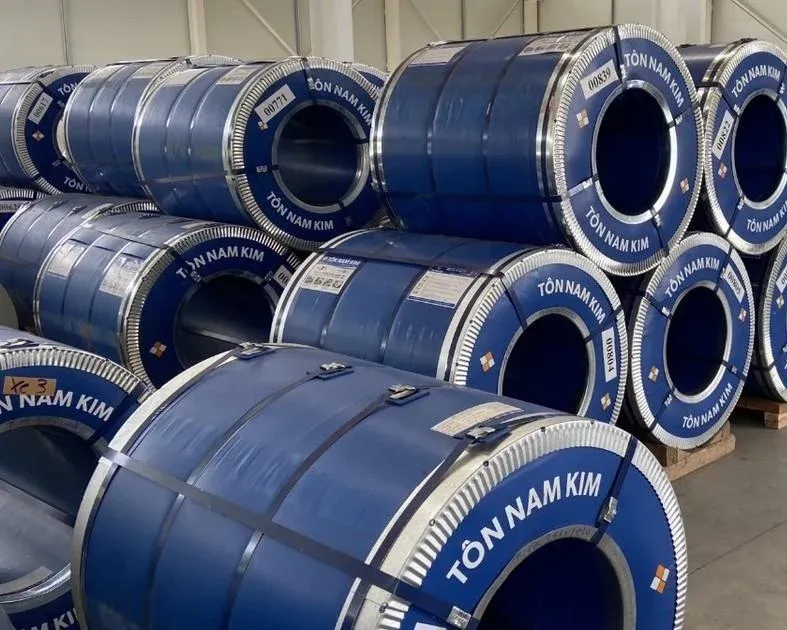
Tôn Nam Kim Phú Mỹ was established in April 2022 and is the investor in a plant with total investment of about VND 6,200 billion. With VND 2,700 billion of charter capital, the remaining gap of about VND 3,500 billion is financed from sources other than paid-in capital.
If the full VND 1,500 billion is contributed, charter capital rises to VND 4,200 billion, roughly 68% of total investment. The equity share of the plant's funding thickens and the part that must come from elsewhere shrinks accordingly.
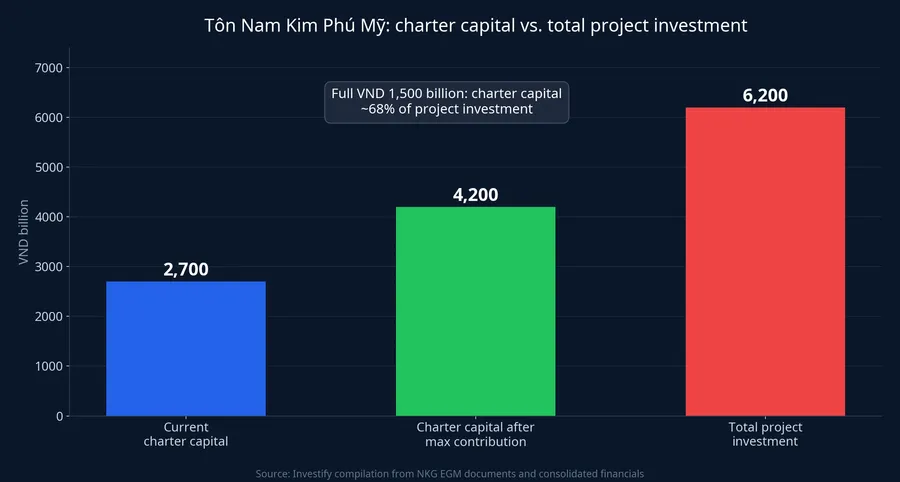
Here the two reporting layers need separating. On Tôn Nam Kim Phú Mỹ's own accounts, equity rises and the company has more cash for the project or working capital. On Thép Nam Kim's consolidated accounts, cash simply moves from one entity to another inside the group. Vietnam Finance also notes that a contribution into a subsidiary is an intra-group transaction and does not automatically raise consolidated equity. So the question that matters to NKG holders is where the money comes from, not where it goes.
Where the cash could come from
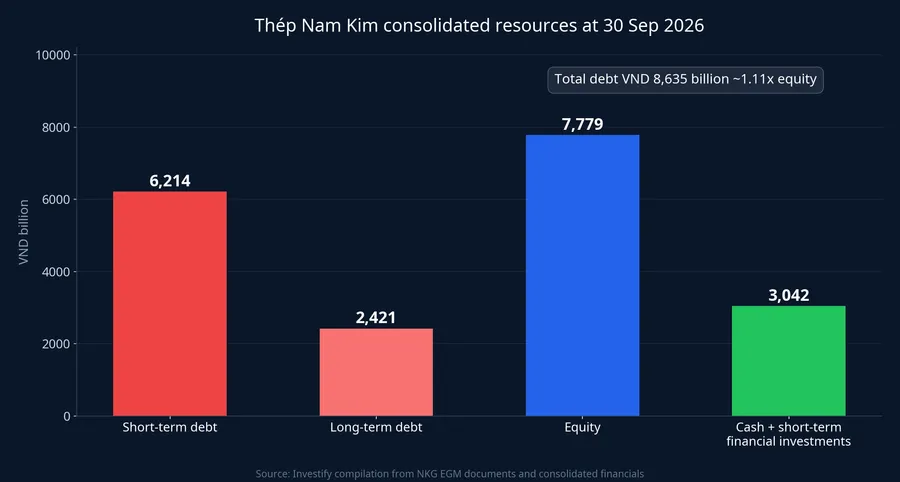
The consolidated balance sheet at 30 September 2026 shows what Thép Nam Kim has to work with. Borrowings stand at about VND 8,635 billion, up 25.7% from the start of the year, made up of VND 6,213.93 billion of short-term and VND 2,421.12 billion of long-term debt. Equity is VND 7,778.82 billion, so total debt is about 1.11 times equity, versus 0.91 times a year earlier.
On the liquid side, cash and cash equivalents are VND 581.66 billion, plus VND 2,460.56 billion of short-term financial investments. Together that is about VND 3,042 billion, double the maximum contribution. That sum is only about 0.49 times short-term debt, though, so it is also the cushion for loans coming due.
Nine-month cash flow adds another layer. Net operating cash flow was VND 747.33 billion, up from VND 532.56 billion a year earlier. Spending on fixed assets and construction was VND 1,301 billion, down from VND 2,571 billion. The shortfall was covered by borrowing: net borrowing over nine months was VND 1,770 billion, against VND 638.17 billion a year earlier. In Q3 alone, operating cash flow was VND 26.26 billion, below VND 161.77 billion in Q3 2025, even as quarterly profit rose sharply.
One more source is shareholders' own money. At the April 2026 annual meeting, shareholders approved a plan to offer about 124.6 million shares to existing shareholders at VND 12,000 each, raising nearly VND 1,495 billion, with the proceeds earmarked for Nam Kim Phu My. The size of that offering nearly matches the maximum contribution in the new proposal. On 23 November, NKG closed at VND 12,150, VND 150 above the offer price.
Each source leaves a different mark on the balance sheet once the money is in. Using existing cash leaves consolidated debt unchanged and thins the liquidity cushion. Borrowing more lifts consolidated debt by roughly the same amount. An equity offering raises Thép Nam Kim's charter capital, and shareholders who do not subscribe are diluted. The proposal leaves the choice to the board.
Operating results are improving
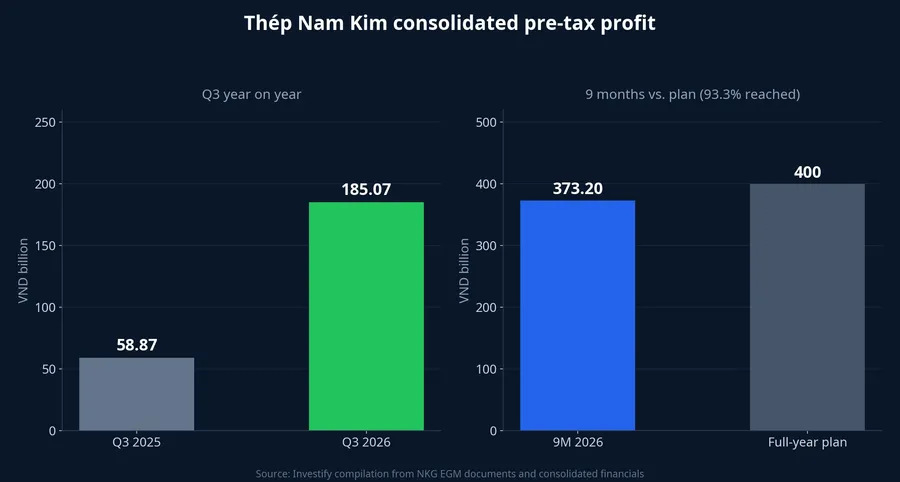
In Q3 2026, net revenue reached VND 5,472.01 billion, up 45% year on year, and gross margin rose to 9% from 4.8%. Pre-tax profit for the quarter was VND 185.07 billion, against VND 58.87 billion in Q3 2025. The gain came from the core business, while financial activity weighed more: quarterly financial expenses rose to VND 121.36 billion, up 89.3%, of which interest expense was about VND 100 billion.
Over nine months, consolidated pre-tax profit reached VND 373.20 billion, up about 48% from VND 252.22 billion a year earlier. The full-year plan is VND 400 billion of pre-tax profit, so after three quarters the company has delivered about 93%. Nine-month after-tax profit rose about 21.9% year on year.
Views on the period ahead point in two directions. According to Vietcap, interest and depreciation costs at Nam Kim Phu My began flowing into earnings from Q3 2026, and the plant may run at only about 30% of capacity in 2027, below the 55–60% pre-tax breakeven level in that brokerage's calculation. On the other side, the plant already has export orders: in early November, a shipment of nearly 20,000 tonnes from the project went to the US. This is a forecast and an early signal, not full-year data.
What a merger changes on paper
Under the plan, once procedures are complete, Tôn Nam Kim Phú Mỹ ceases to exist. Thép Nam Kim inherits all of the subsidiary's assets, rights, obligations and lawful interests, including outstanding debts and obligations to employees. Because it already owns 100%, Thép Nam Kim does not have to issue new shares and its charter capital stays the same.
On the consolidated accounts, the plant and its loans already sit inside the VND 8,635 billion of debt and VND 20,021 billion of assets. A merger leaves those numbers unchanged. As Vietnam Finance put it, the debts are not erased but inherited by Thép Nam Kim, and consolidated debt does not fall just because the legal structure changes.
The real change is on Thép Nam Kim's standalone accounts and in legal standing. After a merger, the plant and Phu My's loan contracts sit directly under Thép Nam Kim's name, and the plant's lenders become direct creditors of the listed company. The board states the purpose as streamlining the organizational structure, cutting management costs, improving internal control and allocating resources.
Put the two proposals side by side and the sequence is contribution first, merger second, with 2027 the earliest merger date. In between, the 35%-of-assets framework lets the two entities borrow, lend and trade goods with each other at large scale.
The milestones that will answer
The 12 December resolution will show whether shareholders give the board the right to contribute up to VND 1,500 billion and to choose the funding source. The Q4 2026 consolidated financial statements will show where the money came from, if it has been disbursed.
The simplest yardsticks are consolidated debt against the VND 8,635 billion mark, and cash plus short-term investments against the roughly VND 3,042 billion mark. If debt rises by about the amount contributed, the contribution was funded with borrowing. If debt stays flat and cash plus short-term investments fall correspondingly, Thép Nam Kim used its existing cash. And if Thép Nam Kim's charter capital rises, the money came from the offering to existing shareholders, and NKG holders are the ones putting it in directly.