

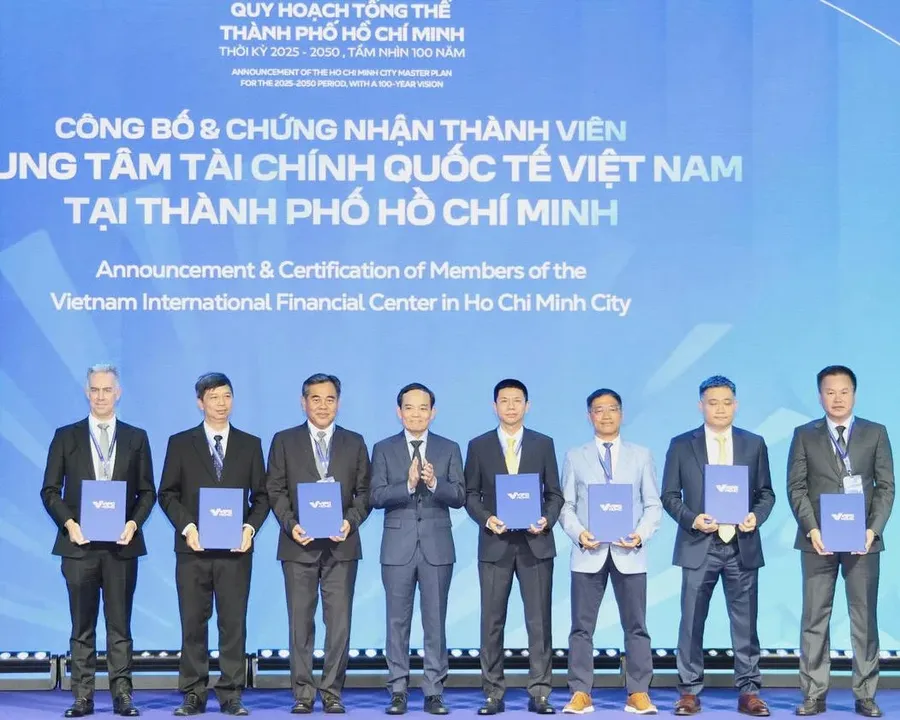
On the morning of Nov 23, the Vietnam International Financial Center in Ho Chi Minh City (VIFC-HCMC) announced seven new members. One of them is Buon Ma Thuot Coffee and Commodity Exchange (BCCE), a company planning to set up an exchange for coffee and other commodities. The name may lead coffee growers to expect a place to lock in prices at home soon. In practice, BCCE is at the start of its path to a license, while the other exchange-oriented member, IFC, already meets the minimum capital requirement.
This piece covers what the second batch of members adds, what a commodity exchange needs before its first trading session, and who could benefit if one gets there.
What the second batch adds that the first did not
The seven members were announced at the conference unveiling the Ho Chi Minh City Master Plan for 2025–2050, with a 100-year vision. Party Secretary of Ho Chi Minh City Trần Lưu Quang handed certificates to company representatives.VnExpress The group has combined initial charter capital of about USD 100 million and plans to raise USD 5 billion over 2027–2030.Đại Đoàn Kết
The first batch, announced in October, had 10 members with planned fundraising and investment of about USD 2.7 billion through 2027. Together the two batches give the center 17 members and roughly USD 7.7 billion in planned fundraising under announced plans.Đại Đoàn Kết The USD 7.7 billion adds up plans with different time frames. It is not money that has already arrived, and it is many times the charter capital the seven new members put in at the start.
The seven fall into three lines of activity.
Capital raising and arranging. Three companies make up this group. Vietnam Green Energy Investment Holding JSC, owned by Dragon Capital, starts with USD 1 million of charter capital, planned to rise to USD 55 million by 2027.VietnamFinance It aims to raise USD 150–250 million by 2030 for renewable energy projects.VnExpress Mekong Capital VIFC Limited, owned by Mekong Capital Partners, expects to raise USD 342 million. Charming Land Vietnam, a member of Singapore investment fund CMIA Capital Partners, will arrange more than USD 400 million over 2027–2035 for a portfolio of urban areas and integrated industrial parks.VietnamFinance
Commodity exchanges. This is the new part of the second batch: Vietnam International Commodity Exchange IFC Co., Ltd. (a single-member company) and BCCE. Both are, for now, exchange plans.
Advisory and technology. 3V Advisors International, owned by 3V Partners, manages the Vietnam Go Global Fund I with a target size of USD 300 million. Corvia Technology is a technology company within the Military Commercial Joint Stock Bank (MB) ecosystem, working on digital finance, cybersecurity, customer identification and anti-money-laundering solutions.VietnamFinance
What an exchange needs before its first trade
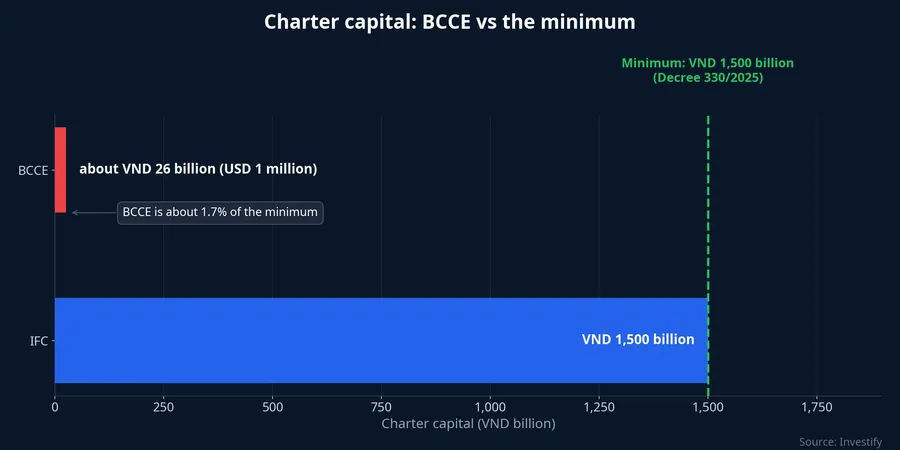
The first requirement is capital. Decree 330/2025/ND-CP, on the establishment and operation of commodity exchanges within the international financial center, sets minimum charter capital of VND 1,500 billion for a company setting up an exchange.LuatVietnam
The two companies stand at different starting lines. IFC already has charter capital of VND 1,500 billion, exactly the minimum from the day it entered the center. According to Tuổi Trẻ, it plans to build a commodity and derivatives trading platform linked to clearing, logistics, delivery and trade finance.Tuổi Trẻ
BCCE starts with USD 1 million of charter capital. At the Nov 23 rate of VND 25,834 per dollar, that is about VND 26 billion, or roughly 1.7% of the minimum. The company has set out a roadmap to raise capital to at least VND 1,500 billion in 2027–2028 so it can qualify to apply for an exchange license. Once operating, BCCE aims to run centralized trading of coffee, pepper, natural rubber and silver, with a reference-price mechanism and derivatives so exporters, importers and producers can hedge price risk.VietnamFinance
On this roadmap, the earliest point at which BCCE could file for a license is 2027–2028. An exchange carrying the Buon Ma Thuot coffee name is therefore a story for the years ahead, not for the current harvest.
The second requirement is payment infrastructure inside the center. VIFC-HCMC says it will finalize the rules and legal procedures to consider licensing members in banking, securities and asset management in the fourth quarter, and will help licensed members register for tax codes and open capital accounts.VnExpress That milestone is not aimed at commodity exchanges. Still, any trading in the center needs accounts and payment channels, so progress on bank licensing is a baseline condition for the other members.
The third is the legal framework for the whole market. The draft Law on Commodity Derivatives Trading has been submitted to the National Assembly for comment at its second session. According to Vietnam Financial Times on Nov 23, the draft will be refined further and submitted for review and passage at the third session in 2027.Vietnam Financial Times Exchanges inside the financial center already rest on Decree 330/2025. The new law, if passed, would become the common framework for all commodity derivatives trading in the country.
Where coffee growers lock in prices today
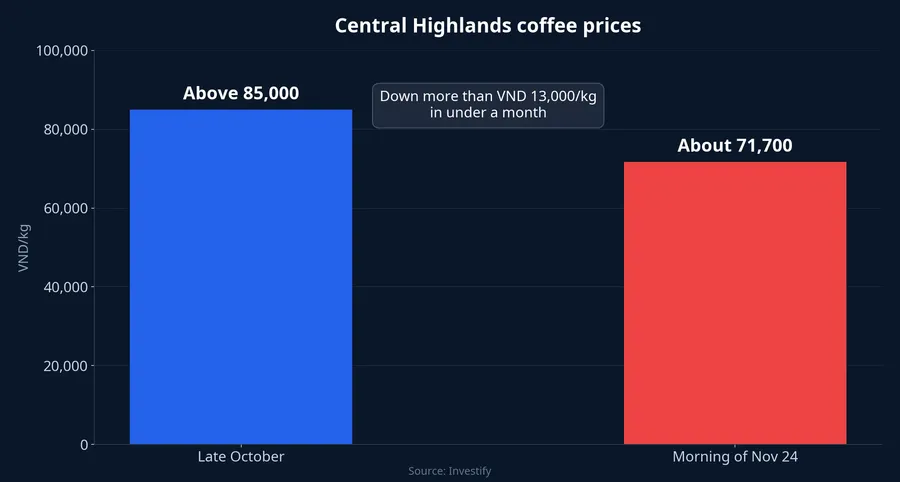
Central Highlands coffee was quoted at VND 71,000–71,800 per kg on the morning of Nov 24, against a common level of more than VND 85,000 per kg in late October.Báo Lào Cai More than VND 13,000 a kilogram has gone just as the harvest picks up, when growers must choose between selling now and waiting for a rebound.
Robusta is a commodity where Vietnam has a large supply advantage, yet London prices are still widely used as the reference for many export contracts.Tuổi Trẻ On the evening of Nov 23, London Robusta for January 2027 traded around USD 2,882 per tonne. Purchase prices in Đắk Lắk or Gia Lai follow that level, plus the exchange rate and quality differentials.Báo Lào Cai
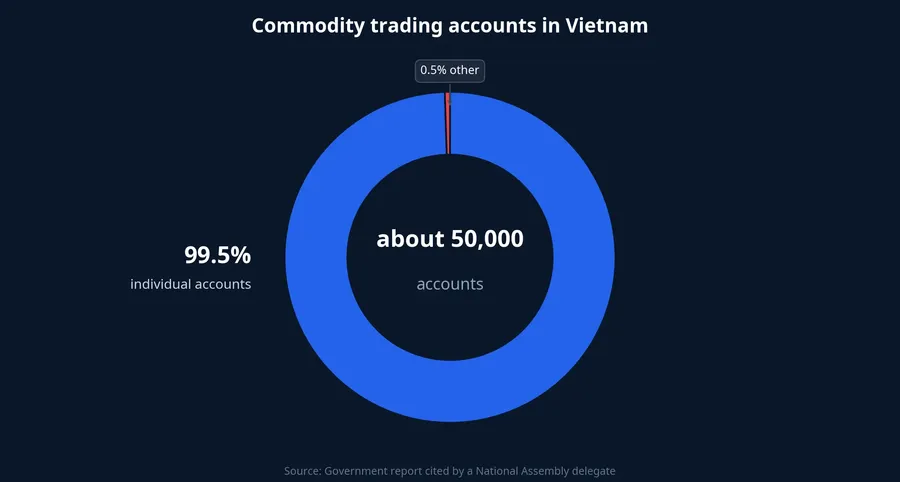
Domestic commodity trading channels already exist. According to a Government report cited at the session by National Assembly delegate Trần Hoàng Ngân, the country has about 50,000 commodity trading accounts, of which 99.5% belong to individuals, mostly trading short term rather than hedging production risk.Tuổi Trẻ In other words, price-locking tools are present in Vietnam, but coffee growers are not their main users.
Barriers for farm households were also raised on the floor. Tráng A Dương, National Assembly delegate for Lào Cai province, said producers, especially ethnic minority communities, still face barriers in capital, technology, language and trading procedures. Thạch Phước Bình, National Assembly delegate for Vĩnh Long province, argued that not every household needs to trade on an exchange directly: cooperatives and companies that buy, process and export can act as the bridge.Tuổi Trẻ
That points to who could benefit first if an exchange in the center reaches real trading. Exporters and purchasing companies have the capital and scale to use forward contracts. Cooperatives come next. Small growers benefit indirectly, if buyers lock in output prices and can therefore offer steadier pre-harvest purchase prices. This is an inference from today's user mix, not an observed result.
The distinctive value a domestic coffee exchange could add is a reference price that reflects Vietnamese beans rather than relying on London. The 2026–2030 development orientation for the commodity derivatives market targets about 10 domestically produced commodities in trading by 2030, with reference prices gradually formed for three to five of them, and Robusta coffee a priority product.Tuổi Trẻ
The milestones that will show when real trading arrives
Based on what has been announced, the conclusion is fairly clear. The second batch brings commodity-trading infrastructure into the center's plans, IFC meets the minimum capital on paper, and BCCE has a roadmap to reach it in 2027–2028. For anyone selling this season's coffee, though, how prices are set has not changed: London prices, the exchange rate and dealers' quotes still drive income.
Three milestones to watch:
- Q4 2026: VIFC-HCMC finalizes the licensing procedure for banking, securities and asset-management members.
- 2027: The National Assembly is expected to consider passing the Law on Commodity Derivatives Trading at its third session. In the same period, BCCE begins its capital-raising roadmap.
- The first license application: IFC already holds VND 1,500 billion of charter capital, so it may be the first to qualify. The filing date and the list of contracts attached will show how early the center's first commodity exchange arrives, and whether coffee is on that list.
VIFC-HCMC says it is aiming to bring the first commodity exchange into operation as soon as possible.Người Quan Sát The first license application and its contract list will be the basis for judging what "as soon as possible" means.