
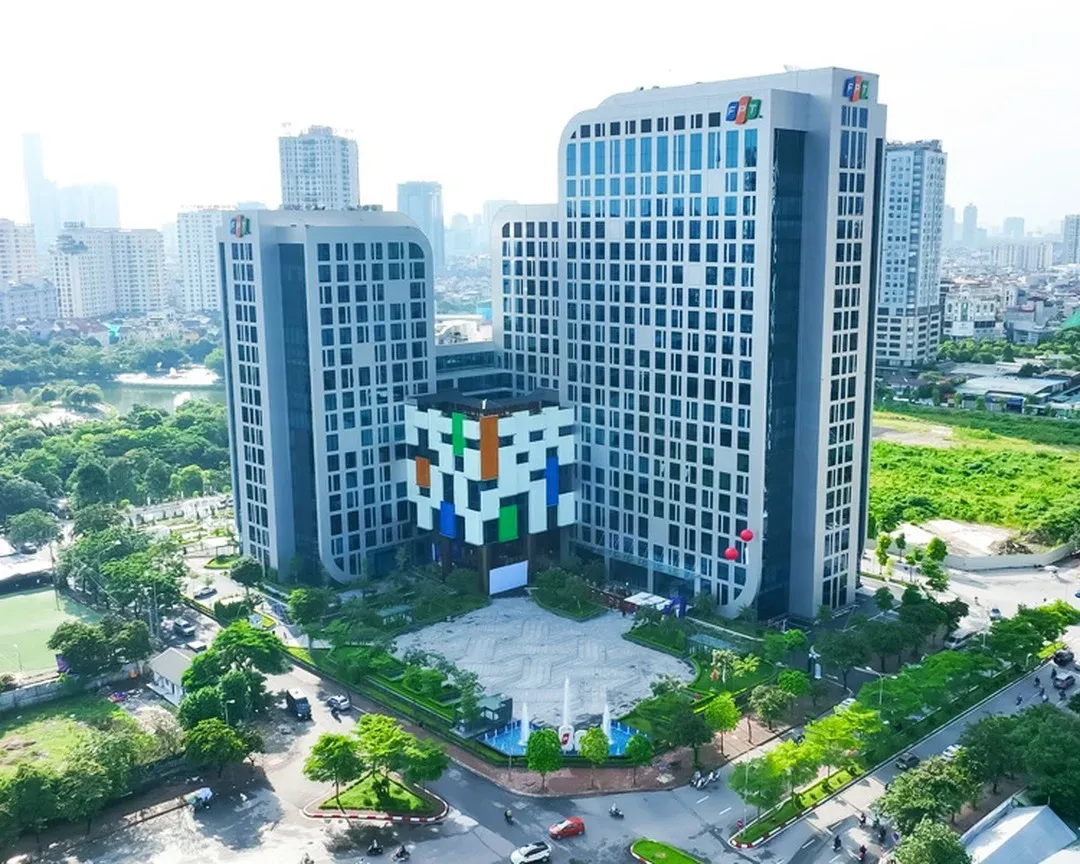

From the start of the year through the November 20 session, foreign investors net sold VND 120,892 billion on HoSE, about 95% of the full-year 2025 figure (VND 127,318 billion), with more than a month of 2026 still to go. The headline suggests selling pressure is intact. The shape of the selling, though, has changed: the November pace per session is only about a third of October's, while what remains is concentrated in FPT and five bank stocks. For anyone holding those names, a slowdown across the market is not necessarily a slowdown in their own stock.
Net selling is close to matching all of 2025
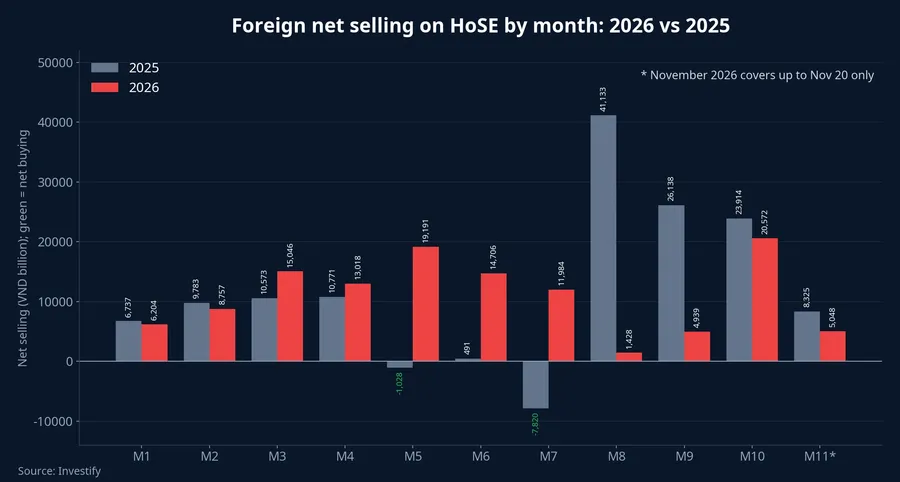
According to Investify's trading data, foreign investors bought VND 581,076 billion and sold VND 701,969 billion on HoSE through November 20, a net sale of VND 120,892 billion. Other outlets use different datasets, so their figures differ. VnExpress on November 22 reported net selling of nearly VND 127,000 billion (about USD 4.9 billion), above the VND 125,500 billion of 2025.VnExpress MarketTimes put it at VND 126,000 billion as of November 19.MarketTimes On either dataset the broad conclusion holds: 2026 is the fourth straight year of foreign net selling, and its scale already matches the heaviest year before it.
On November 23, foreign investors net sold another VND 425.31 billion on HoSE even as the VN-Index rose 0.49% to 1,697.14. The index remains about 12% below its May 18 peak of 1,927.94, in a month when foreigners net sold VND 19,191 billion.
The difference between the two years lies in how the selling was spread. In 2025 it piled into the third quarter: VND 41,133 billion in August and another VND 26,138 billion in September. In 2026 it has been more even. No month exceeded VND 21,000 billion, but every month from March to July was above VND 11,000 billion.
The selling is concentrated in a few large caps
Eight stocks (VHM, FPT, VIC, ACB, VCB, STB, HDB and VPB) together were net sold VND 83,886 billion so far this year, about 69% of total net selling on the exchange.
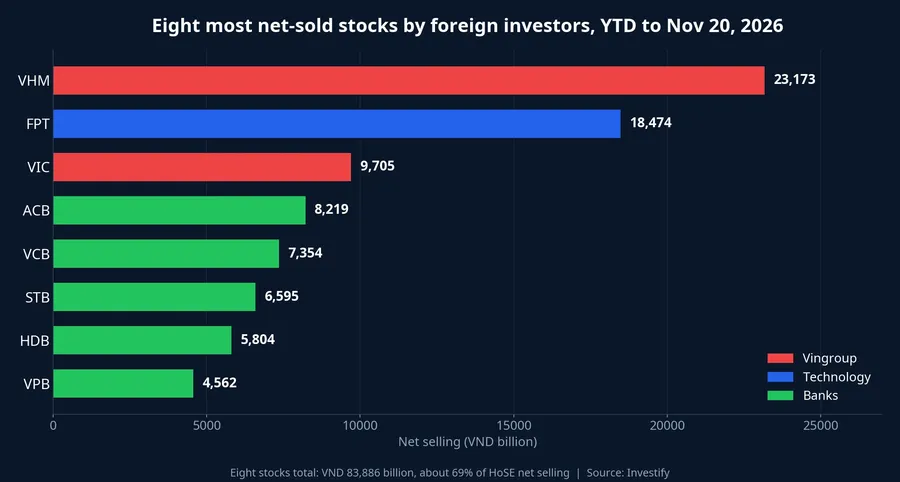
The Vingroup pair leads: VHM was net sold VND 23,173 billion and VIC VND 9,705 billion, a combined VND 32,878 billion, or about 27% of foreign net selling. The order has flipped from last year, when VIC was net sold VND 18,819 billion and VHM VND 9,460 billion.
FPT ranks second at VND 18,474 billion, more than the VND 11,629 billion of all 2025. That one stock accounts for about 15% of the total.
The five banks together were net sold VND 32,534 billion, close to VHM and VIC combined: ACB VND 8,219 billion, VCB VND 7,354 billion, STB VND 6,595 billion, HDB VND 5,804 billion and VPB VND 4,562 billion. For ACB and HDB, this year's selling is many times last year's, when they were net sold VND 1,877 billion and VND 1,313 billion respectively.
VnExpress cited estimates from some analyst groups that foreign ownership on HoSE has fallen below 11%, down about two percentage points year on year.VnExpress That is an estimate, not an official figure.
Why foreigners are selling: several forces at once
Brokerages and the press offer several explanations, and the available data cannot isolate which one accounts for most of the selling.
The first is global capital flows. An SSI report, cited by VnExpress, says the selling is consistent with money leaving many equity markets for bonds.VnExpress High US Treasury yields and a strong dollar make emerging-market equities relatively less attractive. In its November 23 weekly strategy report, VPBankS also noted capital leaving emerging Asia amid a strong dollar and a weaker dong.
The second is competition between markets. MarketTimes argues that international capital is flowing to markets that benefit from artificial intelligence and semiconductors, while Vietnam leans toward banks, real estate and consumer names, and is further held back by foreign ownership limits and a low free float in some large caps.MarketTimes
The third lies in how different funds behave. FireAnt on November 23 suggested active funds may be taking profits or restructuring portfolios, while index funds deploy on a schedule.FireAnt
One detail favors the first explanation: Vietnam is not being drained alone. By VnExpress's figures, South Korea saw outflows of more than USD 152 billion, Taiwan USD 93 billion, India USD 20 billion and Indonesia USD 5.6 billion. South Korea and Taiwan are the two markets that benefit most from the semiconductor wave, so heavy foreign outflows from both point to a regional force more than a Vietnam-specific problem. Even so, ownership limits and low free float still explain why Vietnam struggles to win capital back once that regional force eases.
Mr. Tran Hoang Son, Head of Market Strategy at VPBank Securities (VPBankS), was quoted by VnExpress as saying that persistent foreign net selling has held the VN-Index down for a long time.
November: slower across the market, concentrated in six stocks
In October 2026, foreigners net sold VND 20,572 billion, the heaviest month of the year on Investify's data (VnExpress, on its own dataset, reported about VND 24,000 billion). Spread over 22 sessions, that is an average of about VND 935 billion per session.
From the start of November through November 20, net selling was VND 5,048 billion over 15 sessions, an average of about VND 337 billion per session, or about 36% of October's pace. Including the November 23 session, the November average is VND 342.31 billion per session, and November 23 on its own was still above that average.
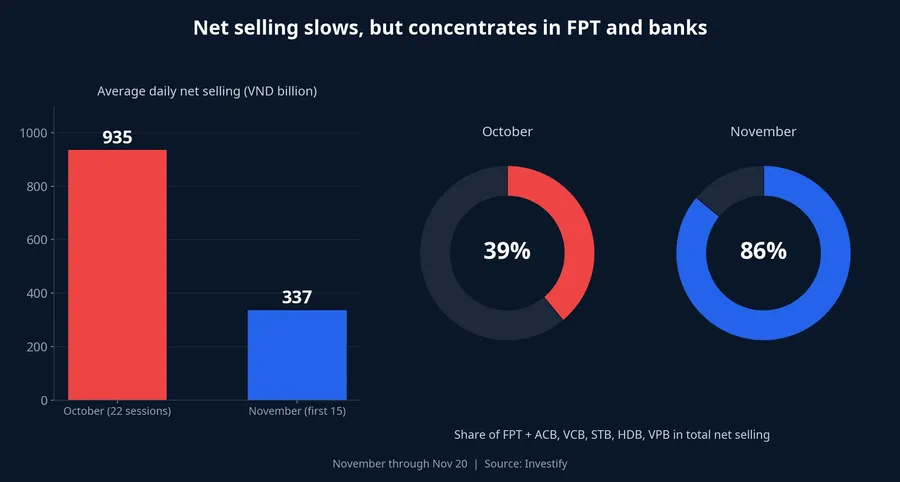
What stands out more is where the remaining selling went. In November through the 20th, FPT was net sold VND 1,990 billion, VCB VND 950 billion, ACB VND 607 billion, STB VND 464 billion, HDB VND 233 billion and VPB VND 110 billion. Together the six come to VND 4,354 billion, about 86% of the exchange's total net selling over the same period. In October the same six accounted for only about 39%.
Meanwhile VHM, the most-sold stock this year, turned to slight net buying of VND 12 billion in November, and VIC was net sold just VND 100 billion. FPT alone saw more selling in the 15 November sessions than in all of October (VND 1,875 billion).
In other words, the market-level slowdown mainly reflects much lower pressure on VHM, VIC and HDB. For holders of FPT and VCB, foreign supply in November has not eased at all from the previous month.
Upgrade-linked money has only partly arrived
FTSE Russell upgraded Vietnam to secondary emerging market status, effective September 21, 2026.Đại biểu Nhân dân Vietnamese stocks are being added to the index in four stages: 10% of weight from September 21, 2026, then 20% from March 22, 2027, 35% from June 21, 2027 and 35% from September 20, 2027.VCCI
Analysts cited by VnExpress estimate total upgrade-linked inflows at about USD 2.5 billion, with only around 10% in so far and the rest expected in 2027.VnExpress Set against the roughly USD 4.9 billion foreigners have net sold this year by the same source, the full USD 2.5 billion would offset only about half. The four-stage schedule also shows that index-tracking money arrives in steps, not all at once.
What to watch
The slowdown is real at the market level, but it is not enough to call the selling pressure over, because November is not finished and the November 23 session was still above the monthly average. What is clearer is that the center of selling has moved: away from VHM and VIC, and toward FPT and the large banks.
In early December, the full-month November net selling figure will show whether the average of about VND 340 billion per session held through the final sessions. At the same time, the share of FPT and the five banks in that figure will show whether foreign supply is dispersing or still bunched in a few names. The longer marker is the FTSE index inclusion on March 22, 2027, the first time upgrade-linked money will be measured by a purchase larger than September's.