

In the first nine months of 2026, BIDV (ticker BID) reported consolidated after-tax profit attributable to shareholders of VND 23,278 billion, up 25.5% year on year.Người Quan Sát The work for 2027 lies elsewhere: about VND 62,000 billion of mortgage balances will come up for repricing over the next 12 months, with rates expected to rise by roughly 2–3 percentage points.Người Quan Sát BIDV gave the figure at its November 11 investor meeting, and MB Securities (MBS) and SHS Research later summarized it in separate reports.Mekong ASEAN
Set beside the other numbers from the same meeting, the VND 62,000 billion is the first link in a chain. BIDV's margin sits below the sector norm, so it needs higher lending rates. The mortgage book coming off promotional pricing is also where retail bad debt is edging up, so the provision buffer needs to thicken. And a 2027 credit plan needs more capital, which makes the planned private placement of about 780 million shares the next link. Each link lands on someone: first the borrowers with mortgages, then the holders of BID stock.
Nine-month results: lending income is the biggest driver
In Q3/2026, consolidated after-tax profit attributable to BIDV shareholders reached VND 8,331 billion, up 39.3% year on year.Người Quan Sát Nine-month pre-tax profit was VND 29,483 billion, up 24.8%.Điện tử & Ứng dụng In the explanatory letter filed with its accounts, BIDV said profit rose on higher net interest income and a stronger push to recover written-off debt. In the nine months alone, recoveries on previously handled loans came to VND 8,296 billion.Điện tử & Ứng dụng
Looking inside Q3, net interest income was VND 17,056 billion, up 12.4%.Mekong ASEAN Credit-risk provision expense for the quarter was VND 4,640 billion, down 25% year on year. By our calculation from the quarterly figures, Q3 pre-tax profit rose by about VND 2,985 billion, of which net interest income contributed roughly VND 1,883 billion and lower provisions roughly VND 1,545 billion. Lending income remains the largest contributor. The provision cut is also material, and under the full-year plan it is due to reverse in Q4.
Link one: the margin and VND 62,000 billion of mortgages
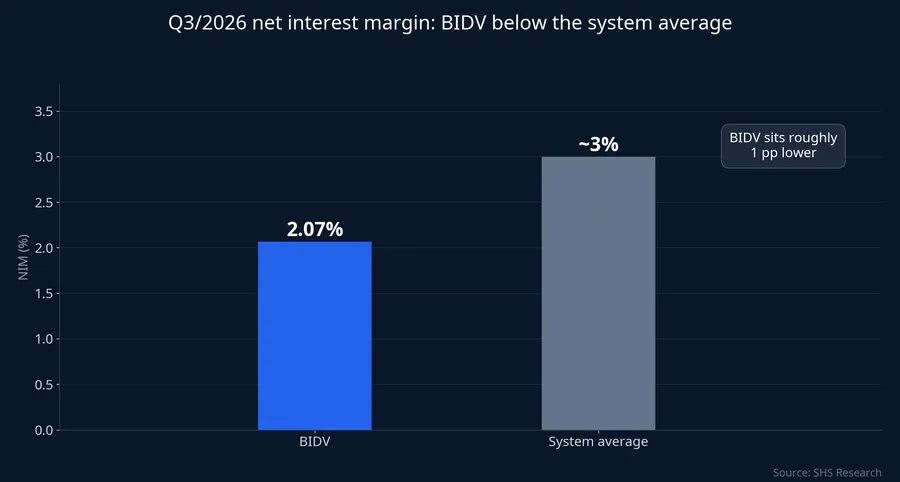
According to SHS Research, BIDV's Q3 net interest margin (NIM) was 2.07%, flat on Q2, against a system average of about 3%.Người Quan Sát Brokerages calculate NIM in different ways. Vietcap puts it at 2.01%, down 3 basis points year on year.Fireant On either measure, BIDV's margin is about one percentage point below the sector norm.
BIDV expects its margin to improve in Q4 and in 2027 from three sources: more low-cost deposits, a larger share of medium- and long-term lending, and mortgages moving from promotional to floating rates.CafeF The third is the VND 62,000 billion. At the end of Q3, BIDV's mortgage book stood at about VND 341,000 billion, down nearly VND 4,000 billion from the prior quarter. New disbursements in the quarter were about VND 14,000 billion, below total repayments of about VND 18,000 billion.Người Quan Sát About 65% of mortgage balances are still in the promotional period and 35% have already moved to floating rates.
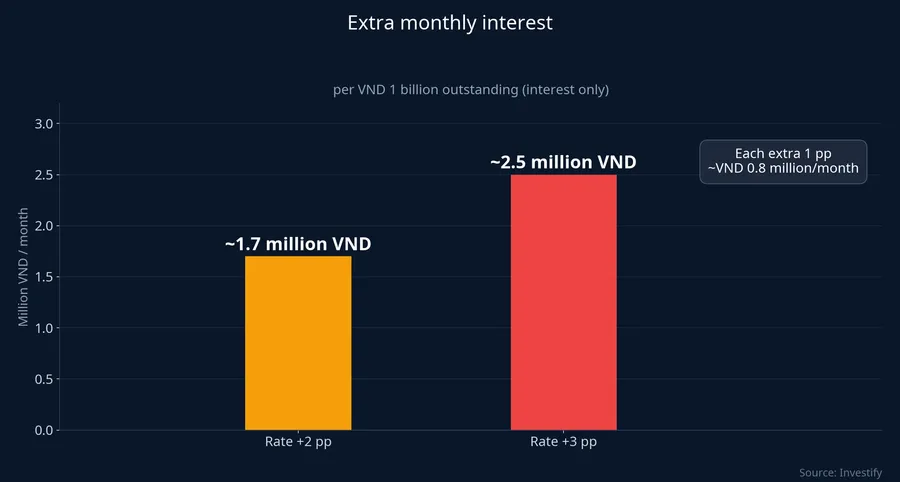
For borrowers the arithmetic is simple. Each extra percentage point adds roughly VND 10 million a year in interest on VND 1 billion of debt. A 2–3 point rise therefore means about VND 20–30 million a year per billion owed, or roughly VND 1.7–2.5 million a month, before principal. A household with VND 2 billion outstanding would pay about VND 3.3–5 million more in interest each month.
On the bank's side, the same arithmetic says that repricing VND 62,000 billion could bring in roughly VND 1,240–1,860 billion more interest a year, provided every loan keeps being repaid on time.
Link two: where retail bad debt is edging up
"Repaid on time" is the condition to watch. At the meeting, BIDV's management said bad debt in the mortgage book tends to rise as the 2023–2025 rate-support programs run out.Người Quan Sát The retail bad-debt ratio rose from 0.95% at end-2025 to 1.22% at the end of Q3, mainly from mortgages and business loans.CafeF
Retail needs to be put in proportion. Per SHS, corporate clients account for about 69% of bad debt, concentrated in construction, building materials and trade. The bad-debt ratio is about 3% for large corporates, 2.26% for small and mid-sized businesses and 1.22% for retail.Người Quan Sát Mortgages are therefore not the biggest source of bad debt. But they are the group about to see higher rates, so the same loans are both a source of extra income and a place where new bad debt could form.
BIDV cites three reasons for the pressure on asset quality: the bank reclassified loans using data from the National Credit Information Center (CIC), some customers' cash flow and repayment capacity weakened, and loans once restructured under Circular 02 moved groups after that mechanism expired.CafeF The bad-debt ratio under Circular 31 is 1.58%, close to the 1.6% ceiling the bank set for itself in 2026. On consolidated accounts, the group 3–5 ratio is 1.85%, up from 1.47% at end-2025.Mekong ASEAN
The buffer: provisions set aside have been used to resolve loans
The loan-loss coverage ratio, meaning provisions per dong of bad debt, fell from 99.9% at end-2025 to 73.4% at the end of Q3.CafeF The reason lies in two figures that are nearly equal. Over nine months, provision expense booked was VND 15,959 billion,Mekong ASEAN and BIDV used VND 16,013 billion of provisions to resolve loans.Điện tử & Ứng dụng The customer-loan provision balance therefore barely moved, at about VND 34,900 billion, while group 3–5 debt rose to VND 47,486 billion, up 35.8% from the start of the year. The denominator grew, the numerator stood still, and coverage fell.
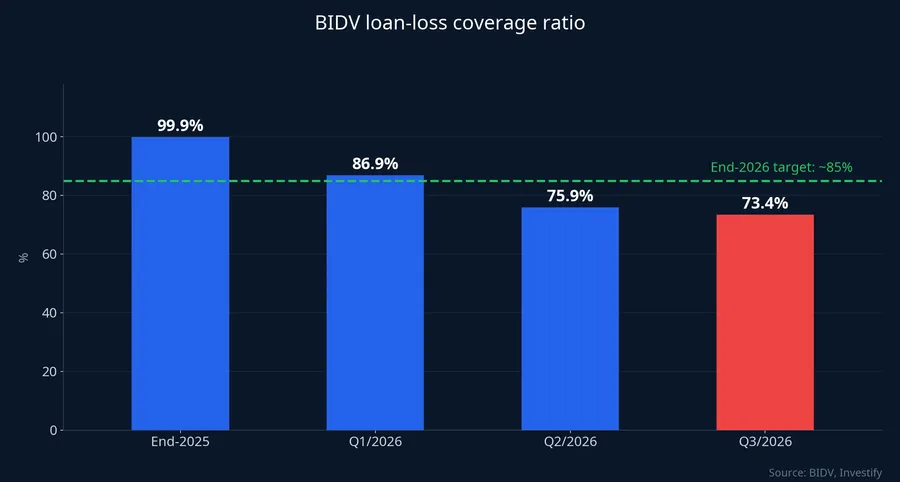
BIDV aims to lift the ratio to about 85% by end-2026. If bad debt stays at VND 47,486 billion, the provision balance would need to reach about VND 40,400 billion, or roughly VND 5,500 billion more. That is what has to stay in the reserve. The charge through the income statement is larger still, because the bank keeps using provisions to resolve loans.
According to MBS, BIDV's full-year 2026 provision budget is about VND 25,200 billion. After nine months, what remains works out to about VND 9,300 billion in Q4, double Q3's VND 4,640 billion.Mekong ASEAN SHS estimates Q4 provisions at VND 8,000–9,300 billion, 1.7–2 times Q3. On that assumption, SHS projects Q4 consolidated after-tax profit of about VND 7,800 billion, down 32% year on year, and full-year profit of about VND 31,049 billion, up 3.8%.Người Quan Sát This is a brokerage projection, not a BIDV plan, and MBS notes that actual costs depend on the pace of new bad debt, recoveries and collateral disposals.
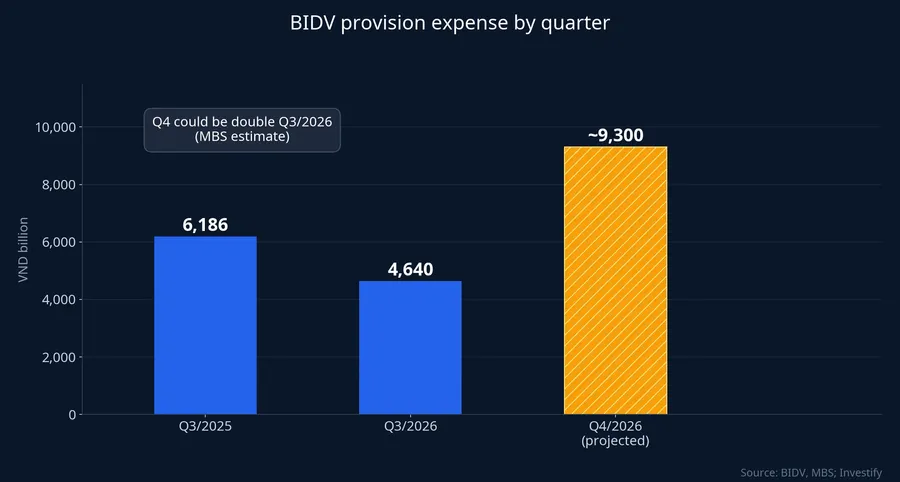
One point needs reading carefully: lower Q4 profit because of heavier provisioning is not the same as lower profit because the business is weakening. SHS records Q3 pre-provision profit up 10.4% year on year. The large Q4 charge is the bank putting money into its buffer, not operating income falling.
Link three: capital for 2027 credit growth
By the end of Q3, BIDV's credit had grown 8% from the start of the year, while the State Bank's full-year 2026 quota is 10.7% and the system has grown about 11.7%. BIDV says its slower pace than some private banks is not because disbursement is restricted, but because it prioritizes capital efficiency and customers' repayment capacity.CafeF For 2027 the bank is drafting a credit plan of about 16%, with no formal target set. According to SHS, the detailed plan awaits board approval, and the actual quota is still the State Bank's call.Người Quan Sát
Lending more takes more equity. BIDV's consolidated capital adequacy ratio at the end of Q3 was 10.13%, up about 0.8 percentage points from end-2025, and its Tier 1 ratio was 7.14%. The bank is also preparing to adopt the Basel III standardized approach from Q1/2027.CafeF SHS records a plan to add about VND 30,300 billion of equity in 2027, alongside roughly VND 25,000–28,000 billion of senior bonds expected over the next two years.
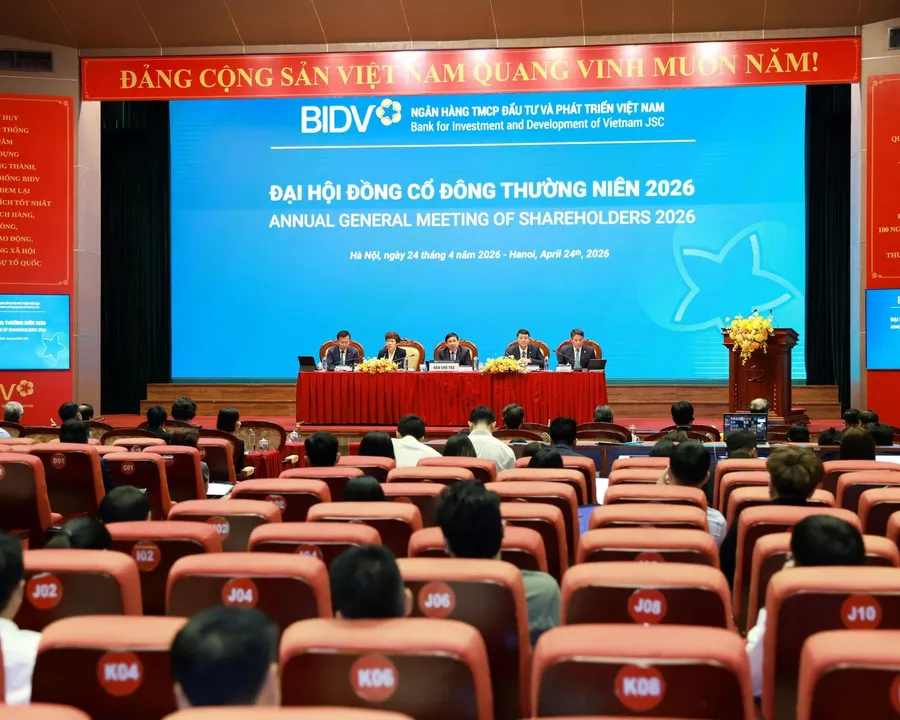
The equity link is a private placement of about 780 million shares, equal to 10.71% of the shares outstanding at the end of Q1/2026. The shareholders' meeting has approved the plan, to be carried out over 2026–2027, with no completion date yet.CafeF For reference, the previous placement closed on March 24, 2026, selling 258.7 million shares at an average price of VND 38,900 and raising more than VND 10,000 billion.VCCI
For existing shareholders, the dilution math rests on shares currently outstanding. After the August bonus issue, BIDV has about 7.78 billion shares. If all 780 million are sold, the share count rises about 10%, and anyone who does not take part in the placement sees their stake fall about 9.1%, for example from 0.010% to roughly 0.0091% of the bank. In return, the new capital gives the bank more room to lend. Whether the dilution is worth it depends on the issue price against book value and on whether 2027 profit grows fast enough to keep pace with the share count.
Who bears the impact, and what to watch
The three links rest on one assumption for BIDV's 2027: that mortgage borrowers can afford the higher rate. If that holds, repricing the VND 62,000 billion both lifts the margin and avoids a fast rise in retail bad debt, and the Q4 provisions settle into the buffer. If the retail bad-debt ratio keeps climbing as promotional periods end, the extra interest income will have to cover more provision expense.
For existing BIDV mortgage borrowers the effect is direct: when the promotional period ends, each VND 1 billion owed costs about VND 1.7–2.5 million more in interest a month if rates rise by exactly 2–3 points. For BID holders, Q4 is projected to show lower profit year on year because of provisioning, against nine-month growth of 25.5%, and stakes will dilute once the 780 million-share placement completes.
The Q4/2026 financial statements will answer most of these questions. Whether the coverage ratio approaches 85% shows whether the buffer has thickened again. The retail bad-debt ratio against 1.22% shows whether borrowers can pay the new rates. The margin against about 2.07% shows whether the VND 62,000 billion has begun to contribute. The price, buyers and timing of the 780 million shares will appear in BIDV's placement-results announcement.