
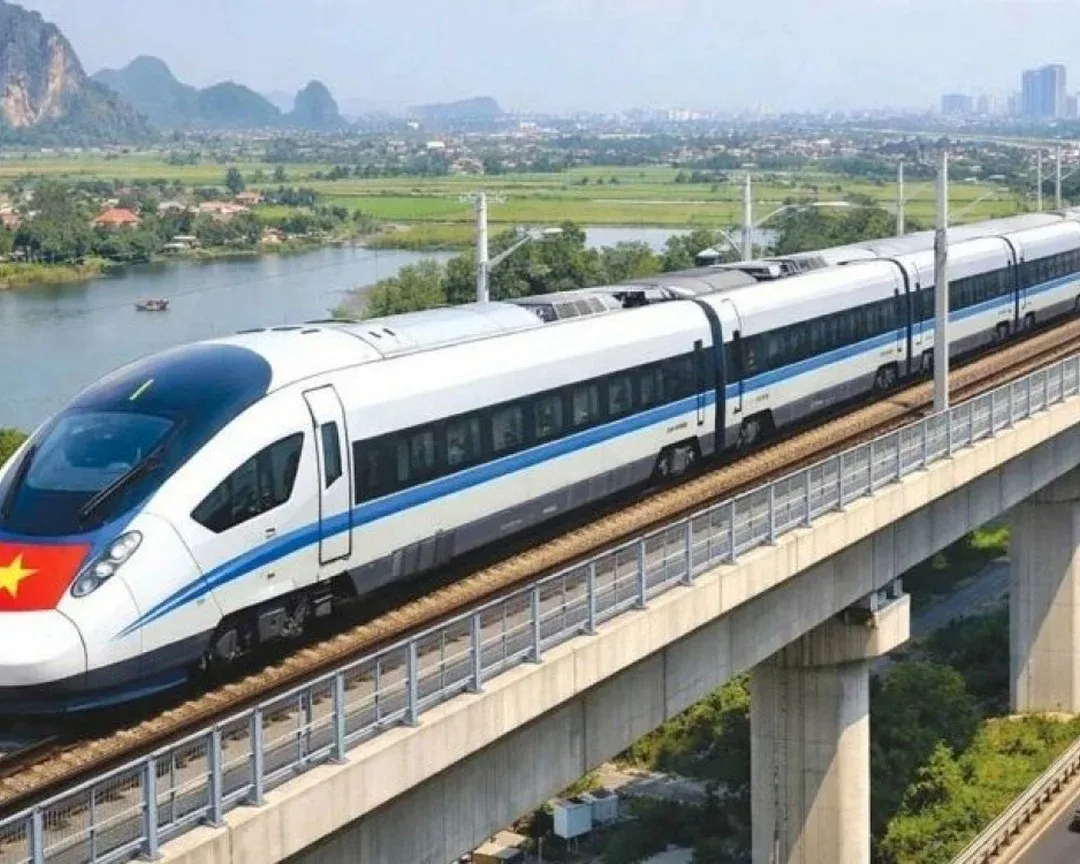

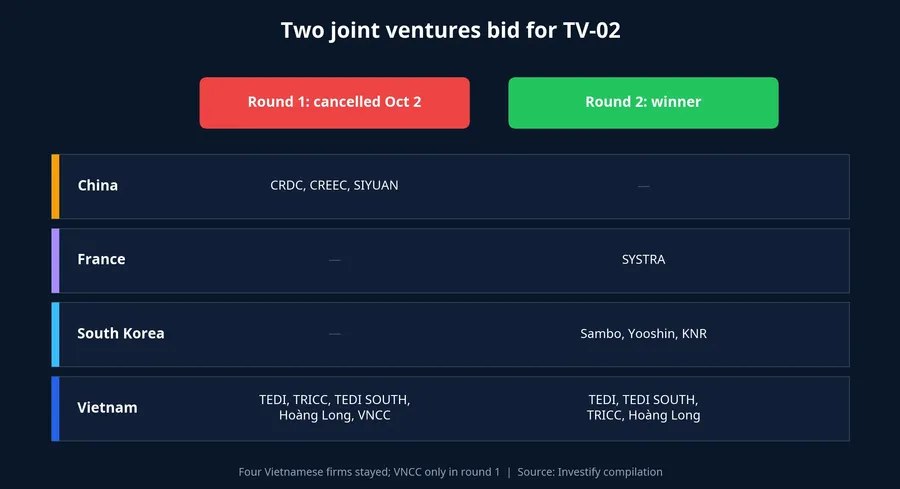
On November 22, 2026, the Thang Long Project Management Board (Ministry of Construction) announced it had selected a contractor for package TV-02, the key consulting package in the preparation stage of the North–South high-speed railway. Under Decision No. 3456/QĐ-BQLDATL, a Vietnam–France–South Korea joint venture won the package at about VND 10,243.4 billion, with a 30-month delivery period.Thời báo Tài chính Việt Nam The result comes after a cancelled bid in early October.
First, what this is: a consulting package. The venture will carry out surveys, prepare the feasibility study, the front-end engineering design (FEED) and the tender documents. It is not a contract to build the line, supply trains or run services. That is why the package's place in the preparation chain matters more than its headline price.
Six months in the life of package TV-02
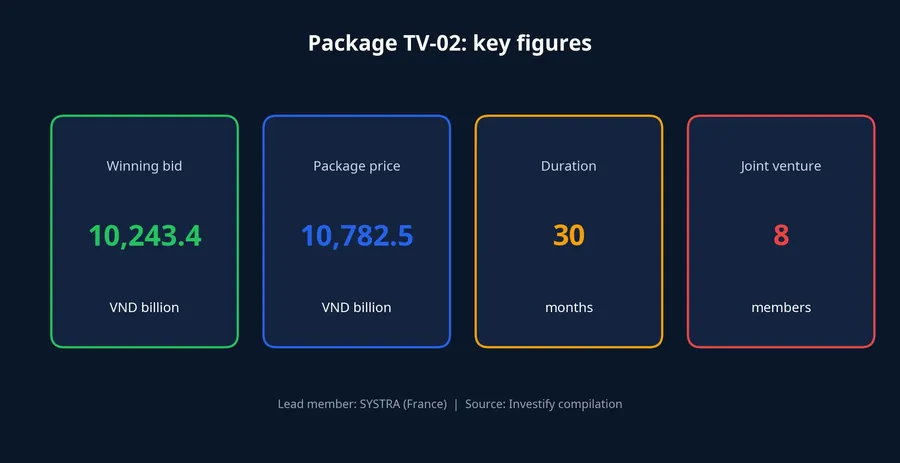
On May 15, 2026, the board held a briefing on TV-02 to sound out the market. More than 80 consulting firms from Vietnam and abroad attended, from Japan, China, Germany, France, Spain and Taiwan (China).Thời báo Tài chính Việt Nam Against that level of interest, the outcome of the first round stands out.
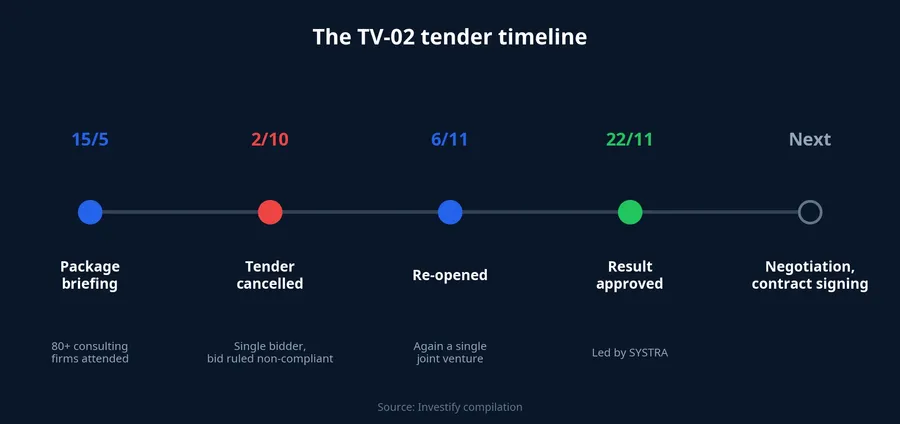
In that round, only one eight-member joint venture bid: three Chinese firms (China Railway Design Corporation, China Railway Eryuan Engineering Group and China Railway Siyuan Survey and Design Group) and five Vietnamese ones (TEDI, TRICC, TEDI SOUTH, Hoàng Long and Vietnam National Construction Consultancy, VNCC). The evaluation found the bid did not fully meet the validity requirements under Clause 1.2, Section 1, Chapter II of the request for proposals, and on October 2, 2026 the board cancelled the tender.Báo Đấu thầu On October 20 it cancelled package TV-05 (environmental impact assessment) as well, because the bids did not meet technical requirements.
The proposals were opened again on the morning of November 6. At the 9 a.m. closing time there was again just one eight-member joint venture: four foreign contractors and four domestic ones. The investor's representative said then that it would aim to finish the selection in about a month.Thời báo Tài chính Việt Nam It came faster: the approval decision was published 16 days after the proposals were opened.
Who stayed, who was replaced
The winning venture is led by SYSTRA (France). The three Korean members are Sambo Engineering, Yooshin Engineering and Korea National Railway (KNR). The four Vietnamese members are Transport Engineering Design Inc. (TEDI), TEDI SOUTH, Transport Investment and Construction Consultant JSC (TRICC) and Hoàng Long Construction Consultancy JSC.VietnamPlus
Set beside the venture cancelled in October, the change is clear. The whole foreign group was swapped: three Chinese firms left, replaced by one French and three Korean firms. On the Vietnamese side, four of the five stayed; only VNCC dropped out.
The Korean side reads this as the result of government-to-government lobbying. According to Vietnam Finance, citing Chosun Biz, South Korea's Ministry of Land, Infrastructure and Transport (MOLIT) sent a delegation to Vietnam in June 2026 to support Korean bidders, and the transport minister visited in July carrying a letter from the Korean president.Vietnam Finance That is Seoul's reading. There is no basis here to rank its weight against other factors in the evaluation.
On price, the winning bid is about VND 539 billion, or roughly 5%, below the package price of about VND 10,782.5 billion.VietnamPlus The contract has two parts: surveys at fixed unit prices, and the feasibility study, FEED and tender documents on a lump-sum basis. CafeF, citing Korean media, reports that of the 30 months the venture expects to spend 18 on the feasibility study and the next 12 on FEED.CafeF
What the package produces
The venture must deliver three products.Thời báo Tài chính Việt Nam
The feasibility study. This is the document on which the investment decision rests. Its findings on technology, investment options, finance and project performance are also used to assess whether non-state capital, including public-private partnership (PPP), can be raised, if the project meets the tests on returns and payback.
The front-end engineering design. This design goes deeper than the feasibility study and is the technical base for the construction packages.
The tender documents. These prepare the construction packages that come later. Put differently, how the construction work is split and what is demanded of the builders will come out of this same venture.
The package also covers surveys for land clearance, with more than 10,000 hectares expected to be surveyed across many localities along the route.CafeF Land clearance is split into standalone projects decided by the people's committees of the provinces and cities the line crosses, due to finish in Q4 2028.VietnamPlus
VND 10,243 billion next to VND 1.7 quadrillion
The line runs about 1,541 km from Ngọc Hồi station (Hanoi) to Thủ Thiêm station (Ho Chi Minh City) through 15 provinces and cities. It is double-track, 1,435 mm gauge, with a 350 km/h design speed, 23 passenger stations and 5 freight stations. Preliminary total investment is VND 1,713,548 billion, about USD 67.34 billion.Thời báo Tài chính Việt Nam
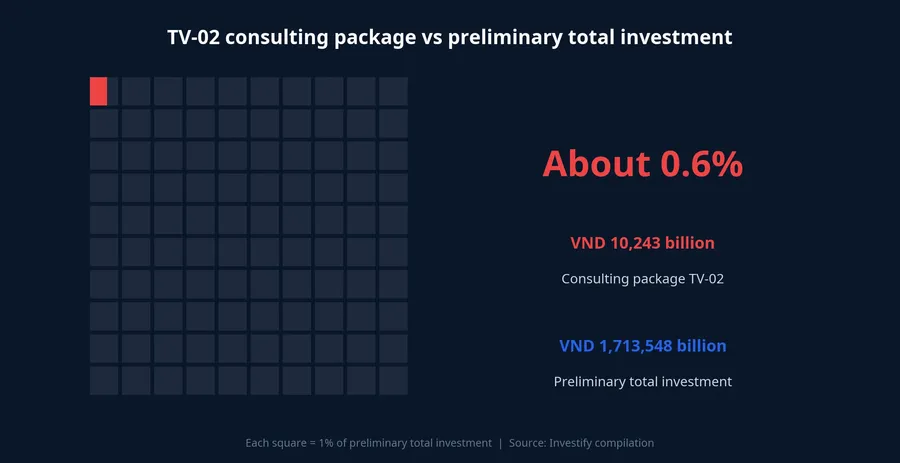
Put side by side, the TV-02 winning price is only about 0.6% of preliminary total investment. A small share, but the package matters far more than that share suggests. How the construction packages are split, how the money is raised and the other figures of the project will be recalculated in the feasibility study this venture prepares. The VND 1.7 quadrillion figure is therefore still a preliminary one, set at the investment-policy stage.
For anyone who owns land along the route, the point to remember is that the alignment and the location of each station will only be settled as the feasibility study is prepared, appraised and approved. Station sites cannot yet be treated as final.
The Vietnamese members and the TED stock
Of the four Vietnamese members, TEDI is the one with a traded stock, ticker TED on UPCoM. TED stood at VND 106,100 per share in the November 20 session, when no shares were matched.
Mr. Phạm Hữu Sơn, Chairman of the Board of Transport Engineering Design Inc. (TEDI), said Vietnamese contractors, TEDI in particular, will take on a relatively large workload under TV-02, having built up experience designing the Hanoi–Quảng Ninh high-speed line.Thời báo Tài chính Việt Nam Even so, the VND 10,243 billion belongs to the whole eight-member venture, so it cannot be turned into one company's revenue. The contract runs 30 months, and each member's share would be recognized gradually as work progresses.
For infrastructure and materials stocks, this result opens no construction package yet. Those packages are only tendered after the venture finishes the tender documents.
The milestone to watch: contract signing
After the contractor selection result was announced, the winning venture and the Thang Long board will negotiate, and the outcome of that negotiation is the basis for signing the contract. On the approved schedule, preparing, appraising and approving the feasibility study and starting construction fall between Q4 2026 and Q4 2028.VietnamPlus
That window has to be read together with the contract's 30 months. If the venture uses the full 18 months for the feasibility study as expected, the rest of the schedule will be tight, and the signing date decides when the 30-month clock starts.
The thesis here is that TV-02 is small in money but large in role: it lays no track, yet it writes the documents that decide how the construction work is split and where the stations go. The signing of the contract after negotiation is therefore the first signal to watch, well before any construction package.