
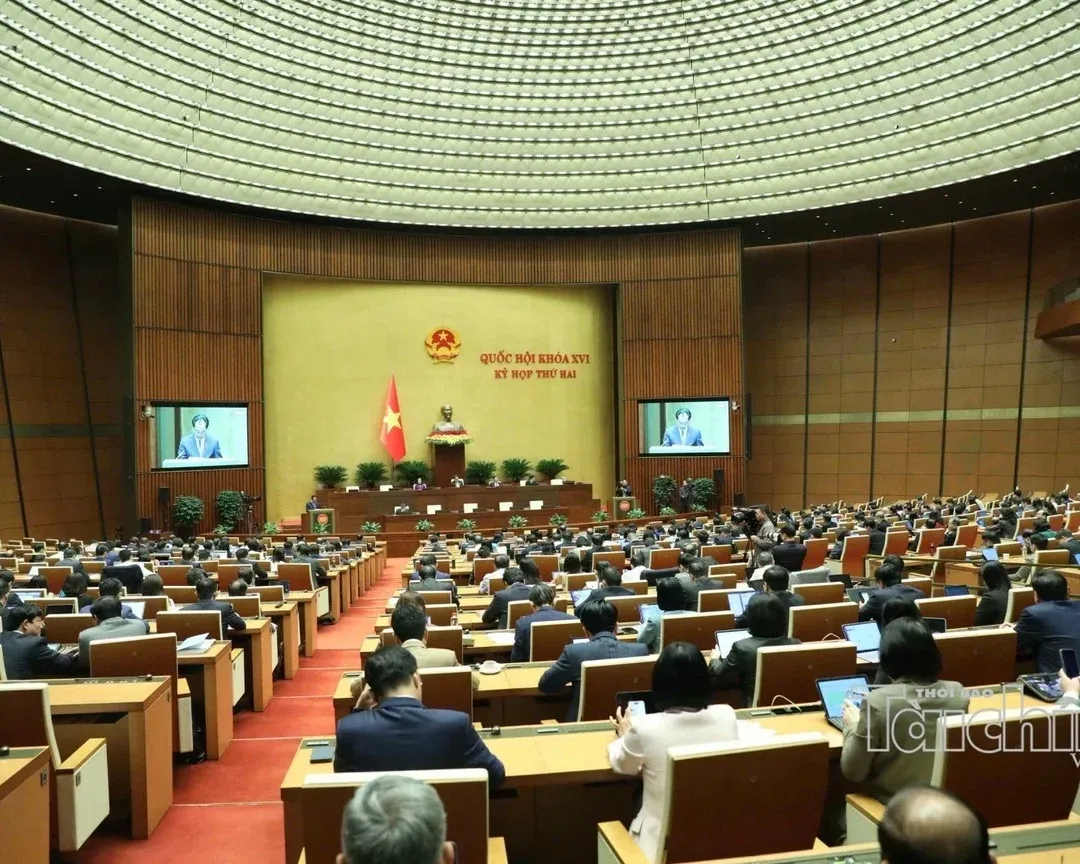

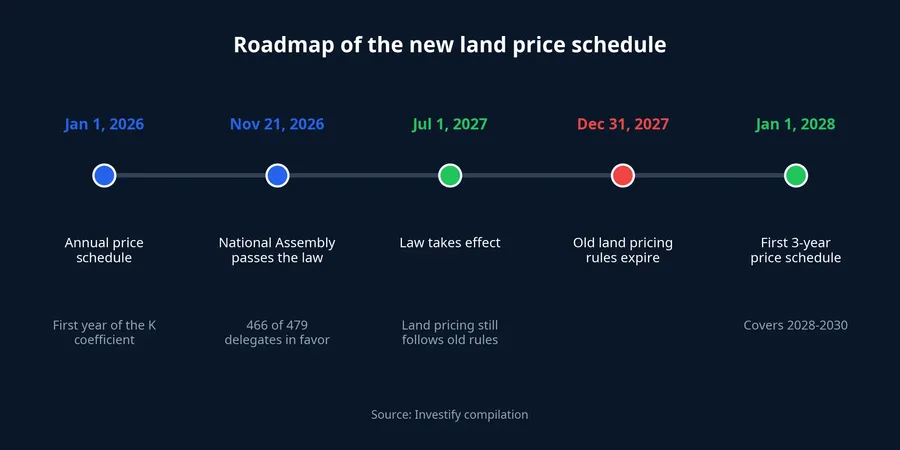
On the morning of Nov 21, 2026, the National Assembly passed the amended Land Law, with 466 of the 479 delegates present voting in favor.Thanh Niên The law has 13 chapters and 112 articles and takes effect on Jul 1, 2027.Người Quan Sát Among its many changes, the one that reaches straight into people's pockets is the new rhythm for land price tables. From Jan 1, 2028, provincial People's Councils will set the land price table and the land price adjustment coefficient (the K coefficient) once every 3 years, instead of annually as today.Báo Đầu tư
The table is more than a reference number. It is the basis for land use fees when land changes purpose or receives a title, for the starting price in land auctions, and for compensation when the State recovers land. So the practical question for anyone who owns land is this: between now and 2028, which table applies to my money, and when the table stays still for three years, who gains and who loses?
2026: Annual tables, first year of the K coefficient
Under the 2024 Land Law, provincial People's Councils set, adjust and amend the land price table every year, for application from Jan 1 of the following year.Người Quan Sát 2026 is also the first year of the K coefficient, a multiplier applied to the table price to produce the price used to compute financial obligations.FireAnt
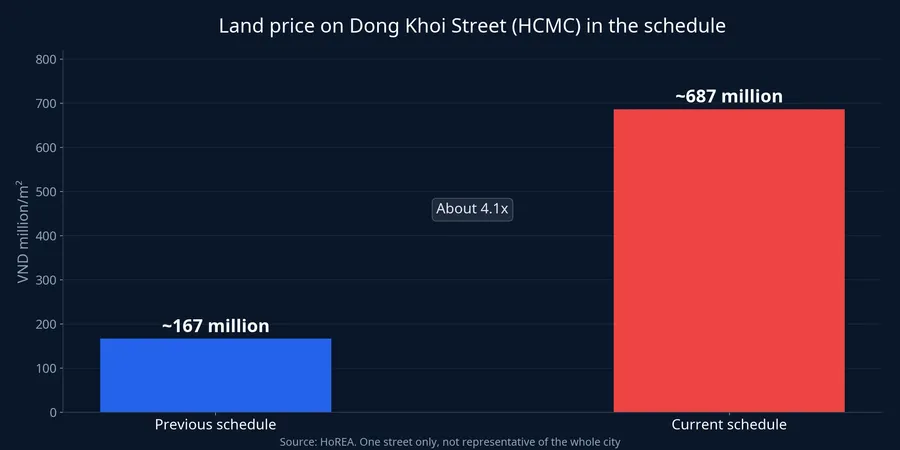
On some streets, the table now in use already differs sharply from the old one. Mr. Lê Hoàng Châu, Chairman of the Ho Chi Minh City Real Estate Association (HoREA), cited Đồng Khởi Street: the table price is now about VND 687 million per square meter, against about VND 167 million before.FireAnt That is one street among the most expensive, not a citywide average. Still, it shows how much the amount owed or received can shift when a table is replaced.
Nov 21, 2026: The Assembly moves to a 3-year cycle
Under the new law, land prices are set by the State. The law drops the concept of specific land prices and the consulting firms that determined them.Người Quan Sát
The table is built by land type, area and location. The K coefficient is the percentage increase or decrease applied to land prices where area, location, infrastructure or planning differ.Thời báo Tài chính Both are decided by provincial People's Councils.
Three years does not mean fully frozen. Under the law, the table and the K coefficient can be reviewed, amended, supplemented and adjusted up or down for state land management and pricing needs, or when infrastructure, planning, administrative boundaries, area names, locations or street names in the table change.Báo Đầu tư
Through Dec 31, 2027: The old pricing rules keep running
Before the vote, Minister of Agriculture and Environment Trịnh Việt Hùng presented the report on incorporating and responding to delegates' comments. According to the Minister, the table under the new law is issued for application from Jan 1, 2028, while the land pricing rules in the 2024 Land Law and Resolution 254/2025/QH15 continue to apply to cases through Dec 31, 2027.Thời báo Tài chính
That creates a notable overlap. The law takes effect on Jul 1, 2027, yet for land pricing the second half of 2027 still runs on the old rules, because the implementation clause separates the start date of the table and K coefficient from the law's general effective date.Thời báo Tài chính For anyone about to pay land use fees, bid at an auction or hold land inside a recovery zone, all of 2027 still follows the current annual rhythm.
The law also opens the door to land titles for people who were often stuck: those using land without papers since before Jul 1, 2014, and those who received a transfer before Aug 1, 2024 but never registered it, if conditions are met.Người Quan Sát These cases owe land use fees (which can be recorded as debt on request), so the title date and the table date travel together.
From Jan 1, 2028: One table for three years
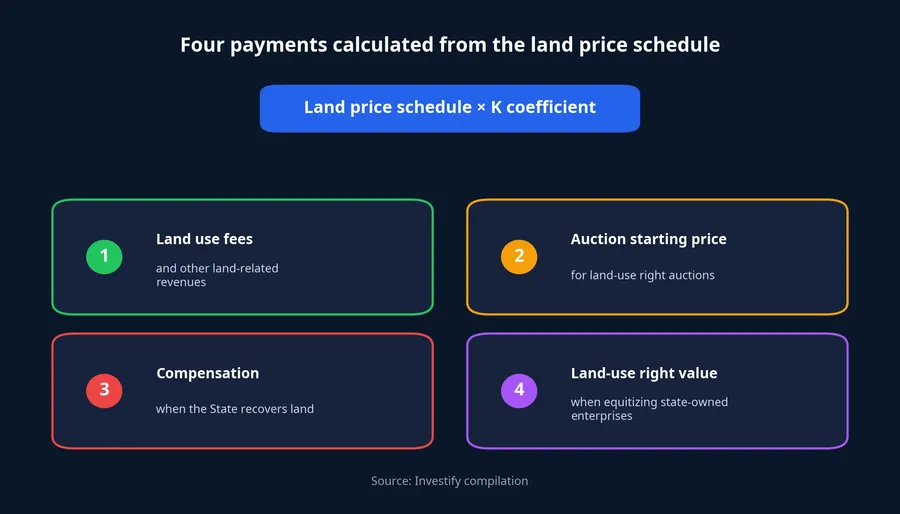
The first table under the new law applies from Jan 1, 2028. On a 3-year cycle, it will in principle serve all of 2028 to 2030, unless the provincial People's Council adjusts it mid-cycle on the grounds above. The law says the table and K coefficient are used consistently to compute land-related budget revenues (including land use fees and land rent), set starting prices for land-use right auctions, calculate compensation when land is recovered, and value land-use rights when public non-business units are converted into companies or when wholly state-owned enterprises are equitized.Người Quan Sát
Compensation: Table price times K, plus a provincial ratio
For people whose land is recovered, the law bases compensation on area, usage term, land type, whether the land was allocated or leased, the price from the table and K coefficient, and a compensation ratio set by the provincial People's Committee that may not be below 1.FireAnt The compensation land price is fixed at the time the compensation, support and resettlement plan is approved. If the plan must be revised, the competent authority applies the more favorable land and asset prices to the affected landholder.
Authorities must also budget for livelihood restoration support for at least 3 years after the recovery decision.Thời báo Tài chính
Land use fees on projects: Easier to forecast, not necessarily cheaper
For property developers, dropping specific land prices is a big change. According to Mr. Châu, the table combined with the K coefficient will be the main method for determining land use fees on real estate projects. HoREA also says the old specific-price method could take 3 to 5 years and still fail to produce a price on some projects. A table fixed for three years lets developers know the bill in advance when they plan.FireAnt
But easier to forecast is not the same as cheaper. Mr. Châu calculates that land use fees on some projects could rise 2 to 2.6 times under the table-times-K mechanism, based on figures the Ho Chi Minh City Department of Natural Resources and Environment once computed for several projects. HoREA also estimates land costs at about 30 to 40% of housing costs.FireAnt The 2 to 2.6 times range applies to some Ho Chi Minh City projects, not to the whole market. The real figure for each project depends on the table and K coefficient each province issues, plus the Government's implementing decree.
Who gains and who loses when the table stands still
Mechanically, a 3-year cycle cuts two ways, and which way wins depends on how market prices move during the cycle.
If market prices rise over 2028 to 2030, a payer of land use fees or an auction bidder late in the cycle is charged on a table fixed earlier, so the bill is lower than under annual updates. The same table works against people receiving compensation late in the cycle, whose payout falls below market. Two cushions help them: the provincial compensation ratio (not below 1) and the provincial People's Council's power to adjust the table mid-cycle.
If market prices stay flat or fall, the picture reverses. Late-cycle payers face prices above market, while those receiving compensation keep the level that was fixed. The law allows adjustments both up and down mid-cycle, so any gap has a route to be corrected, though the correction still depends on each province's decision.
The yardstick is the same in both branches: the further the table drifts from the market, the more one side gains and the other bears. That is the price of trading a table that moves every year for one that is easier to predict.
Signals to watch
The conclusion here leans one way: a 3-year cycle makes the amounts easier to forecast, while whether they are high or low is decided by each province's table. Two milestones will answer the rest. First is the Government's implementing decree, which will set the land use fee formula for each project type and how provinces set the compensation ratio. Second is the table each provincial People's Council issues for application from Jan 1, 2028, which will show whether the next three years of prices sit above or below the 2027 table, and whether each province sets K around 1 or higher.
For real estate stocks, land cost on a project becomes easier to estimate within each three-year cycle, but the level of that cost is still set by local tables. For people holding land in areas planned for recovery, the year of the cycle in which the compensation plan is approved is a detail worth noting.