


On the 10-month numbers, FPT is still growing at double digits: consolidated revenue of VND 44,959 billion, up 12.5%, and pre-tax profit of VND 9,954 billion, up 16.8%.Người Quan Sát The stock has gone the other way. On 19 November FPT closed at VND 45,700, down 2.66% on the day, and foreign investors were net sellers of almost 5.87 million shares.CafeF
What has drawn attention is Japan. At an investor meeting on 18 November, FPT's management said that in 2026 it raised yen-denominated contract prices by about 9% on average for 55 clients, and aims to adjust prices for another 100 clients in 2027. Vietcap Securities recorded the details in a report the same day.Markettimes The thesis here: FPT is trading some short-term momentum in new bookings for higher rates and a new way of billing. October is the first data point suggesting the cost of that trade is not severe, but one month is not enough to conclude.
Why a software outsourcer has to raise prices
Japan is the largest market in FPT's overseas IT segment. In its Q4 2026 plan, management puts Japan revenue at USD 180 million out of USD 395 million for the whole segment, close to 46%.Markettimes A pricing decision here hits the biggest slice of that segment's revenue.
Most of FPT's contracts with Japanese clients are still billed on working time and the number of engineers sent. Clients pay by the hour, so FPT's revenue follows hours. Artificial intelligence (AI) bends that model. When engineers use AI to write and test code faster, the same workload takes fewer hours. If the hourly rate stays flat, FPT works more efficiently and earns less.

According to MB Securities (MBS), Japanese clients are cautious and prefer traditional contracts. Prolonged talks over higher rates pushed some contracts back by roughly a quarter, which weighed on Q3 revenue. MBS says FPT has successfully renegotiated with 55 clients, lifting the average Q4 rate about 9.2% above the Q1 to Q3 period.CafeF That is a rise in unit price, not in revenue.
The argument FPT uses with clients, per MBS, is productivity: even at a higher rate, the client's cost per unit of work can still fall. The analysts judge that FPT keeps its competitive edge in Japan against large Indian rivals, even with average increases of 3% a year.
Changing how it bills, not just the price
Alongside the price rise, FPT is moving toward fixed-price contracts, fixed-capacity contracts and contracts paid on delivered outcomes. The client pays for an agreed output. The hours AI saves then belong to FPT instead of being deducted from the invoice.
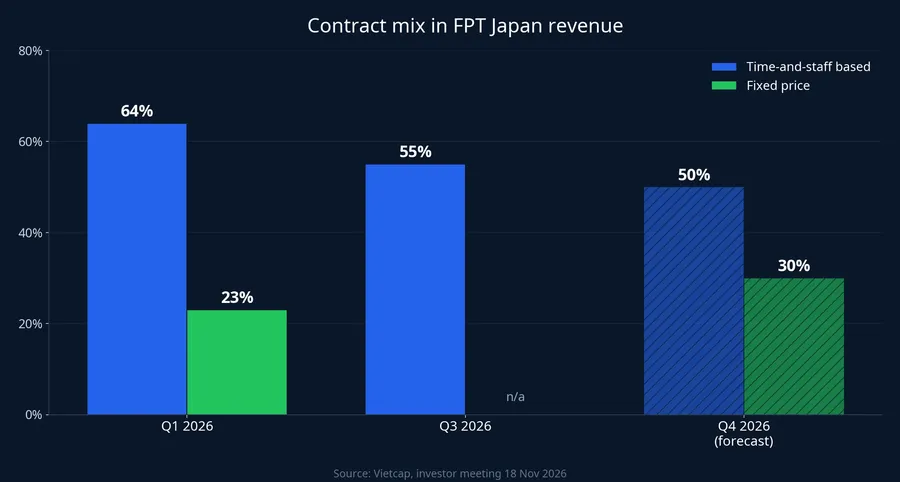
According to Vietcap, the share of time-and-staff contracts in Japan revenue fell from 64% in Q1 2026 to 55% in Q3, and is projected at 50% in Q4. The share of fixed-price contracts is projected to rise from 23% in Q1 to 30% in Q4.Markettimes The MBS report uses a different baseline: hourly contracts falling from 64% in Q3 to 49.5% in Q4.CafeF The two reports attach the 64% figure to different quarters, but they point to the same destination: roughly half of Japan revenue in Q4.
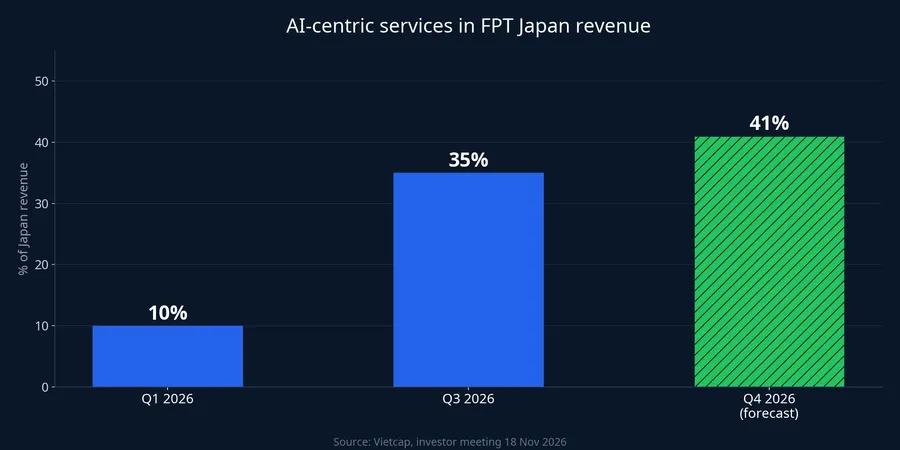
At the same time, AI-centric services in Japan rose from 10% of revenue in Q1 2026 to 35% in Q3, with 41% projected for Q4. Across the whole overseas segment, management aims to lift this share from 27% in 2026 to at least 40% in 2027. AI and data analytics revenue alone reached VND 3,292 billion over 10 months, up 50% year on year.Markettimes
The margin benefit arrives more slowly. Vietcap estimates fixed-capacity contracts could add about 5 percentage points to the overseas segment's gross margin, with clearer gains from 2028.Markettimes That is Vietcap's estimate, not a result already delivered. Margins in 2027 may still swing with exchange rates, AI investment costs and the reskilling of the workforce.Người Quan Sát
Where the slower bookings come from
New contract signings in the overseas IT segment slowed in Q3. According to FPT's management, some clients postponed large contracts to redirect budgets toward AI and to test new solutions before wider rollout. That part is outside FPT's control. In Japan specifically, the price increase and the change in contract model also affected short-term growth.Markettimes The available sources do not split the effect between the two, so it is not possible to say which one dominates.
Exchange rates add another layer. Over 10 months, Japan revenue grew 24% in yen terms but only 18% in dong, a gap that reflects the weaker yen.Markettimes MBS also lists the weak yen, upfront AI investment, and training and staff-reassignment costs as pressures on margins.CafeF
October is the first print after Q3
According to MBS, after August and September grew only in single digits, overseas IT revenue returned to double-digit growth in October.CafeF Japan revenue in October rose 22% year on year and 30% from September.Markettimes
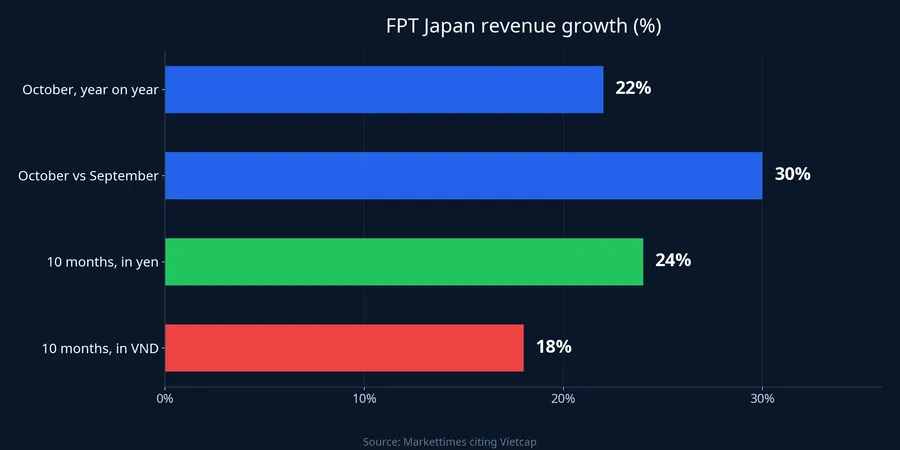
One month does not confirm a recovery. Still, it is the first evidence that contracts delayed by price talks have started moving again. MBS also notes that the total value of renewed contracts in Japan over the past 12 months still grew 14%.Tin nhanh chứng khoán That figure measures renewal value, not the share of clients who stayed.
The group picture
Putting the Japan decision in the 10-month context, profit after tax attributable to FPT shareholders reached VND 8,836 billion, up 13%. From 2026, FPT Telecom is accounted for under the equity method, and 2025 comparatives have been restated accordingly.Người Quan Sát Against a 2026 pre-tax profit plan of VND 11,629 billion in the AGM documents,Thị trường tài chính tiền tệ FPT has delivered about 86% in 10 months (our own calculation from the two figures). The overseas IT segment alone brought in VND 32,079 billion of revenue and VND 5,047 billion of pre-tax profit, up 12% and 11% respectively.Markettimes
Risks of this move
The clearest risk is that clients do not accept the new prices. In 2027 FPT wants to adjust pricing with 100 clients, nearly double this year's number. No source says FPT has lost any Japanese client after the increase. If next year's talks drag on as they did this year, the Q3 pattern of postponed contracts could repeat.
The shift to fixed pricing also moves part of the risk onto FPT. Under hourly contracts, a project that runs long means the client pays more. Under fixed-price contracts, FPT absorbs the overrun. In return, if AI makes delivery faster, the savings are FPT's.
What to watch next
Management targets Q4 2026 overseas IT revenue of USD 395 million, up 10% from Q3 and 9% year on year.Người Quan Sát Japan is expected to contribute USD 180 million, up 13% year on year.CafeF For 2027, FPT targets 15–20% growth in new overseas bookings.Markettimes
Q4 is the test of the Japan trade-off. If Japan revenue lands near USD 180 million while the share of hourly contracts falls to about 50%, FPT will have changed how it bills without losing revenue momentum. If Japan revenue comes in well below that mark, more momentum has been lost than October suggests. Those two numbers, plus the hourly-contract share in the Q4 report, are the yardsticks most worth watching.