


Say you have your eye on a residential plot with a starting price of VND 2 billion. Under the revised Law on Property Auctions that the National Assembly passed on the morning of 20 November, you must put down VND 400 million to VND 1 billion just to enter the auction. The law won 475 of 482 votes cast in favor, or 95.19% of all deputies. It has 7 chapters and 66 articles and takes effect on 1 July 2027, except for the provision in clause 2 of Article 65.Xây dựng chính sách
This post walks through that deposit in the order you would meet it: how much you pay, why the law sets it so high, when the money comes back and when it is lost. Put simply, the law makes bidding high and then walking away very expensive. The cost of that design does not fall only on people trying to inflate prices.
What you need before you can enter
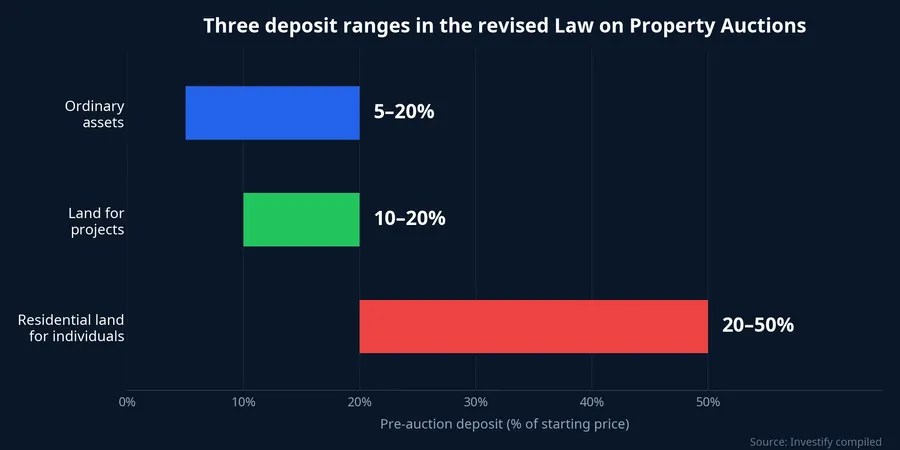
Article 35 governs the deposit. When the State auctions land-use rights to allocate residential land to individuals, participants must pay at least 20% and at most 50% of the starting price. On a plot starting at VND 2 billion, that is VND 400 million to VND 1 billion, depending on the rate set for that auction.Dân trí
That range sits well above the others in the same article. For ordinary assets, the deposit is agreed between the auction house and the asset owner, usually 5% to 20% of the starting price. Land that the State allocates or leases for investment projects requires only 10–20%.Dân trí So someone buying a plot to build a home must put down a higher share than a developer bidding for an entire project site.
The 50% ceiling has been in use since January
The 20–50% range is not new to this law. The 2016 Law on Property Auctions (amended in 2024) set the deposit for residential land allocated to individuals at 5% to 20% of the starting price. On 6 January 2026 the Government issued Resolution 66.11/2026/NQ-CP, raising the range to 10% to 50%.Thời báo Tài chính The resolution runs from 6 January 2026 to the end of 28 February 2027, which makes it a temporary measure.VietnamFinance
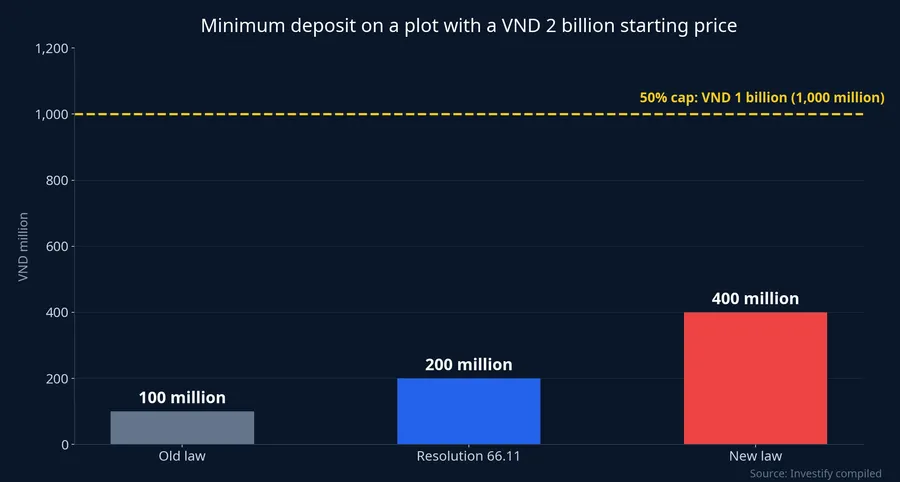
Laying the three documents side by side shows what the new law changes. The 50% ceiling stays as it was under the resolution, while the floor rises from 10% to 20%. On a VND 2 billion plot, the minimum deposit goes from VND 100 million under the old law, to VND 200 million under the resolution, to VND 400 million. The range also moves from a time-limited resolution into the text of a law.
The law does not pick a specific rate. In response to deputies' comments, the draft added clause 10 of Article 35, which tasks the Government with setting principles and criteria for choosing the rate within the range, to suit each type of asset and each locality without creating unreasonable barriers for participants.Xây dựng chính sách
Why a large deposit deters walking away
The mechanism is simple. A bidder who offers a very high price and then fails to pay the winning amount forfeits the deposit. When the deposit is 5% of the starting price, or VND 100 million on a VND 2 billion plot, someone trying to push prices up may treat it as an acceptable cost. At VND 400 million or VND 1 billion, the same move becomes very expensive.
The Government used field data to defend the range. In its response report, presented to the National Assembly on the morning of 20 November by Minister of Justice Hoàng Thanh Tùng on the Prime Minister's behalf, a quick survey of 16 provinces and cities that regularly auction residential land showed that the rules under Resolution 66.11 on higher deposits, cancelled results and auction bans had significantly cut the number of winners who walked away.Nhân Dân
Thanh Hoa is the most concrete example. According to the report, after the province set the deposit at 50% of the starting price, plots whose results were cancelled because the winner did not pay fell from 377 cases in 2025 to 82 in the first nine months of 2026, while plots offered at auction rose from 1,129 to 3,889.Xây dựng chính sách In Quang Tri, cancelled results fell from 35 to 11.Nhân Dân
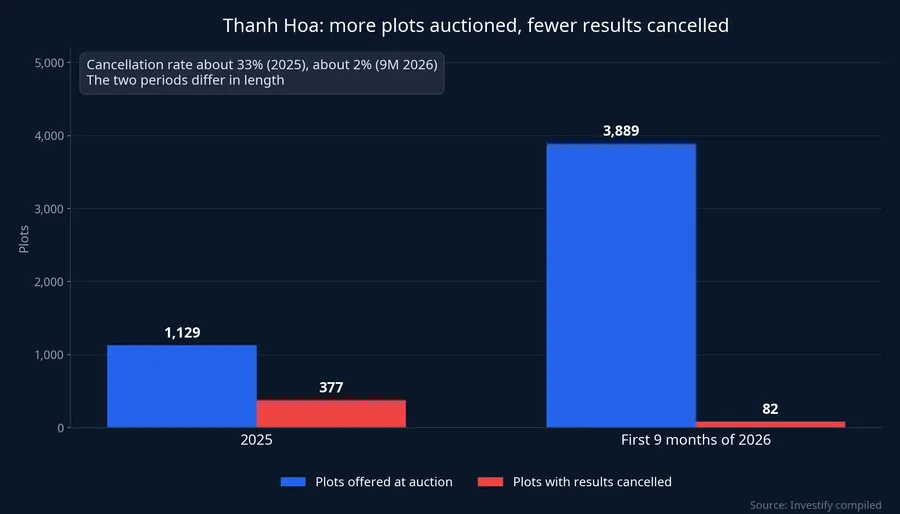
Dividing Thanh Hoa's two pairs of figures ourselves, in 2025 roughly 33 of every 100 plots offered had their results cancelled. In the first nine months of 2026 the figure is about 2. That division shows the scale of the change is far larger than the count of cancelled plots alone suggests.
The numbers come with caveats. This compares a full year, 2025, with nine months of 2026, so the periods differ in length. Over the same period, Resolution 66.11 applied a high deposit and a bidding ban together, so the data cannot isolate the effect of the deposit alone. The report also sets the number of plots offered beside the number cancelled without crediting the rise in plots offered to the 50% rate. Still, the direction of the data matches the mechanism: the costlier it is to walk away, the fewer people do.
The second deterrent: bans of up to five years nationwide
The deposit is only half the mechanism. The other half is in Article 58. Resolution 66.11 already barred winners of residential land auctions who did not pay the winning amount from bidding for 2 to 5 years, or for 6 months to 3 years if they paid only part of it.Thời báo Tài chính
The new law keeps the ban for winners of land-use or mineral-extraction rights who breach payment obligations, leading to cancellation of the approved result. According to the Government's report, clause 3 of Article 58 adds two more cases: refusing the winning result and refusing to sign the auction record, so that violations are addressed at every stage of the auction.Xây dựng chính sách
The ban lasts from 6 months to 5 years, depending on the nature and severity of the violation.Dân trí While it applies, the violator cannot bid on that type of asset anywhere in the country. The decision is sent to the Ministry of Justice and published on the national property auction portal.Người Quan Sát People who refuse the result, refuse to sign the record, or commit a violation that leads to cancellation also do not get their money back.
The two layers reinforce each other. A large deposit makes a single walk-away costly. A nationwide ban stops the same person from moving to another province and repeating it.
Where the money sits and when it comes back
The deposit must be paid into a separate payment account of the auction organization at a commercial bank or a foreign bank branch in Vietnam.Dân trí The law distinguishes these situations.
- You do not win: within 3 working days of the end of the session, or another period agreed in advance, the auction organization must return the deposit plus any interest.
- You withdraw: a bidder with a valid application can withdraw in writing before the session opens. The deposit is returned, but the application fee is lost.
- You lose the money: registering but not showing up (except in force majeure), being disqualified for a violation, or refusing the winning result.
- You win: the deposit and any interest become a down payment securing the contract.
The law also has a rule that gets little attention. Anyone attending the session is deemed to agree to bid the starting price.Xây dựng chính sách If several people accept the starting price and no one bids higher, the winner is chosen by lottery. Anyone who refuses to draw is treated as withdrawing the bid, and the deposit is handled under the rules. According to the Government's explanation, this targets collusion seen in practice: many people register but all decline to bid, so the auction fails and prices can be pushed down.
Who bears the cost of the mechanism
For someone who bids to push prices up and then walks, the risk has changed completely. One high bid followed by walking away can cost from a fifth to half of the starting price, plus a ban of up to 5 years nationwide. The Government states the aim of the range as curbing abnormally high bids followed by forfeited deposits, which hurt the real estate market.Nhân Dân
For someone who genuinely needs residential land, the cost is cash. They must have at least 20% of the starting price ready before the session, and that sum sits in the auction organization's account until at least a few working days afterward. Anyone who wants to enter two or three sessions at once to improve their odds needs that much money several times over. This is exactly what deputies raised in debate: a high deposit may limit people with real needs.Dân trí The law kept the 20–50% range at the Government's request and addressed that concern by tasking the Government with setting criteria for choosing the rate.
So the amount buyers actually pay will be decided by a Government document, not by the 50% figure in the headline. When it is issued, what matters is which end of the range its criteria push each locality toward. If high rates attach to places with many cancelled auctions, buyers there will need to prepare close to half the starting price. If most localities are set around 20%, the sum for a VND 2 billion plot will be closer to VND 400 million than VND 1 billion. On this plot, the two ends of the range are VND 600 million apart.
Resolution 66.11 remains in force until the end of 28 February 2027, and the new law applies from 1 July 2027. Until then, each session's deposit is still set out in the auction rules published by the auction organization. The signal to watch is the Government document setting the criteria for choosing the rate.