
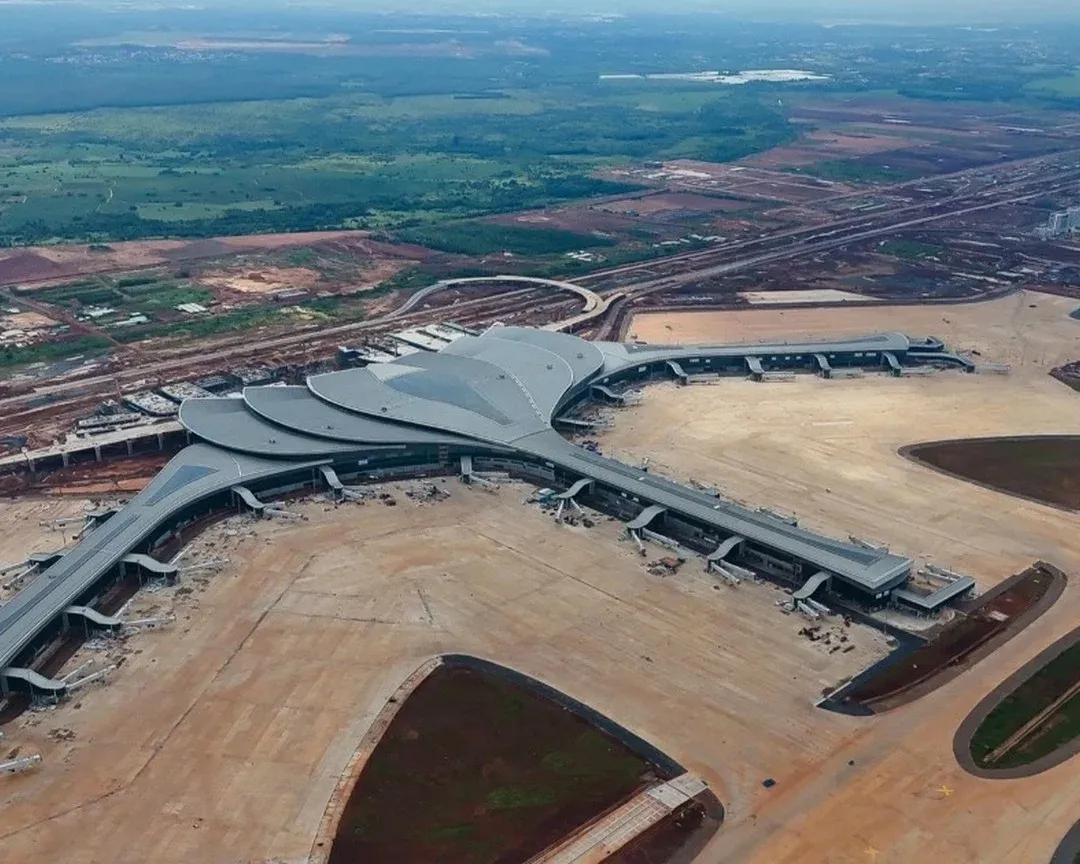

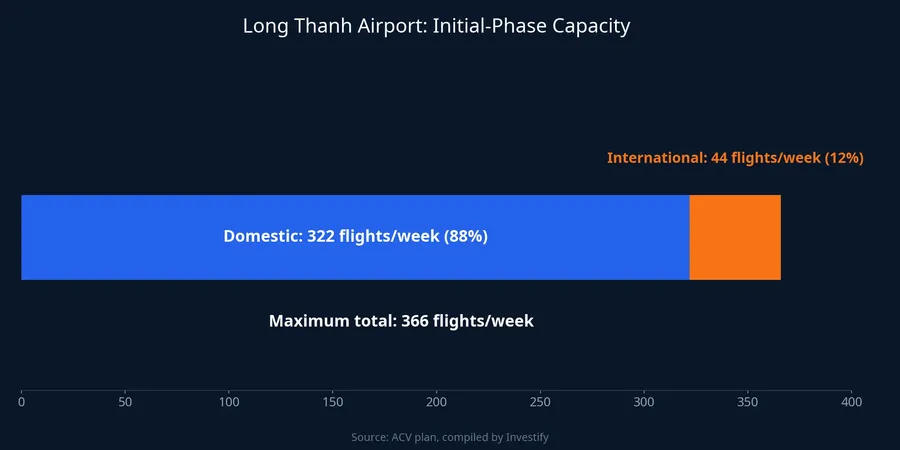
Under ACV's plan, Long Thanh Airport will handle at most 366 flights a week in its first phase: 322 domestic and only 44 international.VnExpress In other words, most of Ho Chi Minh City's international travelers will still fly through Tan Son Nhat in the early months. The open question is for how long.
A consultation run by the Civil Aviation Authority of Vietnam, set out in a report to government leaders, shows about 34 foreign airlines want to push back the date they move from Tan Son Nhat to Long Thanh.VnExpress The final date will come from the document that fixes the transition schedule between the two airports. That document does not exist yet.
First phase: two Vietnamese carriers go first
According to ACV's plan, Vietnamese airlines are the ones ready earliest. Vietnam Airlines expects to operate 72 flights a week and Vietjet up to 294, all domestic.VnExpress The two figures add up to exactly the 366-flight cap, so they are best read as each carrier's maximum registration, not a final slot allocation.
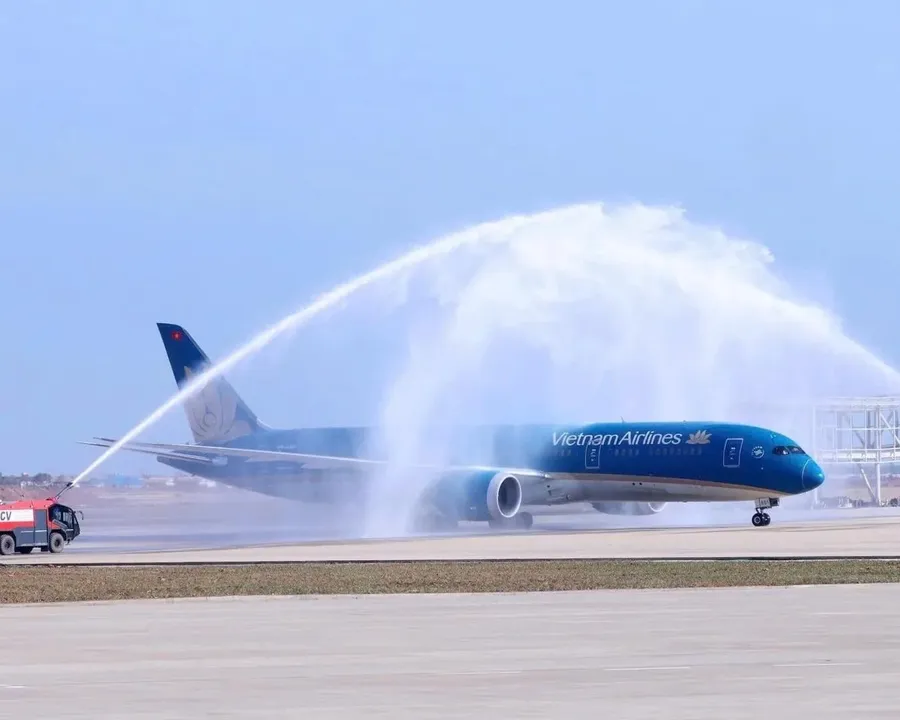
Vietjet's registration is more than four times Vietnam Airlines'. Both carriers will have to run two airports that serve the same city: part of their domestic network at Long Thanh, the rest plus all their international flights at Tan Son Nhat. Long Thanh's first phase is designed for 25 million passengers and 1.2 million tonnes of cargo a year.VnExpress According to Người Quan Sát, the two carriers' initial registrations equal roughly 6–10% of design capacity, or about 20–30 flights a day.Người Quan Sát
Two schedules, about seven months apart
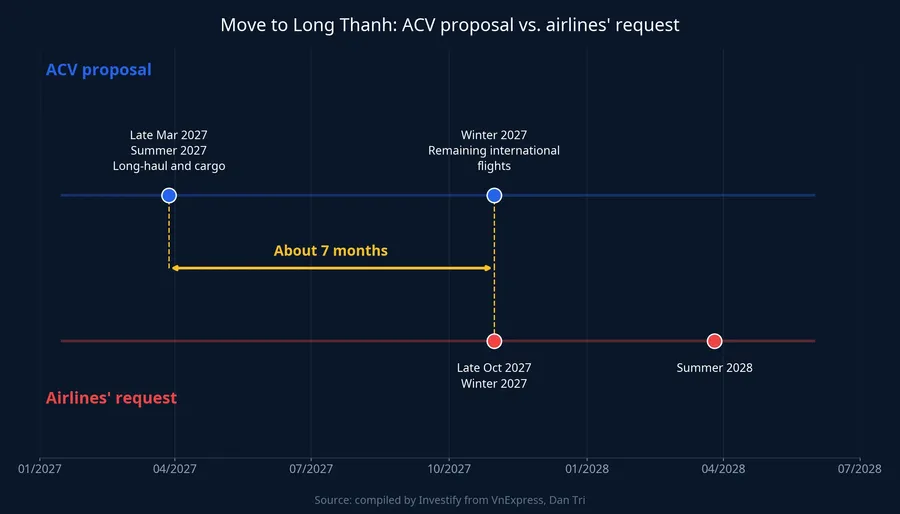
ACV has proposed a three-step schedule. From the start of operations through the winter 2026 flight season (to March 2027), airlines are encouraged to run international routes, including cargo, at Long Thanh as demand allows.Dân trí In the summer 2027 season (March to October 2027), all long-haul international flights, cargo included, move to Long Thanh. From the winter 2027 season (October 2027), the remaining international flights follow, except short routes under 1,000 km flown by Vietnamese carriers. Vietstock reports the same three steps.Vietstock
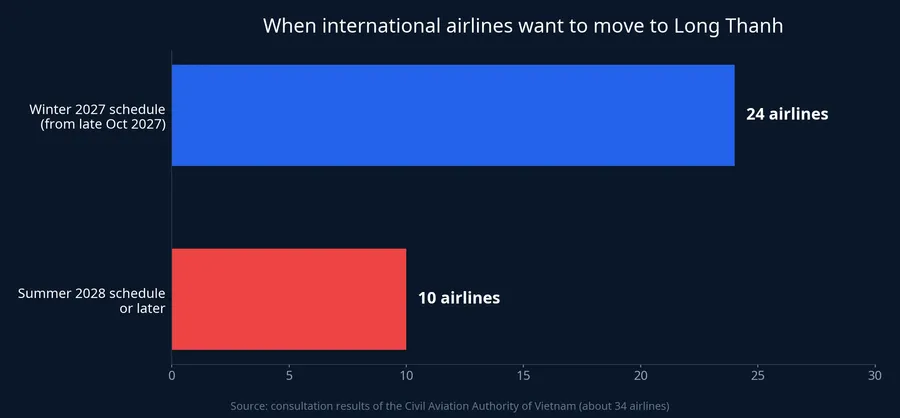
The foreign carriers answered with a different date: 24 expect to operate at Long Thanh from the winter 2027 season (late October 2027 to late March 2028), while 10 propose the summer 2028 season or later.VnExpress For long-haul flights, the gap between ACV's summer 2027 date and the late-October 2027 date preferred by the 24 airlines is about seven months.
The airlines' stated reason is preparation time. They say they need 6–12 months to plan operations at a new airport, from route network and aircraft and crew assignments to ground handling and ticketing systems.VnExpress To open direct cargo routes from Long Thanh to the US, the Transportation Security Administration (TSA) has to inspect and assess the airport in person.Người Quan Sát The express carriers UPS, FedEx, DHL and Cargolux ask for synchronized express terminals, customs, truck-handling areas and connecting transport, with preparation and technical assessment that could take about 12 months.VnExpress
Beyond airport infrastructure, the airlines also list transit hotels of 4 stars or above, medical services and smooth road links to Ho Chi Minh City. They also ask that the transition schedule be fair to domestic and foreign carriers alike.VnExpress That request stands out because ACV's proposal leaves Vietnamese carriers' sub-1,000 km routes at Tan Son Nhat.
Scenario one: keep the summer 2027 date for long-haul flights
If regulators keep ACV's schedule, long-haul international and cargo flights move to Long Thanh from late March 2027. Measured against the 6–12 month window the airlines cite, long-haul carriers would have to start preparing now, and for those needing 12 months the date is already tight.
Road access is another constraint. Travel between Ho Chi Minh City and Long Thanh currently depends entirely on roads, and the expressways and the An Phu interchange under construction are due to be largely finished in early Q2 2027.Dân trí That lands in the first weeks of the summer 2027 season.
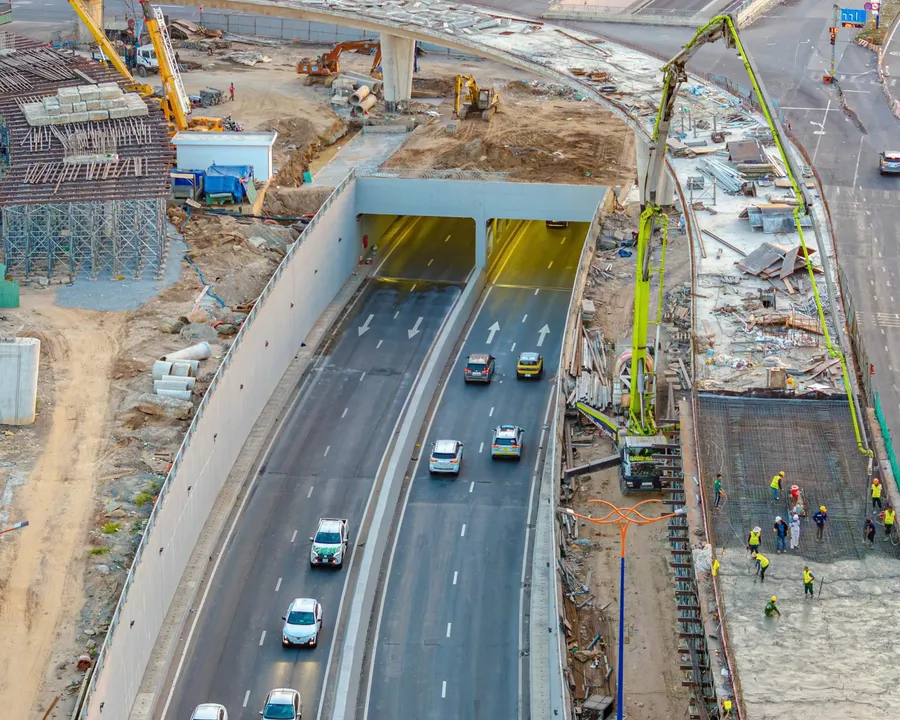
If this scenario plays out, Long Thanh gets long-haul international traffic from summer 2027, Tan Son Nhat is relieved earlier, and long-haul passengers from Ho Chi Minh City have to plan the trip out to Dong Nai starting next year.
Scenario two: follow the airlines' requested dates
If the final schedule follows the airlines' request, most international flights reach Long Thanh only from late October 2027, some from summer 2028. From the expected commercial start on December 24 to late October 2027, about ten months, Long Thanh would mainly serve domestic flights by Vietnam Airlines and Vietjet, plus at most 44 international flights a week. Tan Son Nhat would keep most of the city's international passengers through nearly all of 2027.
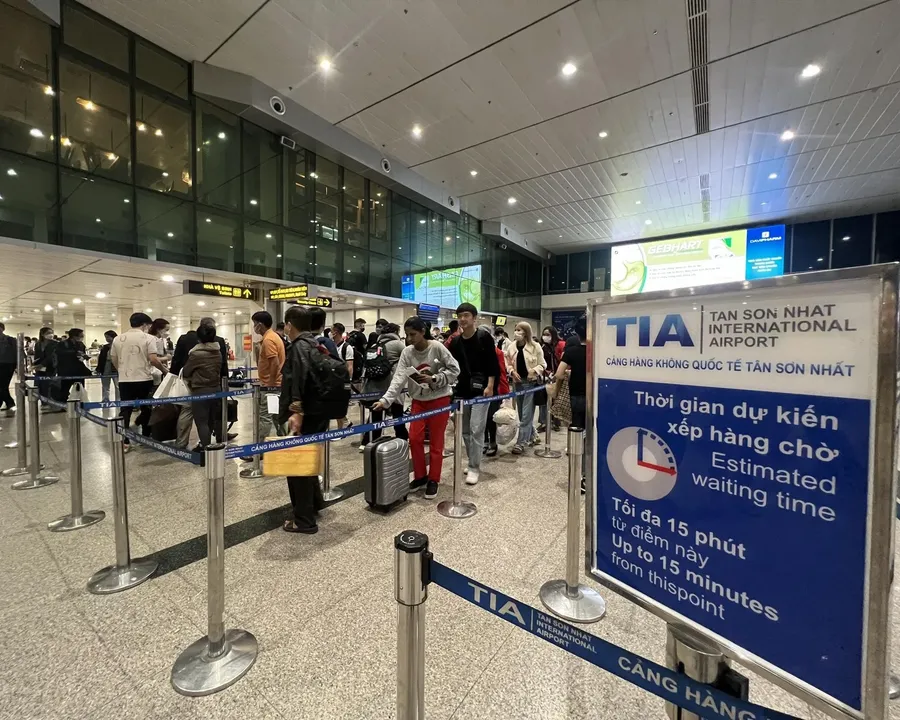
For passengers, this stretches the period in which two airports share one city. A domestic traveler could depart from Long Thanh and connect to an international flight at Tan Son Nhat. ACV has already recommended prioritizing buses, shuttles and multimodal links between Ho Chi Minh City and the airport to ease the commute.FireAnt
For ACV, HVN and VJC, the difference is price and where passengers fly through
For ACV, international passengers staying longer at Tan Son Nhat does not mean they leave the system, since ACV runs both airports. The difference between the scenarios is which airport passengers use and what rates they pay. To draw airlines to Long Thanh, on top of incentives under Circular 23/2026/TT-BXD, ACV plans to cut some aviation service charges by 20–50% in 2026–2027.Dân trí Scenario one brings more international passengers to Long Thanh sooner, within the incentive period. Scenario two keeps most of them at Tan Son Nhat under current rates for longer, while Long Thanh runs mostly on domestic traffic.
For Vietnam Airlines and Vietjet, both scenarios mean operating from two bases. Scenario two extends that period: domestic flights shift to Long Thanh first, while the carriers' own international flights and connections with foreign airlines stay at Tan Son Nhat, so schedules and crews are split across two sites for longer.
Who decides the schedule
The three-step schedule remains ACV's proposal. On October 15, the Civil Aviation Authority reported to the Ministry of Construction and proposed a meeting of ministries, agencies, localities and ACV to agree on, or escalate to the competent authority, the start date and transition plan for Long Thanh and Tan Son Nhat.Dân trí The Ministry of Construction says the schedule should fit IATA's flight-season cycle and limit disruption to airlines' operating plans.
That cycle has two dates a year: late March and late October. The evidence is not enough to say which one will be picked for long-haul international flights, so the thing to wait for is the document that fixes the transition plan. If it is summer 2027, Long Thanh gets long-haul international traffic after three months of operation. If it is late October 2027, the new airport's first ten months will be mostly domestic.