


In early afternoon trading on 18 November, FPT shares were down about 3.3%, changing hands around VND 46,900. The previous session, 17 November, they closed at VND 48,500, down 1.82%, the lowest level since early July 2023.CafeF Measured against the adjusted closing peak of 23 January 2025, the stock has lost almost 60%.Thanh Niên Market capitalisation stands at roughly VND 91,400 billion at the 17 November close.
The business numbers, though, point the other way. FPT Corporation (consolidated) reported 9-month 2026 revenue of VND 40,023 billion, up 12.4%. Pre-tax profit came to VND 8,770 billion, up 17%, and after-tax profit attributable to FPT shareholders reached VND 7,778 billion, up 13.3%.CafeF In Q3 alone, shareholders' after-tax profit was VND 2,723 billion, up 11.8% year on year and the highest of any quarter on record.
This piece looks for the reason behind that gap. The thesis: the market is currently pricing FPT on the growth of new contracts and on whether its billing model can change, not on the profit already booked.
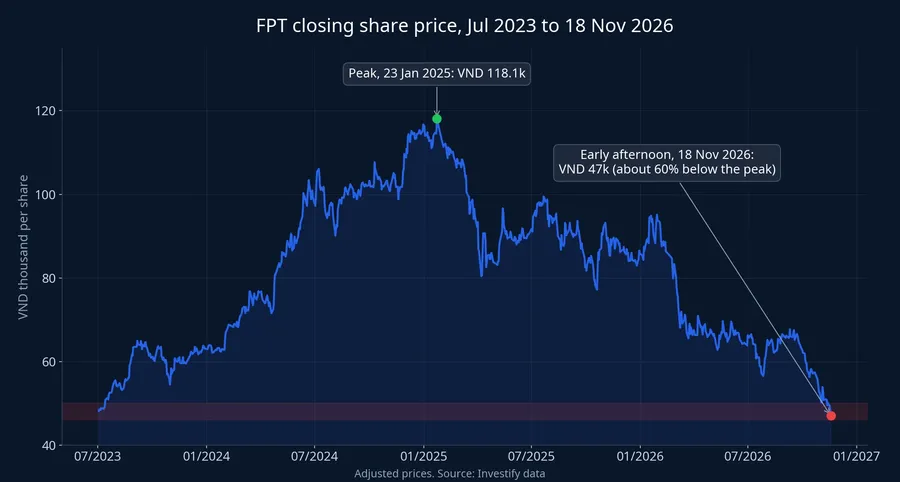
Profit Is Still Rising, Steadily
One note on comparability: from 2026, FPT Telecom is no longer fully consolidated and is instead accounted for under the equity method. The 2025 comparison figures have been restated on the same basis, so the growth rates above are like-for-like.
FPT's 2026 plan calls for revenue of VND 58,580 billion and pre-tax profit of VND 11,629 billion.FireAnt After nine months, pre-tax profit has reached about 75% of the plan. Simple subtraction shows Q4 needs only about VND 2,860 billion to get there, below the roughly VND 2,920 billion quarterly average of the first nine months. The domestic IT segment is growing faster than the group: 9-month revenue of VND 6,977 billion, up nearly 30%, and pre-tax profit of VND 542 billion, more than double a year earlier.CafeF Revenue from AI and data analytics services rose 55%.CafeF
So what is the price reflecting? Booked profit belongs to this year. A share price reflects expectations of profit in later years, and in FPT's largest segment the earliest indicator for those years is new contracts.
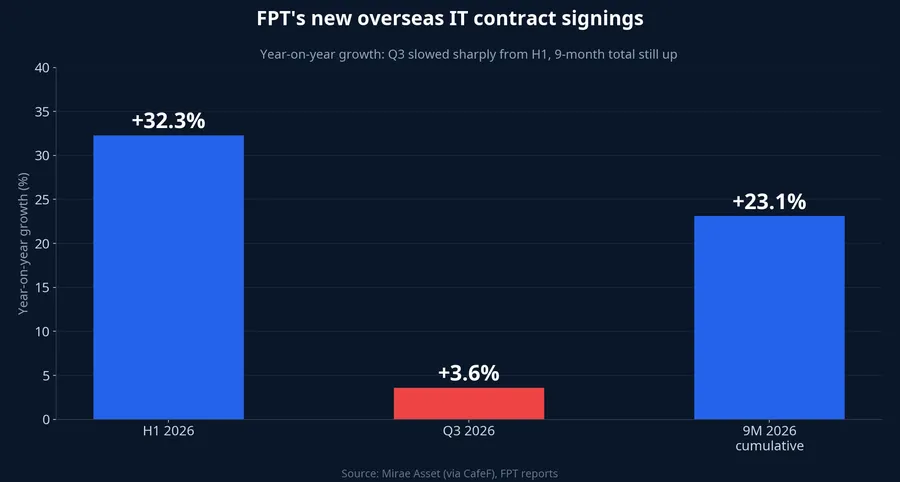
Overseas Signings Slowed in Q3
New contract revenue is the total value of contracts signed in a period. Most of that money does not become revenue immediately; it is recognised gradually as projects roll out over the following quarters and years. It therefore says more about future revenue than about current-quarter profit.
Cumulatively over nine months, new contract revenue in overseas IT reached VND 36,137 billion, up 23.1%.Thanh Niên The nine-month figure still looks strong. But split by quarter, according to an early-November Mirae Asset Securities report relayed by CafeF, Q3 signings alone rose just 3.6% year on year to VND 9,799 billion, against 32.3% growth in the first half. The number of contracts worth more than USD 10 million fell from 19 to 16 over the nine months.CafeF
Japan has also stalled. Q3 revenue there was VND 4,270 billion, down 10.1% from Q2, though still up 8.3% year on year. Exchange rates shrink the figure in dong terms: over nine months, Japan revenue grew 25.2% in yen but only 17.2% in dong, as the yen weakened by about 6%.CafeF According to an ACB Securities (ACBS) report dated 13 November, the Japanese market is being affected by currency swings and by some clients delaying their IT budgets.CafeF
One slower quarter is not enough to call a trend. Mirae Asset itself still forecasts Q4 revenue up 17.8% and Japan revenue up 20%.CafeF Even so, when the earliest indicator of the biggest segment slows just as the share price is already weak, markets tend to react cautiously first.
US Clients Change How They Pay
The second driver is how clients pay for outsourced work. In an interview with Nikkei Asia on the sidelines of the Global Management Dialogue 2026 in Tokyo, Chu Thi Thanh Ha, Chairwoman of FPT Software, said large US clients have moved to paying for outcomes rather than for engineers' working time as before.Người Quan Sát
For a software outsourcer, this changes the foundation of the model. When billing is by the hour, revenue rises with headcount and hours worked. If AI lets the same volume of work be done in less time with fewer people, that billing method pulls revenue down even though the workload is unchanged. In Ms Ha's words, AI makes it possible to build the same software product in less time with fewer engineers, making headcount-based pricing increasingly ill-suited.
FPT Software has set out a roadmap. Hourly billing still contributes most of its revenue, and that share is expected to fall to about 50% in 2027 and below 50% in 2028 as the company expands turnkey solutions and higher-value AI services. Outcome-based contracts could let the company keep a share of the productivity gains AI creates, but margins then depend more on how efficiently each project is delivered.
Both Drivers Meet in the Valuation
The price-to-earnings ratio (P/E) tells you how many dong the market pays for each dong of profit. A company expected to grow fast carries a high P/E, because buyers pay up front for future profit.
In a 13 November report, BIDV Securities (BSC) calculated FPT's 2027 forward P/E at about 8.5x, against an average of 19–20x over the previous five years. ACBS put the trailing 12-month P/E at about 9.3x as of 11 November, almost half the three-year median.CafeF The two measures differ, but the conclusion is the same: the market is paying roughly half as much for each dong of FPT profit as it did before.
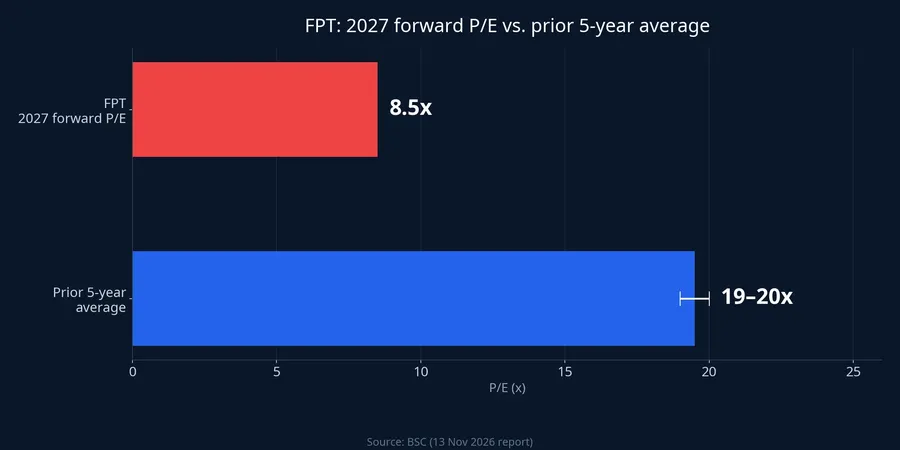
BSC offers part of the explanation: FPT's growth will struggle to return to the roughly 20% annual average of 2021–2025, given challenges in the international technology market. ACBS cut its 2027 pre-tax profit forecast by 3% to VND 13,025 billion, implying 10.6% growth, because of weakness in overseas IT.CafeF A company growing profit at 10–13% a year is unlikely to command the P/E of one growing at around 20%.
On flows, from the start of 2026 through the 12 November session, foreign investors were net sellers of more than 229 million FPT shares, worth about VND 17,400 billion.CafeF That is direct selling pressure in the market.
What to Watch
The 2026 profit target is nearly within reach, since Q4 only has to come in below the average of previous quarters. What remains open is whether the Q3 slowdown was a one-quarter misstep or the start of a slower signing cycle.
Q4/2026 results, together with full-year new contract revenue expected in early 2027, will answer that. If Q4 signings return to double-digit growth, Q3 was most likely an off-beat quarter. If signings keep growing in single digits, today's low P/E reflects a slower growth phase, not an overshoot in selling. The share of revenue billed by the hour, which FPT Software will disclose in coming periods, is the second indicator, showing whether the shift in model is moving fast or slowly.
This article offers no view on FPT's share price or its direction.