
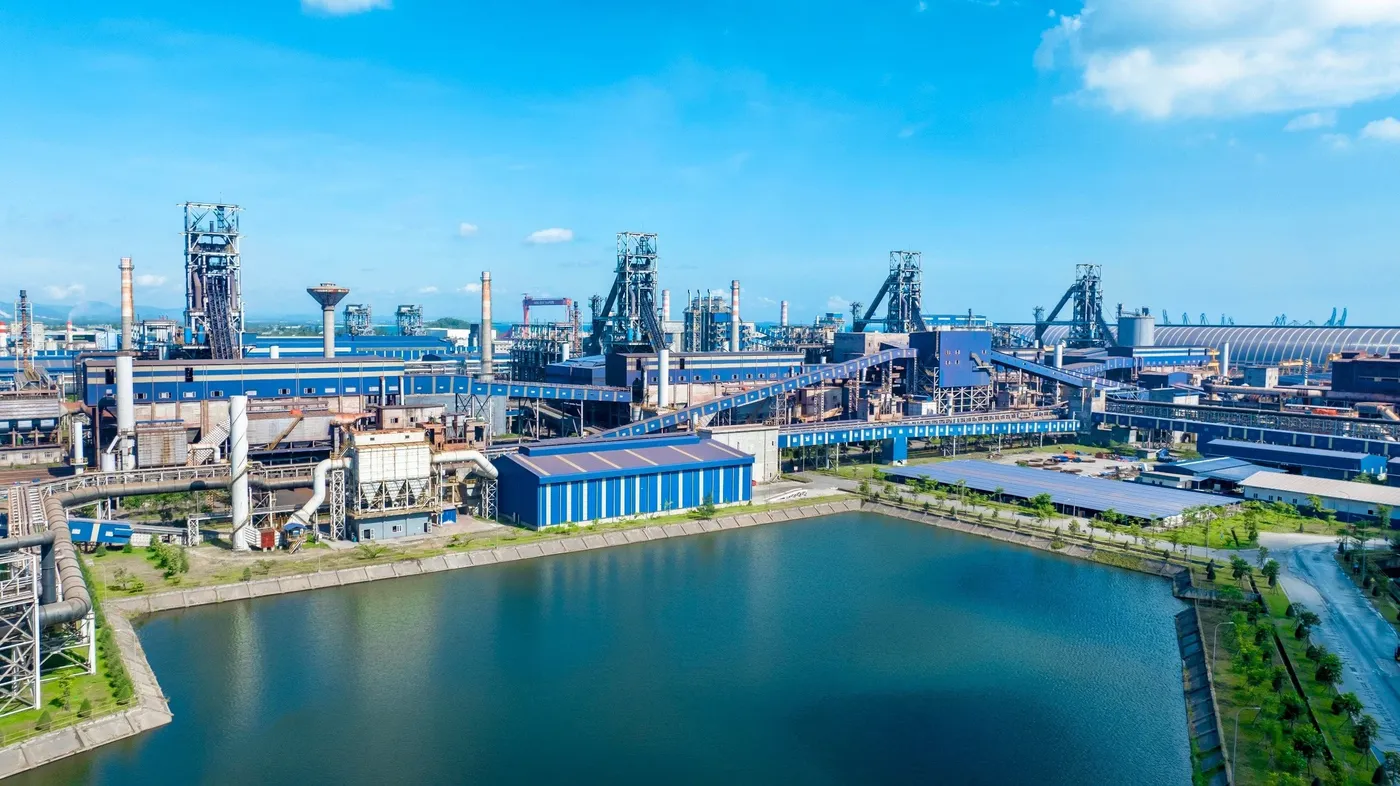

Hoa Phat Group JSC (HoSE: HPG) has carved its renewable power business out into a separate legal entity. According to a board resolution dated November 13, 2026, reported by CafeF and Nguoi Quan Sat, Hoa Phat will contribute capital to set up Hoa Phat Renewable Energy JSC, with planned charter capital of VND 650 billion. The group's share is VND 649.87 billion, or 99.98%.CafeFNgười Quan Sát
Against the group's size, the contribution is small. Consolidated net profit for the first nine months of 2026 reached VND 23,746 billion, double the same period last year and equal to 108% of the full-year profit plan.Người Đưa Tin For an HPG shareholder, the practical questions are what the new company will do, how heavy the money is, and how it differs from the power Hoa Phat has long generated for its own furnaces.
What the November 13 Resolution Decides
The resolution, as the press relays it, is short. The new company is Hoa Phat Renewable Energy JSC, with planned charter capital of VND 650 billion.CafeF Hoa Phat contributes VND 649.87 billion. The remainder is tiny, so in substance this is a subsidiary almost wholly owned by the group. Its business is power generation from renewable sources, including wind and solar.Người Đưa Tin
The board authorized Ms. Tran Thi Thu Hien, Deputy General Director of Hoa Phat Group JSC, to manage the entire capital contribution. The Chairman may change the representative when needed.Người Đưa Tin
The stage matters. This is a decision to contribute capital and incorporate a company, with charter capital that is planned. It is not yet a project with a site, a capacity figure or a power buyer.
Is VND 649.87 Billion Large or Small?
To weigh the figure, set it beside the group's consolidated nine-month results: revenue of VND 170,274 billion, up nearly 55% year on year, and net profit of VND 23,746 billion.VnExpress
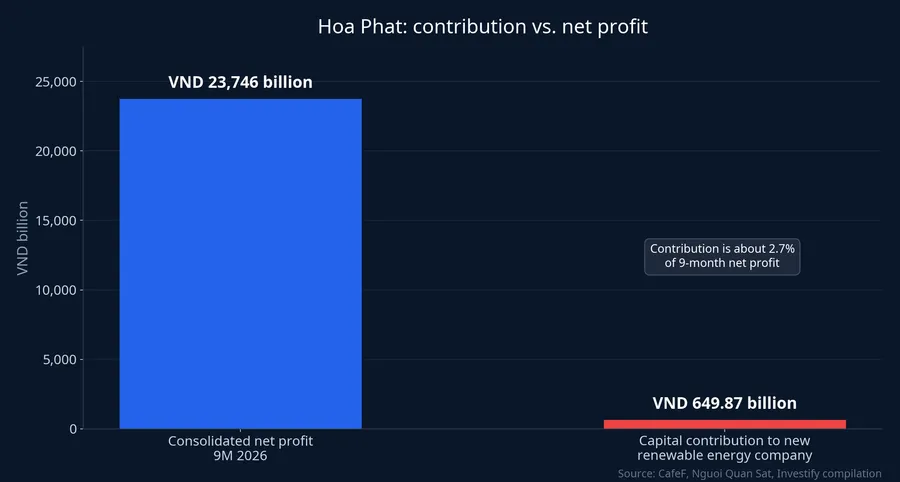
From those numbers, the contribution equals about 2.7% of nine-month net profit and about 0.4% of nine-month revenue. Against HPG's market value of roughly VND 177,700 billion, with the stock closing at VND 21,050 on November 13, it is also about 0.4%.
The other side of the comparison is steel. Steel accounts for more than 95% of Hoa Phat's revenue, even though the group also operates in real estate, agriculture, containers and home appliances.VnExpress In nine months alone it produced 10.7 million tonnes of crude steel, up 35% year on year.Người Đưa Tin Put simply, at this scale the new renewable company cannot change Hoa Phat's near-term profit picture, for better or worse.
The Power Hoa Phat Already Makes Is a Different Kind
Hoa Phat is no stranger to generating its own electricity. But the power the group produces today is recovered-energy power, not renewable power. It is generated by recovering waste heat from coke ovens and using surplus gas from iron and steelmaking as fuel for power plants.CafeF In other words, it follows the furnaces: the more the furnaces run, the more power comes out.
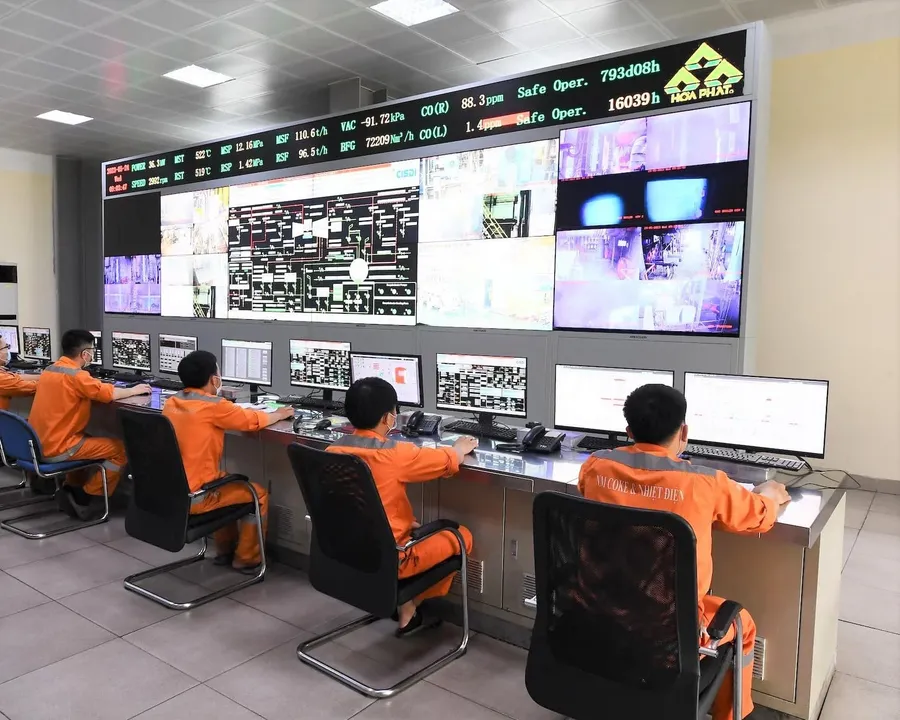
Two complexes have generation systems. At Dung Quat (Quang Ngai, designed capacity 12 million tonnes of steel a year), two thermal plants with 10 units total 600 MW, and output in the first 10 months of 2026 reached 3.96 billion kWh, up 55% year on year.Người Quan Sát At Hai Duong (2.5 million tonnes a year), 5 units total 114 MW, and 10-month output was just over 652 million kWh, up almost 3%.Người Đưa Tin
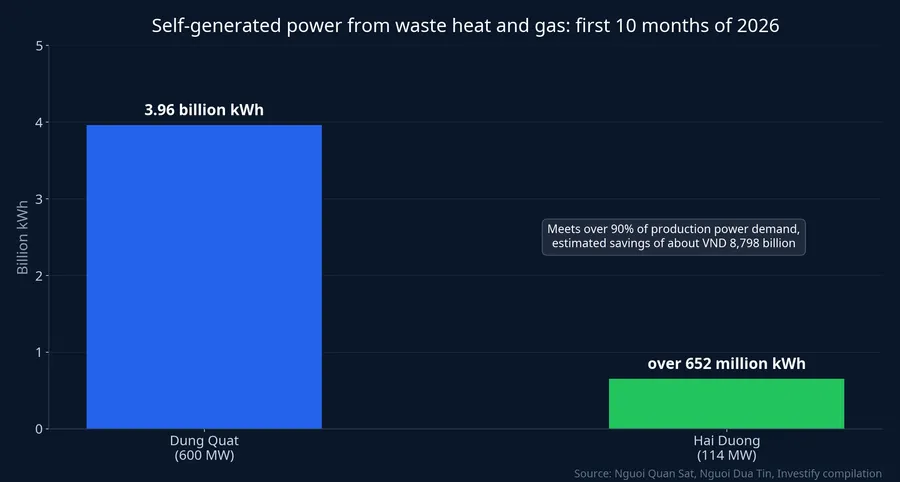
Together the two complexes generated more than 4.6 billion kWh in 10 months, meeting over 90% of production power demand. Hoa Phat estimates the self-generated power is worth savings equal to VND 8,798 billion at current electricity prices.Người Quan Sát That is the company's own estimate based on grid purchase prices, not a separate cash line in the financial statements.
The difference matters for a shareholder. Recovered-energy power needs almost no new fuel, because it reuses what the furnaces already emit. Wind and solar need dedicated construction capital, land or sea area, and a grid connection or a buyer. The two share the word "power" but earn money differently. The VND 8,798 billion saving over 10 months comes from the first kind, not from the new company.
The Link to the Song Hau Offshore Wind Stake
The new company is not Hoa Phat's first step into renewables this year. On June 20, 2026, the board approved the plan to contribute capital to Song Hau Offshore Wind JSC, with charter capital of VND 2,000 billion, of which Hoa Phat contributes VND 600 billion, or 30%.VnExpress That company is based in Can Tho City and also focuses on wind and solar generation.Người Đưa Tin
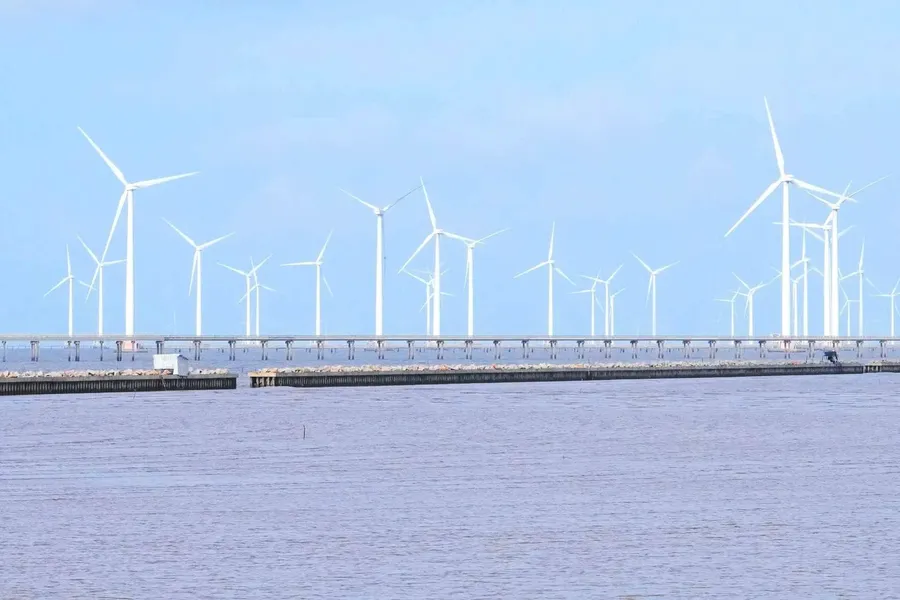
The two entities take different forms. At Song Hau, Hoa Phat is a 30% shareholder alongside other parties. At the new company, Hoa Phat holds 99.98% and appoints the capital manager itself. Added together, the capital the group has committed to renewable entities in 2026 is about VND 1,250 billion, or roughly 5.3% of nine-month net profit (VND 600 billion plus VND 649.87 billion, against VND 23,746 billion). In about five months, then, Hoa Phat has set up two renewable entities: one co-invested with partners, one almost entirely its own.
What a New Business Means for a Steelmaker
Wind and solar differ from steel in how capital turns over, and this is a feature of the sector rather than of Hoa Phat specifically. First, VND 650 billion is the capital to found the company. A large power project typically needs many times that, mostly from borrowing, so the true scale of the business appears only once a project exists. Second, a power plant collects cash gradually over many years of electricity sales, while a steel mill's profit moves with steel prices quarter by quarter. Third, a project's revenue depends on the power tariff, grid connection and the power purchase agreement, factors outside the company's control.
At today's scale these points are small relative to the group. They matter only once Hoa Phat announces a specific project with large investment capital.
What to Watch
The VND 649.87 billion equals about 2.7% of nine-month net profit, so the new company does not yet change Hoa Phat's near-term profit picture. Group earnings still follow steel output and steel prices.
What will show how big the renewable business becomes is the next two kinds of documents for the new company: a specific project (site, capacity, power buyer) and a capital increase plan. If the company's capital stays around VND 650 billion, this is a side business. If the board approves capital increases into the thousands of billions of dong, the business starts to deserve a place next to steel in how Hoa Phat's reports are read.