


In the early hours of 12 November, Vietnam time, MSCI published the results of its November 2026 review of the frontier market indices. According to the original list released on 11 November, the main MSCI Frontier Markets Index adds two Vietnamese stocks, Nam Long (NLG) and Phu Nhuan Jewelry (PNJ), and removes DIC Corp (DIG), FPT Securities (FTS) and PC1 Group (PC1).MSCI The changes are made at the 30 November closing prices and take effect on 1 December 2026.CafeF
The detail most readers will skip sits in the first line of MSCI's document: the review uses data as of the 20 October 2026 cut-off date.MSCI Think of it as MSCI taking a photograph on that day and scoring the picture. Share prices in the week of the announcement, or each quarter's profit and loss, are not in the frame.
Vietnam makes up nearly a third of the index
As of 31 October, Vietnam accounted for 31.25% of the MSCI Frontier Markets Index, well ahead of second-placed Romania (13.7%), Morocco (9.07%) and Slovenia (6.43%).CafeF At the end of July the weight was 29.12%, a rise of about 2.1 percentage points in three months. Vietnam Finance notes that the increase reflects share prices and cross-market movements, not only new additions.Vietnam Finance
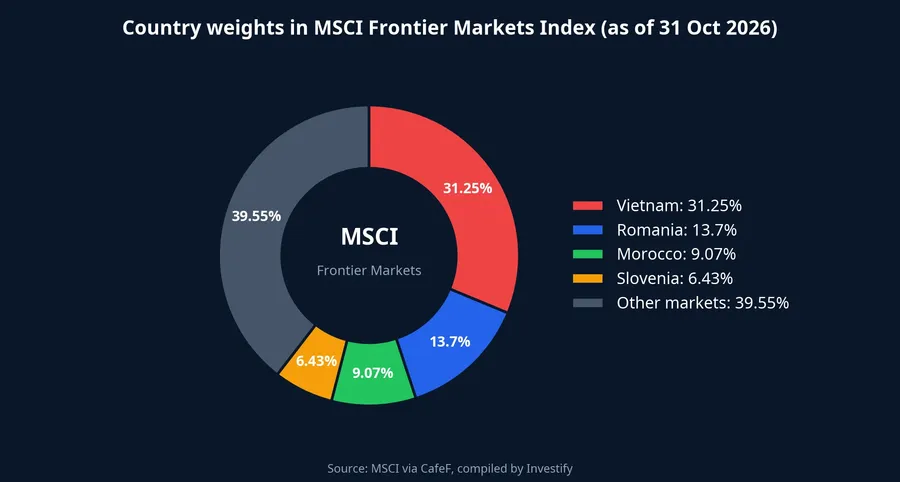
That weight is concentrated in a few names. VIC leads the entire index at 10.65% and VHM ranks seventh at 2.03%.CafeF Together, the two Vingroup stocks make up more than 40% of Vietnam's share. For anyone holding PNJ or NLG, that changes how to read the news: a new entrant joins an already crowded block of Vietnamese stocks, so its own weight is far smaller than VIC's, and the money flowing through it scales accordingly.
How MSCI scores a stock
According to MarketTimes, MSCI selects stocks on market capitalisation, free-float-adjusted market cap, liquidity and accessibility for foreign investors. The outlet does not mention profit or recent price moves as criteria.MarketTimes
For stocks with foreign ownership limits, as in Vietnam, accessibility is measured by the foreign room still open. As MarketTimes describes MSCI's methodology, a new stock is considered only if at least 15% of room is open. If open room is between 15% and below 25%, the shares counted in the index are multiplied by 0.5. At 25% or more there is no room-related discount.MarketTimes
MSCI gives no stock-by-stock reasons in its published list. The safest reading is to set each stock's numbers against these criteria on the cut-off date itself.
| Ticker | Close, 20 Oct (VND) | Total market cap, 20 Oct | Review result |
|---|---|---|---|
| NLG | 21,400 | about VND 10,400 billion | Added to main index |
| PNJ | 19,750 | about VND 10,100 billion | Added to main index |
| DIG | 9,580 | about VND 8,100 billion | Removed from main, added to small-cap |
| FTS | 19,200 | about VND 7,300 billion | Removed from main, added to small-cap |
| PC1 | 16,174 | about VND 6,700 billion | Removed from main, added to small-cap |
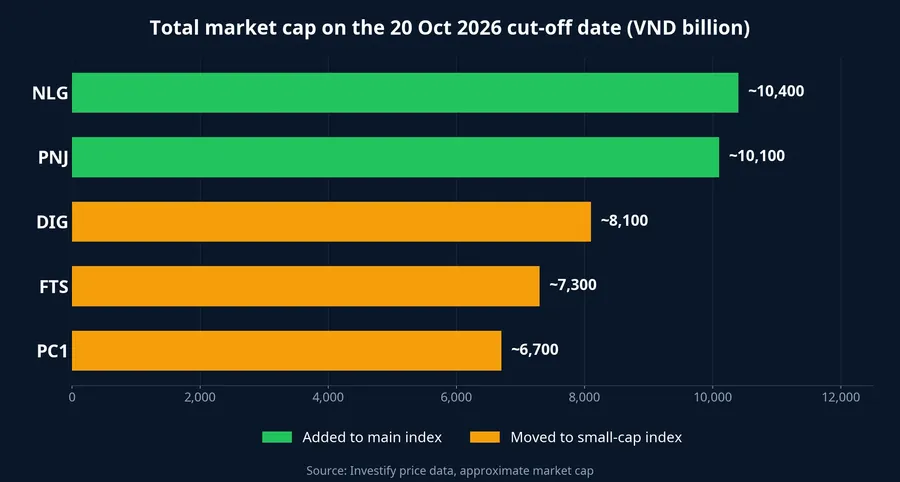
Both additions have a larger total market cap than the three removals. But this is total market cap. MSCI uses market cap after stripping out non-free-float shares and adjusting for foreign room, so the table shows direction, not MSCI's own calculation. The gap between DIG and PNJ is also too small for size alone to explain everything.
PNJ: foreign room opened after months of foreign selling
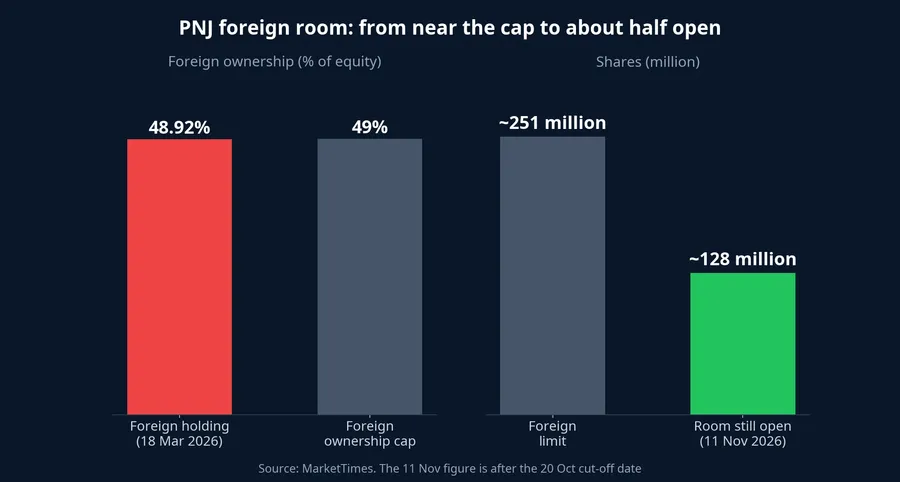
PNJ shows the room criterion most clearly. According to the 2025 annual report cited by MarketTimes, foreign investors held 48.92% of PNJ on 18 March 2026, just under the 49% cap. Open room was close to zero, so PNJ could not meet the minimum threshold for a new stock.MarketTimes
After months of foreign selling, open room at PNJ on 11 November was about 128 million shares out of a foreign limit of about 251 million.MarketTimes In other words, roughly half the limit is unused. That figure falls after the 20 October cut-off, so it shows the trend from March to November rather than a measurement taken on the day MSCI scored. MarketTimes argues that this capital-flow shift helped PNJ fit MSCI's accessibility criterion.
Room is not the only factor. PNJ's liquidity before the cut-off was heavy: about 16.3 million shares traded on 20 October and about 51.8 million on 7 October. MarketTimes says this trading volume helped PNJ meet the liquidity criterion. So at least two factors pushed PNJ over the line: wider room and high liquidity. The data leans toward room as the factor that changed the stock's status, since it was the condition PNJ could not meet while foreign holders sat near the cap.
On results, PNJ's Q3 2026 financial statements show a net loss of VND 258 billion for the quarter, but nine-month cumulative profit is still VND 471 billion, down 71% from a year earlier.MarketTimes Neither figure affects the review outcome, because MSCI does not use profit to pick stocks.
NLG: the largest market cap of the five
NLG had a total market cap of about VND 10,400 billion on the cut-off date, the largest of the five stocks changing this time. It is not the first time NLG has appeared in the change list: in the May 2024 review, MSCI removed NLG from the MSCI Frontier Markets Index.The Investor The source gave no specific reason at the time.
DIG, PC1 and FTS remain inside the MSCI family
Leaving the main index does not mean leaving MSCI altogether. According to the small-cap list, DIG, FTS and PC1 are all added to the MSCI Frontier Markets Small Cap Index in the same review. Some outlets listed the third ticker as "FPS", but MSCI's original document reads "FPT Securities", which is FTS.MSCI
In the small-cap index, Vietnam has 7 additions and 6 deletions. Besides the three stocks moving down from the main index, four others are added: HII, HPA, HVH and MZG. The six leaving are DBD, STK, GHC, JVC, RAL and VFG. Across the main index, MSCI adds 12 stocks and removes 10, bringing the total to 248.CafeF
For holders of DIG, PC1 or FTS, this means two groups of funds will stand on opposite sides on 30 November: funds tracking the main index will sell, and funds tracking the small-cap index will buy. Vietnam Finance points out that removal from the main index does not necessarily bring matching selling pressure if the stock stays in another index.Vietnam Finance Which side wins depends on how much money tracks each index.

The 30 November session and what to watch
Index-tracking funds usually place orders to match the closing price on rebalancing day, so volume in the closing auction on 30 November is where fund flows will show up most clearly. The actual impact depends on each stock's new weight, each fund's size and how each fund builds its portfolio. Being added to an index does not guarantee a large inflow.Vietnam Finance
This review also changes index membership only, not market classification. MSCI still classes Vietnam as a frontier market, while FTSE Russell has upgraded Vietnam to secondary emerging, effective 21 September 2026.Vietnam Finance
Between now and 30 November, three signals are worth tracking:
- Brokerage estimates: before each rebalancing, research desks usually publish the expected fund buying and selling volume per stock. Setting that number against the stock's average daily volume shows whether fund flow is large or small relative to normal trading.
- Closing-auction volume on 30 November: if closing volume in PNJ and NLG is well above average, fund buying genuinely went through. If it is no different, fund flow was small relative to the stock's usual trading. The same yardstick applies to the three stocks moving to the small-cap index.
- PNJ's foreign room at the next review: open room decides whether the stock faces the 0.5 factor. If foreign investors buy back and room narrows below 25%, the market cap counted in the index could be discounted in later reviews.
The takeaway is simple: this result is a snapshot of 20 October, so price moves in the days since do not rewrite the list. What will show the real weight of the change is closing-auction volume on 30 November. The next review is expected to be announced on 9 February 2027, early on 10 February Vietnam time, effective 1 March 2027.CafeF