


Two companies file VAT refund claims in 2026. One gets its money in about a week. Another waits more than a month, and a third has its claim rejected. What decides who lands where is the processing track the tax authority assigns, based on each company's compliance history.
On the morning of 12 November, at the National Assembly's question-and-answer session, Finance Minister Ngô Văn Tuấn laid out figures for each group in reply to deputies. This article puts the three groups side by side around the same three questions: who is in the group, how long the money takes, and why.
Context: the full-year refund budget is almost spent
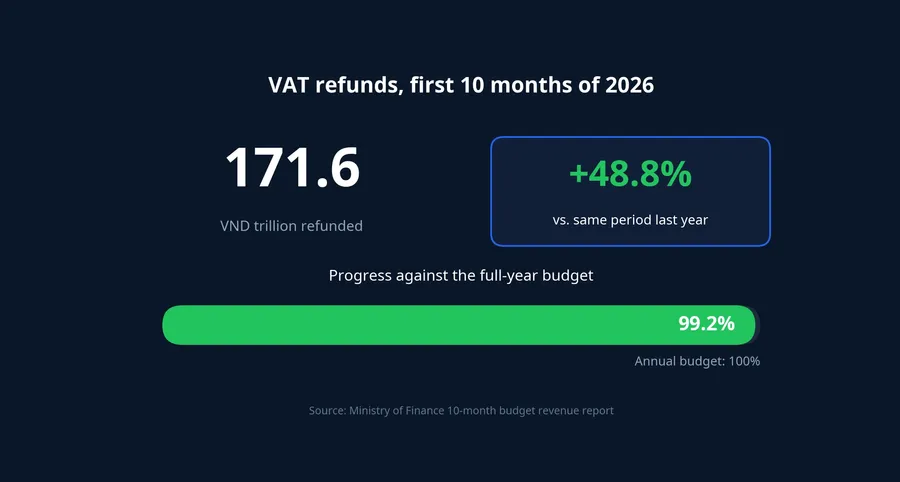
According to the Ministry of Finance's 10-month budget revenue report, VAT refunds under the standard regime reached VND 171.6 trillion, or 99.2% of the 2026 budget and up 48.8% from a year earlier.CAND Only about 0.8% of the budget is left, with roughly seven weeks of the year to go.
A large total does not mean fast refunds. At the session, the Minister acknowledged that refunds are still slower than required. "Almost every meeting, the Prime Minister reminds me to look at this. People are still complaining a lot about refunds, they are slow," he said.Znews In his view, when companies already struggle to access credit, delayed tax refunds leave capital tied up.
Group one: the green lane, refund first and audit later
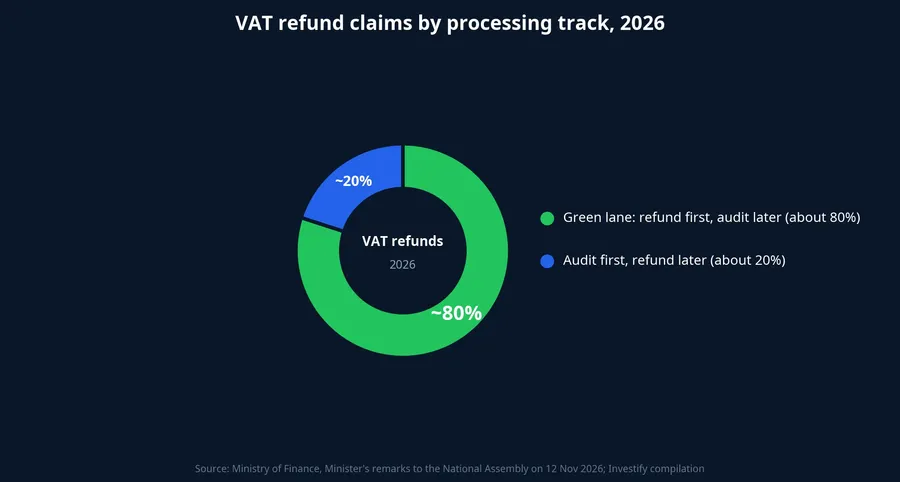
Who is in it. The Ministry of Finance directed that claims be sorted by each company's record of legal compliance. Companies with a good record go into the green lane, about 80% of all claims, where the rule is refund first, inspect afterwards.Thời báo Tài chính
How long the money takes. 88% of green-lane claims are refunded within 7 working days.Thời báo Tài chính The rest of the lane is resolved in roughly 7 to 10 days.VTC News
What to keep in mind. Refund first does not mean no scrutiny. Tax officials still inspect after paying out, so green-lane companies need to keep invoices and input documents in order so that a refund already received is not adjusted later.
Group two: audit first, refund afterwards
Who is in it. The remaining 20% or so of claims must pass inspection before any money moves.Thời báo Tài chính According to the Minister, matching invoices for this group still takes time to verify, because risk is concentrated among companies with compliance problems.
How long the money takes. Average processing time has fallen from about 50 days to about 40 days, and the press ties that figure to the audit-first group.Znews It is the actual reported processing time, not a statutory deadline for each claim.
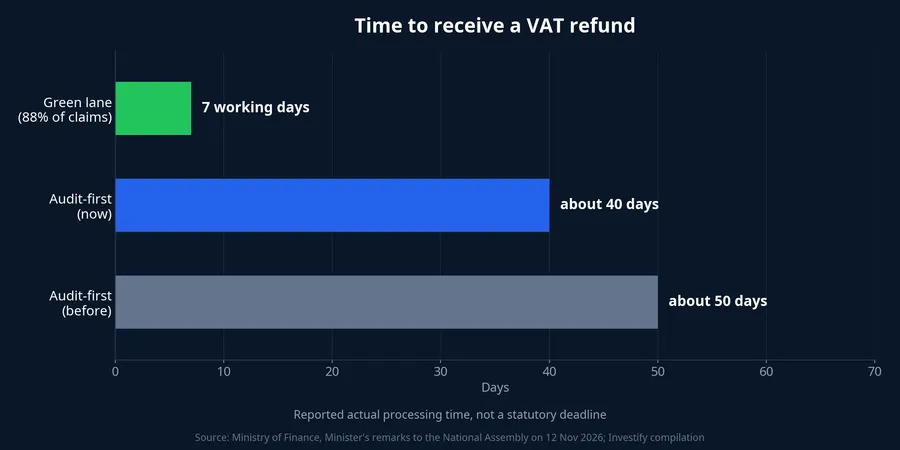
Compared with the green lane. Money in this group sits about a month longer. For exporters with large deductible input VAT, the group deputy Dương Khắc Mai raised in his question, that gap is working capital that has to be found elsewhere.
Group three: rejected claims
In the first 10 months of 2026, tax officials rejected refunds of more than VND 10,000 billion.Thời báo Tài chính The Minister said the reasons were incomplete files and the need to cross-check invoices. He added that 100% of refund claims are now received and processed electronically, yet risk remains very high.
That risk ties directly to the invoice trading that deputy Hà Đức Minh (Lào Cai delegation) raised in the same session. In reply, the Minister acknowledged that trading in invoices and setting up shell companies to exploit tax policy still exist.Thời báo Ngân hàng An illegally traded input invoice is input tax that never existed. If cross-checking misses it, the budget refunds tax that was never paid. That is why tax officials keep the 20% group under audit-first review, even though companies in it wait longer.
The VND 10,000 billion figure is not money stuck in a backlog. A claim rejected for missing paperwork can be supplemented and filed again.

When tax officials sit on a valid claim
Deputy Trần Anh Tuấn (Ho Chi Minh City delegation) raised a fairness question between the two sides. Companies that pay tax late owe a late-payment charge of 0.03% per day, he noted.Znews The 2019 Law on Tax Administration once required the State to pay corresponding interest on late refunds, but the 2025 law no longer does.
The Minister answered with the principle that whoever is at fault bears the consequences. If a taxpayer files a complete, compliant claim and the tax official who receives it fails to process it, responsibility must be firmly enforced, including material compensation to the taxpayer.Thời báo Tài chính He attached one condition: the file must be correct and complete.
The stage of this principle matters. It is a statement made at a Q&A session, not a rule. On the proposal to restore interest payments when tax officials refund late, the Minister said the Ministry of Finance will keep studying it carefully.Znews So companies have no document yet to cite when claiming interest or compensation for time spent waiting.
The three groups side by side
| Green lane | Audit first | Rejected | |
|---|---|---|---|
| Who is in it | Companies with a good compliance record, about 80% of claims | About 20% of claims, the higher-risk group | Incomplete files or claims caught in invoice cross-checks |
| When money arrives | 88% of claims within 7 working days | About 40 days on average | No refund, more than VND 10,000 billion in 10 months |
| Remaining risk | Post-refund inspection | Waiting for invoice cross-checks | Supplement and refile |
Refund speed depends first on the track a claim is assigned, not on whether it was filed early or late. Companies with a strong compliance record get capital back in about a week. Companies on the audit-first track should add roughly another month to their cash-flow plans.
Reading an exporter's financial statements
Input VAT that has not been refunded sits on the balance sheet under deductible VAT. When reading an exporter's quarterly report, you can set that line next to short-term borrowings. If both rise over several quarters, that is a cue to dig further into whether refunds are arriving slower than orders. It is not a conclusion, since short-term debt can rise for many other reasons.
What to watch: claims filed in the last two months of the year
With about 0.8% of the budget left, the question for claims filed in November and December is whether refunds keep being paid out at the pace of earlier months. The Ministry of Finance's 11-month budget revenue report will answer it. If VAT refunds in that report exceed 100% of the budget, year-end claims are still being paid. If the figure stays around 99.2%, companies filing late in the year should plan for a wait longer than the average for their track.