

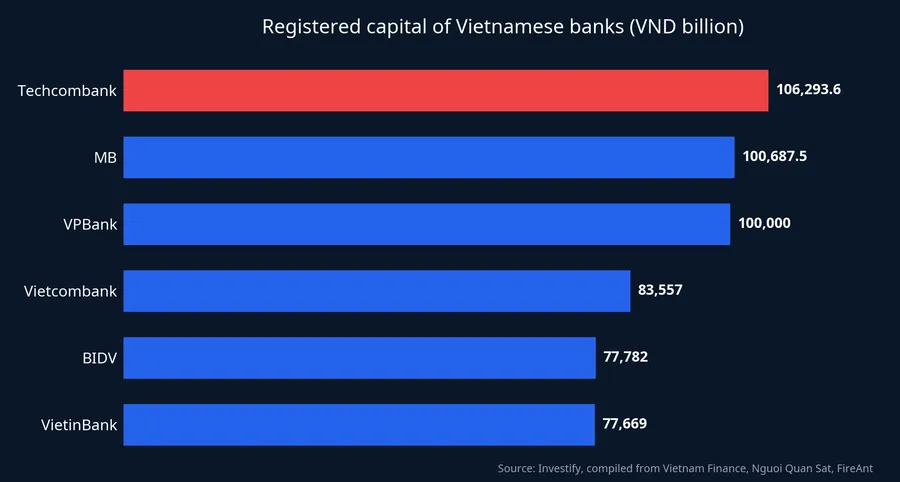
Techcombank (TCB) has become the bank with the largest charter capital in Vietnam's banking system, at VND 106,293.6 billion. The increase of more than VND 35,431 billion is not fresh cash from shareholders. It is profit the bank earned in earlier years, moved from the "undistributed profit" line to the "charter capital" line on its balance sheet.
Put simply, the same pot of money moved from one drawer to another in the same cabinet. For someone holding TCB shares, the issuance changes the number of shares in the account, the price on the board and earnings per share. It does not change their ownership stake in the bank. Meanwhile, consolidated net profit for the first nine months of 2026 came to VND 23,014 billion, up 21.3% from a year earlier.Vietnam Finance
The issuance closed on October 30
Techcombank's board of directors approved the results of the stock dividend issuance. The issuance ended on October 30, 2026 at a 50% ratio: a shareholder with 100 shares received 50 new ones. The bank distributed more than 3.54 billion shares to 88,833 shareholders. A further 5,082 shares, left over from rounding fractions, were not distributed and were cancelled.Vietnam FinanceNgười Quan Sát
Total shares outstanding rose from 7,086,240,414 to 10,629,355,539, all in circulation. Charter capital rose accordingly, from VND 70,862.4 billion to VND 106,293.6 billion.FireAnt That puts Techcombank ahead of the two private banks that had just crossed VND 100,000 billion: MB at VND 100,687.5 billion after a share offering completed in September 2026, and VPBank at VND 100,000 billion after its own stock dividend.Người Quan Sát Among state-controlled banks, third-quarter 2026 reports show Vietcombank at VND 83,557 billion, BIDV at VND 77,782 billion and VietinBank at VND 77,669 billion.FireAnt
Where the VND 35,431 billion comes from
The source was cumulative undistributed profit in the audited 2025 financial statements.Vietnam Finance That is earnings from prior years that the bank has not paid out to shareholders in cash, and it has stayed in equity.
Techcombank's consolidated balance sheet at the end of September 2026 shows the mechanism clearly. Equity stood at VND 197,325 billion, of which undistributed profit was VND 71,681.5 billion. Once the dividend was completed, about VND 35,431.2 billion moved into charter capital. Undistributed profit fell by roughly the same amount and charter capital rose by roughly the same amount, so total equity did not gain a single dong from this issuance alone.
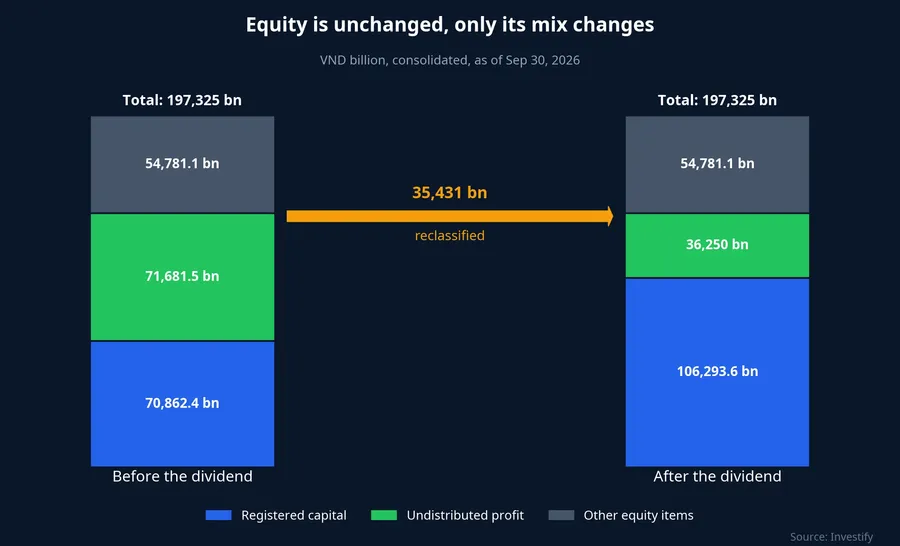
The money is real and was already inside the bank. It is profit that shareholders left in rather than took out. For 2025 earnings, Techcombank shareholders had already received a cash dividend of VND 700 per share, paid on June 10, 2026. The retained portion was then converted into shares in this latest issuance.
Because total equity is unchanged, the bank's capacity to absorb losses is not stronger just because charter capital is bigger. The figure to read for that is the capital adequacy ratio. According to Techcombank's third-quarter results release, its Basel II capital adequacy ratio at September 30, 2026 was 15.0%, and its Tier 1 ratio rose to 14.1%.Techcombank
What changes in a shareholder's account
The ex-dividend date was October 29, 2026. Anyone buying TCB from that session onward does not receive new shares from this issuance.
Share count. Someone holding 1,000 TCB shares on the October 30 record list now holds 1,500. Fractions below one share are cancelled, like the 5,082 shares mentioned above.
Share price. On the ex-dividend day, the reference price was adjusted down to reflect a 50% increase in share count, which in theory means dividing by 1.5. Historical TCB price series on data sites have also been restated at the same ratio. On November 10, TCB closed at VND 22,000. Multiplied by 10.63 billion shares, Techcombank's market value is about VND 233,800 billion. The value a shareholder holds does not rise because there are more shares; it is simply cut into smaller pieces.
Earnings per share. In the first nine months of 2026, consolidated profit attributable to Techcombank's shareholders was VND 21,964.1 billion. Divided by 7.09 billion old shares, that is roughly VND 3,100 of profit per share over nine months. Divided by 10.63 billion new shares, it is about VND 2,066. This is an illustrative calculation, not a reported figure, since official reports use the weighted average share count for the period.
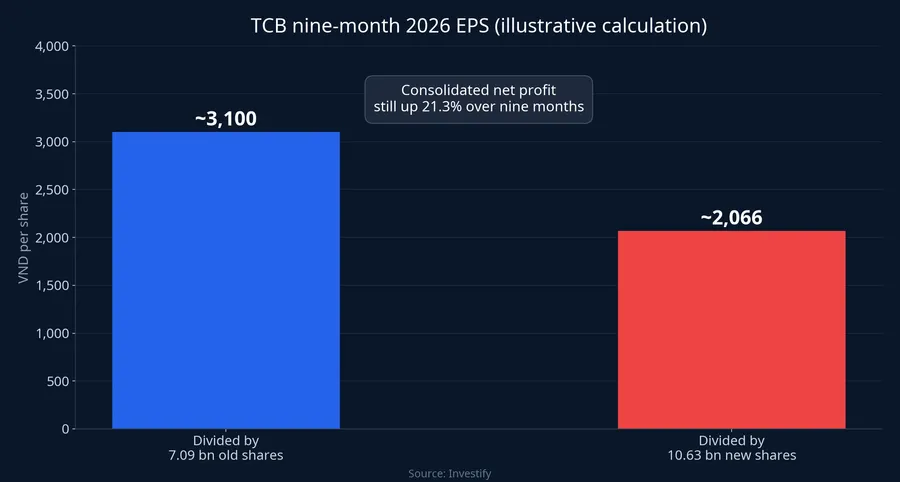
The bank's overall profit has not fallen. Each share now represents about two-thirds of the old earnings, while a holder owns 1.5 times as many shares. Their ownership percentage is unchanged because every shareholder received new shares at the same ratio.
The practical consequence is in how you read the numbers. Per-share metrics for TCB before October 29, such as earnings per share or book value per share, need to be divided by 1.5 before being compared with figures from now on. Data sites may adjust in different ways, so the same metric can show two different values depending on where you look.
Past VND 100,000 billion by two different routes
Three private banks have crossed VND 100,000 billion in charter capital in 2026, but not by the same path.
MB completed a share offering to existing shareholders in September 2026.Vietnam Finance In an offering, shareholders who want the new shares must pay for them. That cash goes into the bank and raises equity for real. Shareholders who do not subscribe see their ownership percentage diluted.
Techcombank and VPBank raised charter capital through stock dividends.Người Quan Sát Shareholders did not put in more money and the bank did not receive any. Charter capital rose because retained earnings were reclassified.
So a ranking by charter capital tells you the size of capital recorded in a bank's charter. It does not tell you which bank has just gained more money to lend. Two similar charter capital figures can sit alongside very different levels of equity. To compare resilience, put each bank's equity and capital adequacy ratio side by side.
The rest of the capital increase
On October 13, the State Bank of Vietnam approved an increase in Techcombank's charter capital of up to VND 35,730.97 billion. Of that, VND 35,431.2 billion came from the stock dividend, which is done. The remaining VND 299.77 billion comes from the employee share program. If both are completed, charter capital is expected to reach about VND 106,593 billion.Vietnam Finance
At a par value of VND 10,000, VND 299.77 billion equals about 29.98 million shares, roughly 0.28% of the share count after the dividend. That dilution is small next to the dividend just completed.
Conclusion
Techcombank's top spot in charter capital reflects profit the bank has accumulated and retained, not a new sum of money that just arrived. That does not make the capital any less real: it is still shareholders' money, simply recorded on a different line. But for the same reason, charter capital is not a yardstick for loss-absorbing strength.
For TCB holders, the next marker is the fourth-quarter 2026 financial statement, the first period in which the 10.63 billion share count enters the earnings-per-share calculation. If profit keeps growing close to the nine-month rate of 21.3%, earnings per share on the new share count could gradually narrow the gap. If profit stalls, the gap from the 50% larger share count will show up plainly in valuation ratios. As for how sturdy the bank is, the yardsticks remain equity and the capital adequacy ratio, currently 15.0%.