

Today, November 6, the State Bank of Vietnam (SBV) is running a USD/VND swap of up to USD 2 billion with a tenor of 182 days.VietnamBiz The size is nothing new: September's round also carried a USD 2 billion cap. What has changed is the clock. Participating banks keep the dong for about six months, through year-end and the Tet holiday, while earlier rounds gave them anywhere from a few days to three weeks. In exchange, there is a new entry condition: only banks with medium- or long-term foreign borrowings, or international bonds, can sign up.
Both changes answer the same question: where does longer-dated dong funding go in the banking system, and who gets to use it first?
How one swap works
An FX swap is two opposite trades signed at the same time. Under the plan the SBV announced on November 3, the bank first sells USD to the SBV at a spot rate of VND 24,399 per USD and receives dong from the value date of November 9, 2026. When the contract matures, the bank buys back exactly the same amount of USD at a forward rate of VND 24,704, which means paying VND 305 more per dollar.VietnamBiz
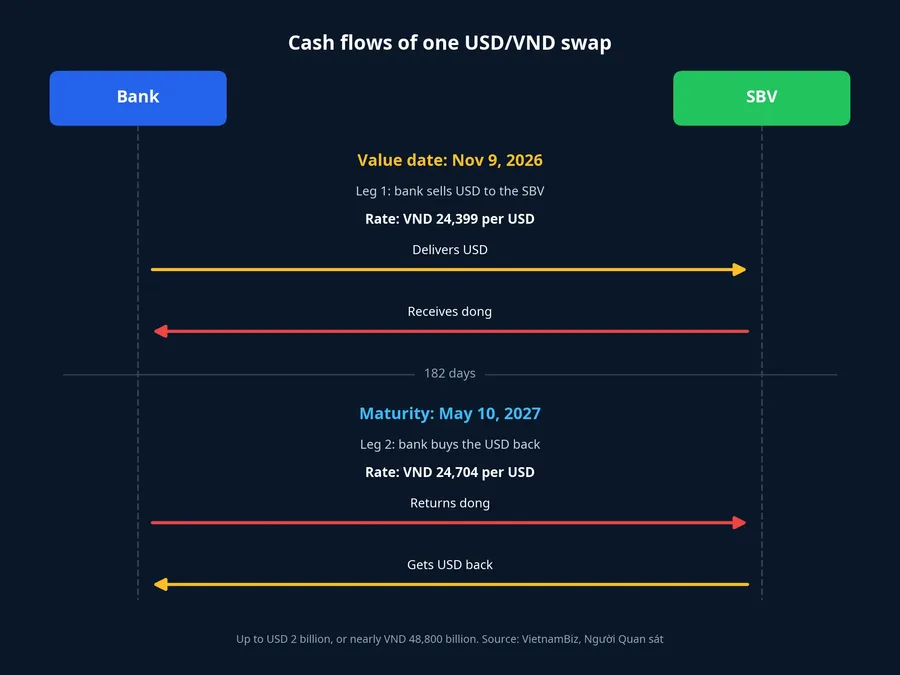
If the full quota is used, the initial dong injection is nearly VND 48,800 billion, and the SBV takes it back at maturity, scheduled for May 10, 2027.Người Quan sát The VND 48,800 billion figure is a ceiling; the actual amount depends on how today's session turns out.
Because the same dollars go out and come back, what matters for a participating bank is the gap between the selling leg and the buy-back leg. The spot rate of VND 24,399 sits close to the SBV's posted buying rate of VND 24,392 on November 5, and far below that day's interbank rate of VND 25,720.Thời báo Ngân hàng
How 182 days differs from earlier rounds
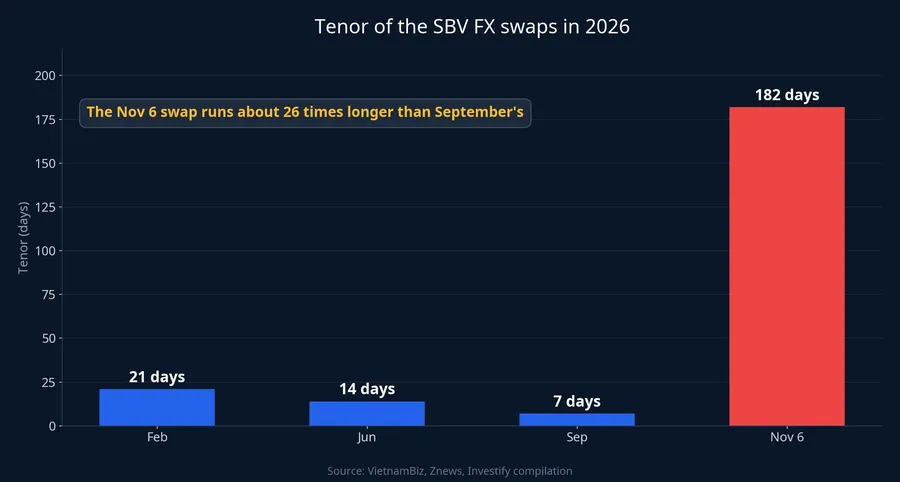
Since the start of 2026 the SBV has used swaps up to seven times, with tenors from 3 to 21 days.Công an Nhân dân The rounds media most often cite ran 21 days in February, 14 days in June and 7 days in September.Znews Against the latest one, this tenor is 26 times longer.
Short swaps have a flip side: money that comes in fast has to go back fast. According to Thời báo Tài chính Việt Nam, overnight interbank rates briefly touched almost 20% a year on February 3, the highest since October 2011, then fell to 4.6% by month-end after the SBV injected net funds and ran swaps. In early March overnight rates topped 10% again. The paper listed USD 3 billion of maturing swap contracts as one cause, alongside maturing open-market lending and Treasury deposits.Thời báo Tài chính Việt Nam
Put simply, every short swap creates a repayment date ahead. If that date lands when the market is short of cash, the pressure piles up. A 182-day tenor pushes repayment to May 2027, beyond the year-end lending season and the pre-Tet cash withdrawals. Công an Nhân dân, citing VPS Securities, also judges that the longer term lets banks worry less about constantly finding replacement funding.Công an Nhân dân
Interbank rates: dong is costly at the long end
Early-November interbank rates split into two very different stretches. At the short end money is cheap: on November 5, overnight stood at 4.5% a year and the 1-month rate at 5.4%.Thời báo Ngân hàng At the long end it costs far more. On November 2, the reference rate was 7.45% for 3 months, 7.9% for 6 months and 8% for 1 year.Znews
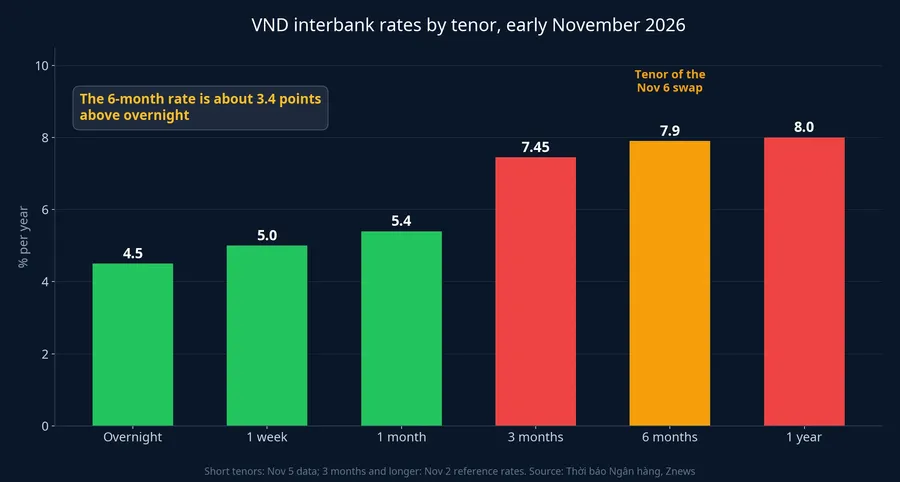
That gap explains why tenor matters more than size. A bank that needs money to lend for six months or a year but can only borrow overnight must keep rolling its debt, and each roll carries the risk of overnight rates spiking as they did in February and March. To lock in six-month funds, a bank must pay around 7.9% a year on the interbank market, or keep long-dated deposit rates high to hold on to customers.
The dong from this swap sits exactly in that six-month stretch. By the simple conversion the press uses, the VND 305 spread equals roughly 2.51% a year.Người Quan sát That figure leaves out the cost of the dollars the bank must hold to put into the swap; for reference, the 1-month USD interbank rate was 4.04% a year on November 5. So 2.51% should not be set directly against 7.9% to conclude that banks gain that much, because the real cost depends on each bank's own dollar funding. An analyst at An Binh Securities (ABS), quoted by Công an Nhân dân, called swap costs "relatively favorable" given that interbank rates have recently trended up.Công an Nhân dân
Who gets in
The new condition narrows the field. According to VietnamBiz, the SBV swaps only with banks holding medium- or long-term foreign loans, or internationally issued bonds, with at least 12 months remaining. Each bank may register no more than the lower of 80% of the session quota and its total eligible foreign-currency debt, which caps any one bank at USD 1.6 billion.VietnamBiz The 80% limit already applied in September; the foreign-debt condition is the new element.
The condition fits the structure of the trade. A bank that borrows dollars long-term abroad already holds the dollars, and needs a way to convert them to dong while knowing the exchange rate at repayment. A swap does exactly that for six months. SHB is one example: when it issued Singapore-dollar bonds in October, it said it used a swap into USD to hedge currency risk over the bonds' life.VietnamBiz
VietnamBiz tallied recent international fundraising: a USD 1.44 billion syndicated loan at VPBank (VPB), USD 1 billion at Techcombank (TCB), USD 721 million at HDBank (HDB), USD 550 million at MB (MBB), USD 500 million at ACB and USD 340 million at SHB.VietnamBiz
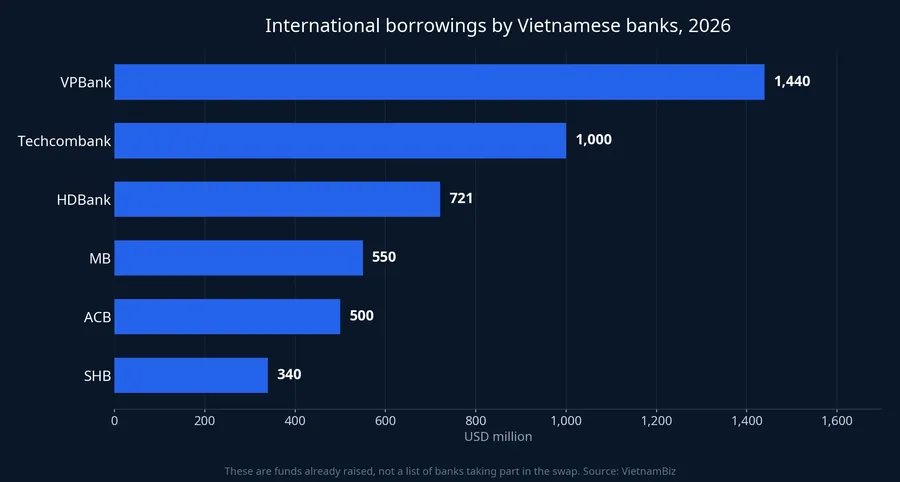
The list shows who holds medium- and long-term foreign funding. It is not a list of eligible banks or of banks taking part today. Remaining maturity, the actual balance of each loan and available dollars determine who gets in.
Selective support, not broad easing
The swap comes while the SBV is still draining cash through other channels. Over three straight sessions from November 3 to 5, it absorbed net VND 7,839 billion,Znews VND 7,143 billionNgười Quan sát and VND 3,646.28 billion through open market operations, with the pledged-lending rate held at 4.5% a year.Thời báo Ngân hàng Short-term cash is being pulled back while longer-term cash is offered to a group of qualifying banks.
That reading matches the cautious view of SSI Research, cited by Công an Nhân dân: this is selective liquidity support, not broad monetary easing. SSI Research says the next effect depends heavily on whether the SBV does this once or makes it a regular tool.Công an Nhân dân Thời báo Tài chính Việt Nam reports the SBV assesses that the measure gives credit institutions more abundant dong funding and helps lower the overall interest rate level.Thời báo Tài chính Việt Nam
Short-term interbank rates also respond to other forces: maturing open-market lending, Treasury deposits and the year-end lending season. So if overnight rates fall next week, the swap cannot take all the credit. The cleaner test is the 3- to 6-month stretch, which is what this tool targets.
What depositors, borrowers and bank shareholders may see
A bank's long-dated deposit and lending rates follow its own long-dated funding cost. If today's session is used at large volume, participating banks gain an extra six-month dong source on top of customer deposits and interbank borrowing. The pressure to keep 6- to 12-month savings rates high could then ease first at those banks. This is Investify's conditional reading, based on how the press describes the mechanism, not an SBV commitment on any bank's rates.
In the other direction, if the allotted volume is low, the effect on savings and lending rates will be hard to see. Banks that don't qualify still have only their existing funding, so the deposit-rate gap between the two groups could widen rather than narrow.
For bank shareholders, the eligibility rule creates differences in access to funding between banks. How large the difference is depends on what each bank actually receives. The trace will appear more slowly, in funding costs and net interest margin (NIM) in Q4 and Q1 2027 reports.
Signals to watch
The thesis of this piece is that the 182-day swap targets the costliest tenor in the interbank market, and that the first beneficiaries are qualifying banks rather than the whole system. It holds if the allotted volume is large enough. The SBV's announcement of the session result will show that number: close to USD 2 billion, or nearly VND 48,800 billion, means six-month dong funding big enough to affect the costliest tenor; only a small share of the quota used means the session mostly serves as a policy signal.
After that, the second marker is the 3- and 6-month interbank reference rates in coming weeks, against 7.45% and 7.9% on November 2. The third is whether the SBV runs another long-tenor swap. According to SSI Research, that is what will decide the effect on bank funding in 2027.