


Between November 5 and December 4, 2026, Mr. Nguyen Do Lang, founder of Apec Group, is cleared to sell 10 million APS shares and 10 million API shares. According to the HNX disclosure of November 4 reported by CafeF, both sales are registered as negotiated and order-matching trades, with "personal needs" given as the purpose.CafeF
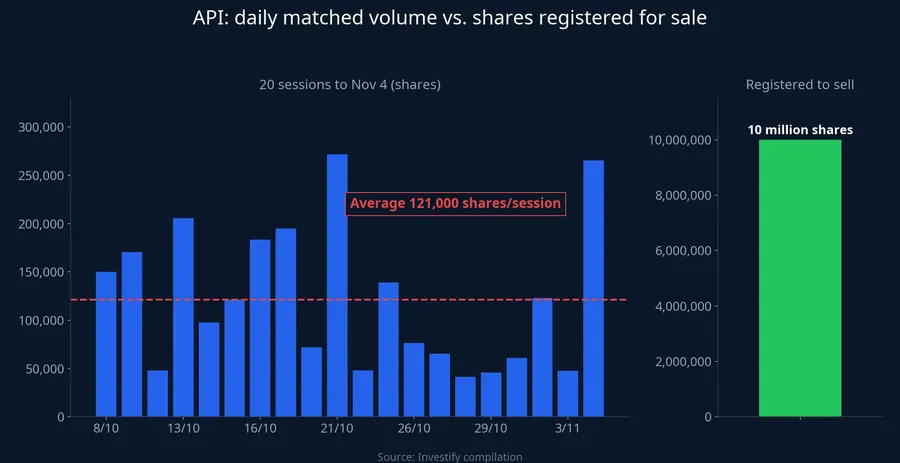
For anyone holding either stock, the number to set beside the registered volume is liquidity. Over the 20 sessions to November 4, API matched an average of about 121,000 shares a day. Ten million shares therefore equal the matched volume of roughly 82 sessions added together, while the registration window has only 22 trading sessions.
What Mr. Lang is selling, and what he would keep
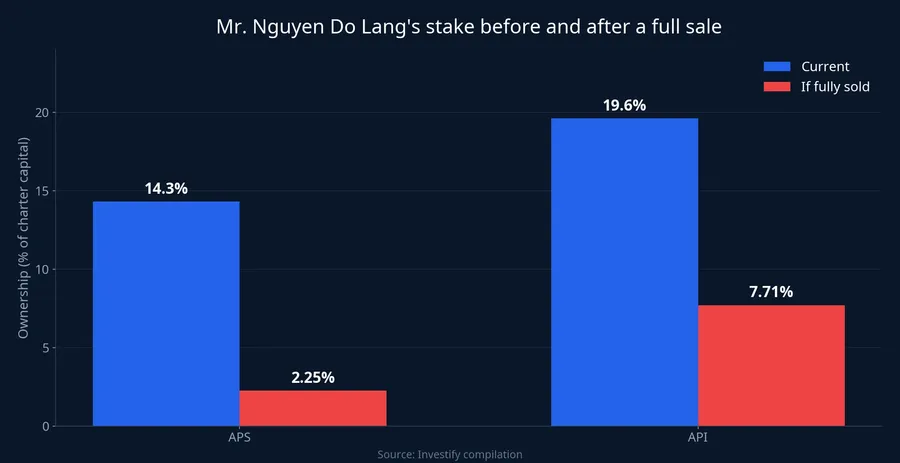
At Asia Pacific Securities JSC (APS), Mr. Lang holds just over 11.87 million shares, or 14.3% of charter capital. If he sells the full amount, he is left with about 1.87 million shares, or 2.25%, and would no longer be a major shareholder of the brokerage he founded.Fireant Doanh Nhan VN magazine puts the post-sale stake at 2.26%.Doanh Nhân VN The gap comes from rounding and does not change the conclusion.
At Asia Pacific Investment JSC (API), he holds just over 16.48 million shares, or 19.6%. Selling 10 million leaves about 6.48 million shares, or 7.71%. He would remain a major shareholder of API.CafeF
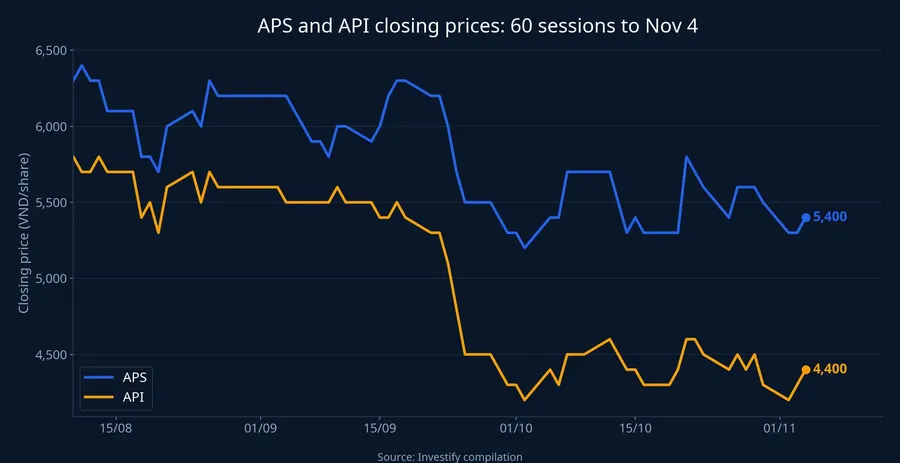
At the November 4 close, APS traded at VND 5,400 and API at VND 4,400 per share, so the two blocks together are worth about VND 98 billion.Fireant
Mr. Lang no longer holds a management position at either company.Doanh Nhân VN His sales must be disclosed in advance because he is a related person of Ms. Nguyen Do Hoang Lan, his daughter and a board member at both APS and API.Tin nhanh chứng khoán Ms. Lan holds 800,000 APS shares (0.96%) and 800,000 API shares (0.95%).CafeF
Registered volume against real liquidity
Over the last 20 sessions, APS matched an average of about 421,000 shares a day. Selling all 10 million APS shares through order matching alone would take the full matched volume of nearly 24 sessions, more than the window allows. For API the figure is about 82 sessions.
This comparison says nothing about where the price goes. It speaks only to how the sale could be done: to sell everything within 22 sessions, most of the volume would likely have to go through negotiated trades, or matched liquidity would have to rise many times over. The registration is also a ceiling, not a guarantee of what will actually be sold.
Both companies are loss-making after nine months
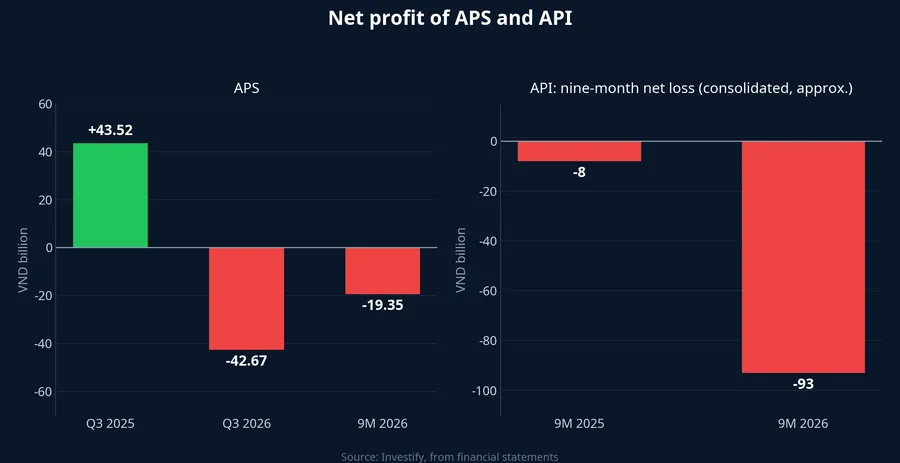
At APS, the Q3 2026 financial statements show operating revenue of under VND 10 billion, down about 90% year on year. The company posted a net loss of VND 42.67 billion for the quarter, against a profit of VND 43.52 billion in Q3 2025. Per Nguoi Dua Tin, the loss came from a proprietary portfolio that fell in value, with a fair-value revaluation loss of VND 54.98 billion on financial assets through profit or loss.Fireant Brokerage revenue also fell, from VND 3.6 billion to nearly VND 1.3 billion.Báo Pháp Luật Việt Nam
For the nine months, APS lost VND 19.35 billion even after reversing nearly VND 51.84 billion of management-expense provisions. Undistributed after-tax profit stands at negative VND 94.59 billion.Fireant On the other side of the ledger, APS carries almost no debt: at September 30, liabilities were only about VND 5.4 billion against total assets of more than VND 757.4 billion.Báo Pháp Luật Việt Nam
API, on a consolidated basis, reported Q3 net revenue of about VND 6 billion and a net loss of more than VND 38 billion.Fireant Over nine months it lost about VND 93 billion, compared with a loss of nearly VND 8 billion a year earlier.Doanh Nhân VN
The link between APS earnings and Apec-group share prices
What sets this case apart from an ordinary major-shareholder sale is APS's proprietary portfolio. The brokerage holds shares of companies in its own ecosystem: API, IDJ, Apec Group and Apec Finance. Per Nguoi Dua Tin, this "Apec family" group of investments carries an unrealized loss of about VND 289 billion against cost.Fireant
The accounting makes the link tighter. Financial assets through profit or loss are revalued at market price at the end of each reporting period, so the API and IDJ prices on the last day of a quarter flow straight into APS's earnings for that quarter. The Q3 revaluation loss of VND 54.98 billion is one example. IDJ closed at VND 2,900 per share on November 4.
The upshot is that an APS holder carries two sources of risk at once. One is the brokerage and margin-lending business itself. The other is the price of API and IDJ, two thinly traded stocks that sit in the same group that was once investigated.
Legal background and trading restrictions
On June 28, 2023, the Investigation Security Agency of the Hanoi Police issued a decision to prosecute Mr. Nguyen Do Lang and four other individuals as suspects and ordered their detention, to investigate stock-market manipulation under Article 211 of the Criminal Code. The case involved trading in APS, API and IDJ shares, and Mr. Lang was then APS's general director.CafeF This article refers only to the opening of the case and offers no view on its outcome.
Against the November 2021 peak, both stocks are down about 91%: APS from VND 59,900 and API from VND 46,330 per share. Both are now on HNX's warning and control lists and cannot be traded on margin.Doanh Nhân VN They still trade in every session. What changes for holders is that these shares cannot be used as collateral for margin loans, and cannot be bought with borrowed money.
For APS, the company itself explained the causes in its filing to HNX. The stock has been under control since July 2, 2025 because auditors issued a qualified opinion on the 2023 and 2024 financial statements. The warning status applies from April 6, 2026 because undistributed after-tax profit at December 31, 2025 was negative. APS says auditors fully accepted its 2025 financial statements and that it is recovering provisioned receivables to bring undistributed profit back above zero.Báo Pháp Luật Việt Nam
The milestones that will answer the rest
The first is Mr. Lang's trade-results report after December 4, which will show how much he actually sold and by which method. If most of the block goes through negotiated trades, daily matched volume in APS and API will be little affected. If it goes through order matching, liquidity in both stocks would have to rise sharply from today's average.
The second is APS's Q4 financial statements. The line to read is the revaluation gain or loss on financial assets, together with the unrealized loss on the Apec-family holdings against the roughly VND 289 billion at September 30. The API and IDJ prices on the last session of the year will decide that number. Undistributed profit is a third indicator to watch, since it is the condition for APS to leave the warning list, as the company itself has said.