


On the afternoon of October 29, a tael of DOJI's 9999 round gold ring sold for VND 141.5 million.VietnamBiz On October 30, DOJI listed the ring at VND 136 million to buy and VND 140 million to sell.FireAnt A buyer who took the ring back to the shop the next day would have received VND 136 million, which is VND 5.5 million less than they paid.
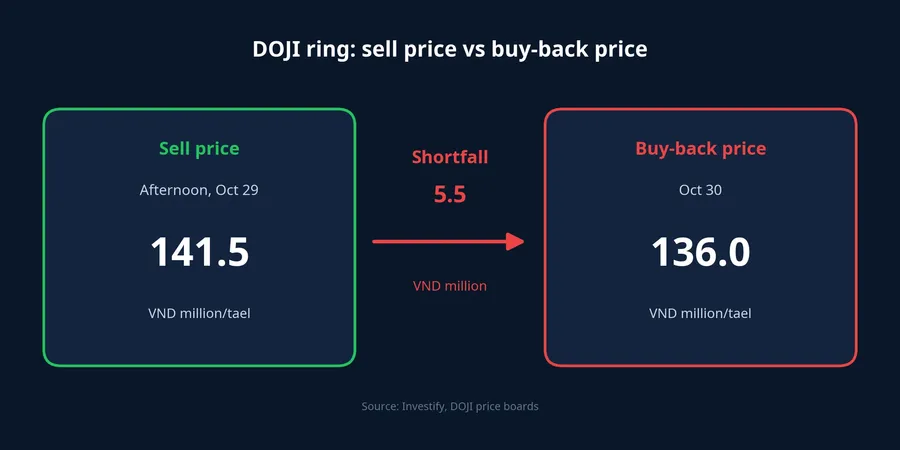
The price board shows a drop of only VND 1.5 million. The other VND 4 million or so is the gap between the shop's selling price and its buying price, a cost baked in the moment the buyer walks out the door. Put simply, you pay twice: once for the fall in the gold price, and once for the distance between the two boards. This piece walks through both layers, starting with the one that is easy to see.
The Oct 30 board: bars down 1.3 million, rings down 0.9 to 1.5 million
For gold bars, SJC, DOJI and PNJ all listed VND 138.4 million to buy and VND 141.4 million to sell, down VND 1.3 million per tael on both sides from the close of October 29.Người Quan Sát Bảo Tín Minh Châu sold bars at the same VND 141.4 million but bought back at only VND 136.2 million after its early-afternoon cut.FireAnt
Gold rings fell unevenly across brands:
- DOJI: VND 136 to 140 million per tael, down VND 1.5 million from the October 29 close of VND 137.5 to 141.5 million.FireAnt Some outlets report a VND 1.6 million drop because they start from the morning price on October 29.Người Quan Sát
- PNJ: down VND 1 million to VND 136 to 140 million in the morning, then listed at VND 137 to 141 million per tael by the afternoon.FireAnt
- Bảo Tín Minh Châu: plain rings at VND 136.2 to 140.2 million per tael in the early afternoon, after a further cut of VND 200,000 from the start of the session.FireAnt
- SJC: rings of 1 to 5 chi at VND 134.3 to 138.3 million per tael, after a further VND 400,000 cut in the early afternoon, bringing the day's total to VND 900,000.FireAnt
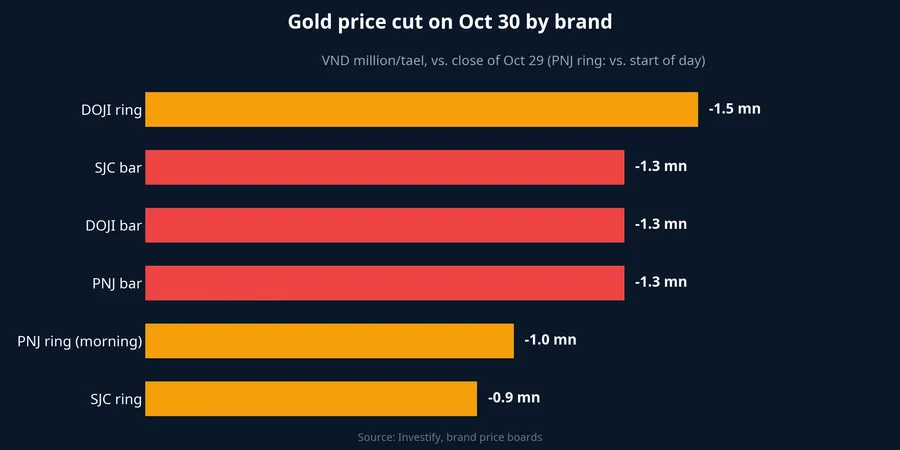
A one-day drop of VND 1 to 1.5 million is about 1% of a tael of ring gold. That is a notable move for gold in a single day, but it is not the biggest amount a holder gives up when cashing out.
Layer one: why the board fell
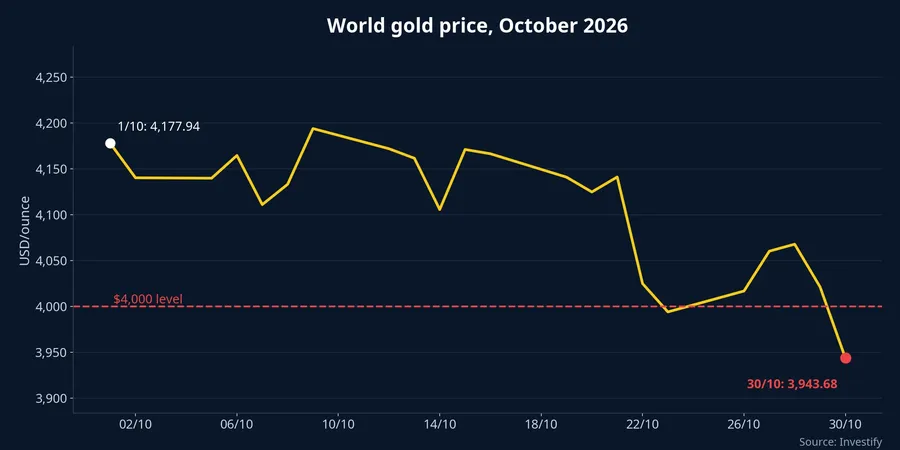
World gold closed on October 30 at $3,943.68 per ounce, down $77.63 or 1.93% from October 29. Against October 1 ($4,177.94 per ounce), the decline is 5.61%. This is not the first time gold has slipped below $4,000 this month: on October 23 it closed at $3,993.96, then recovered above that level from October 26 to 29 before falling back.
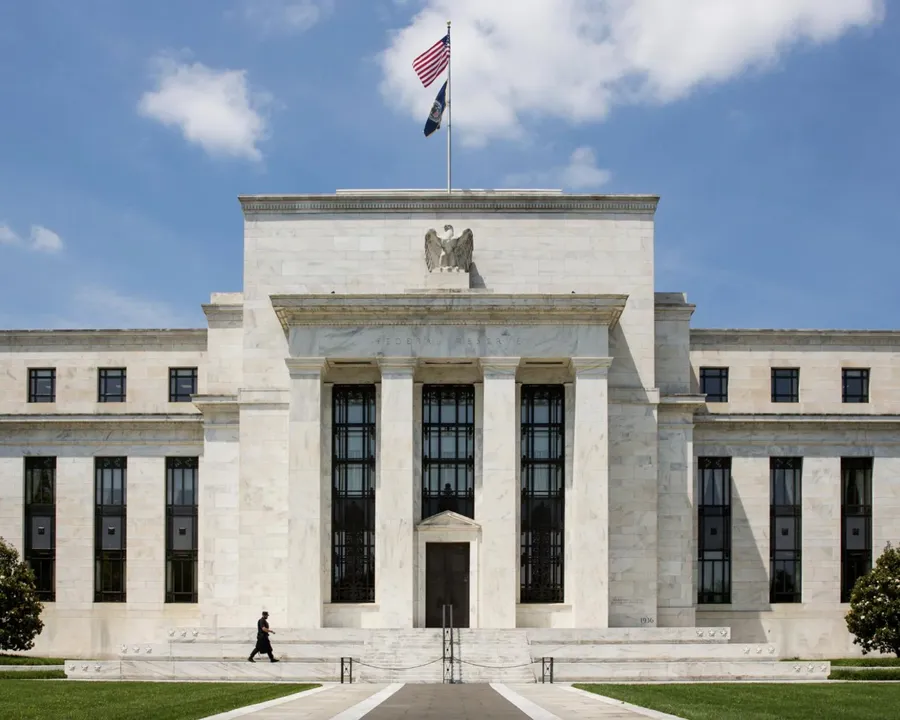
The main pull comes from US rate expectations. On October 28 the Federal Open Market Committee (FOMC) held rates at 3.75 to 4% in a 10-2 vote.Federal Reserve Both dissenters wanted to raise rates at that meeting. The Fed's statement said inflation "remains elevated" and economic activity is "expanding at a solid pace".
Data released afterward tilted the market further toward tightening. US third-quarter GDP grew 3.4%, and the September personal consumption expenditures price index rose 0.5% month on month. According to Reuters, as relayed by Người Quan Sát, markets are pricing in roughly an 80% chance of a Fed hike in December.Người Quan Sát That is a market expectation, not a Fed decision.
The mechanism linking the two is straightforward. Gold pays no interest. When US rates may rise further, holding dollar deposits or bonds pays more, so the opportunity cost of holding gold goes up and gold becomes less attractive.
Rate expectations are not the only factor. FireAnt notes that gold fell as oil rose and US inflation heated up.FireAnt Brent closed on October 30 at $112.91 per barrel, about 15% above its $98.03 level on September 30. Higher oil lifts inflation expectations, so it adds to the same rate-driven pull. The available data cannot say how much each factor contributed to the October 30 drop. What is clear is that they all push in one direction: the Fed has more reason not to ease yet.
From world prices to the shop board
Local gold shops do not reprice with every world session. They adjust in rounds, often several times a day. On October 30, brands cut prices from early morning, and some cut again in the early afternoon.
The local move also does not track the world percentage. In October, the SJC bar selling price fell from VND 144.3 million to VND 141.4 million per tael, about 2%, while world gold fell 5.61%. Domestic prices also depend on local supply and demand and on the supply of raw gold, so a holder cannot infer their own loss from the world percentage drop.
Layer two: the gap built in at purchase
Every gold shop posts two prices. The sell price is what the buyer pays. The buy price is what the shop pays when a holder sells back. The gap between them on October 30:
| Type | Buy | Sell | Gap |
|---|---|---|---|
| SJC, DOJI, PNJ bars | VND 138.4m | VND 141.4m | VND 3m |
| Bảo Tín Minh Châu bars | VND 136.2m | VND 141.4m | VND 5.2m |
| DOJI ring | VND 136m | VND 140m | VND 4m |
| PNJ ring (afternoon) | VND 137m | VND 141m | VND 4m |
| Bảo Tín Minh Châu ring | VND 136.2m | VND 140.2m | VND 4m |
| SJC ring, 1 to 5 chi | VND 134.3m | VND 138.3m | VND 4m |
Source: FireAnt and Người Quan Sát, October 30, 2026. Unit: VND per tael.
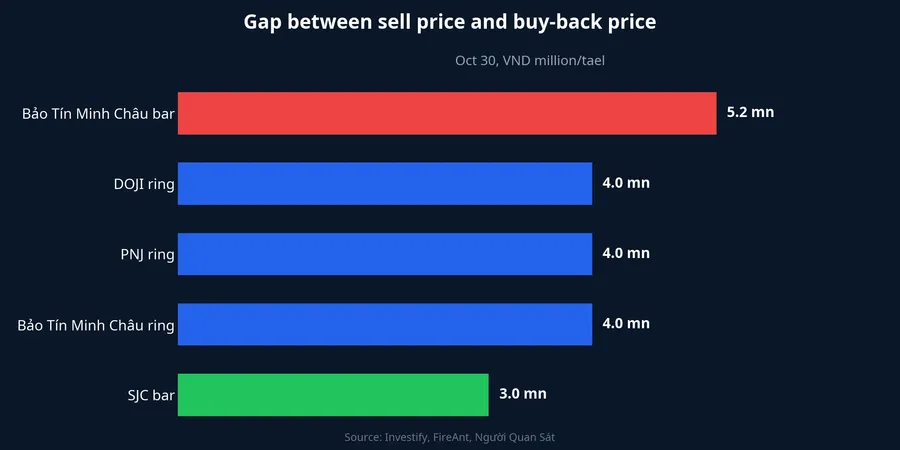
For the DOJI ring, the VND 4 million gap is about 2.9% of the VND 140 million selling price. For the SJC bar, the VND 3 million gap is about 2.1% of the VND 141.4 million selling price. In other words, the moment it is bought, a tael of ring gold is already "down" about VND 4 million if sold back on the spot, even if the price has not moved.
When prices fall, the holder bears both at once: the drop in the buy price and the gap that was there from the start. That is why the shortfall on resale is usually larger than the drop printed on the board.
Where holders stand
For someone who bought a DOJI ring on the afternoon of October 29 at VND 141.5 million, the shop's buy-back price on October 30 is VND 136 million. The shortfall is VND 5.5 million per tael, about 3.9% of the amount paid. To break even, DOJI's buy price has to return to VND 141.5 million, roughly 4% above today's level.
For someone who bought a DOJI ring on October 30 at VND 140 million, the buy price must rise by VND 4 million, about 2.9%, before the purchase breaks even. Anyone planning a shop visit this weekend faces the same arithmetic.
For an SJC bar bought at the start of the month, the arithmetic is wider. On October 1, SJC sold at VND 144.3 million per tael; on October 30, SJC bought at VND 138.4 million. Selling now, the early-month buyer receives VND 5.9 million less per tael.
The general rule for holders: the number to set against your cost basis is the shop's buy price, not the large sell price on the board. The two differ by VND 3 to 5.2 million depending on the type of gold and the brand.
Two dates that show whether US pressure persists
The first is the US October CPI inflation report, scheduled for release on November 10.Thrive in Markets The second is the Fed's next meeting on December 8 to 9.Federal Reserve
If October CPI cools, the probability of a December hike falls and the main pull on world gold weakens. If CPI keeps running above forecasts, tightening expectations strengthen and world gold stays under pressure. On either branch, for a domestic ring holder the yardstick is the same: has the shop's buy price returned to your cost basis?