


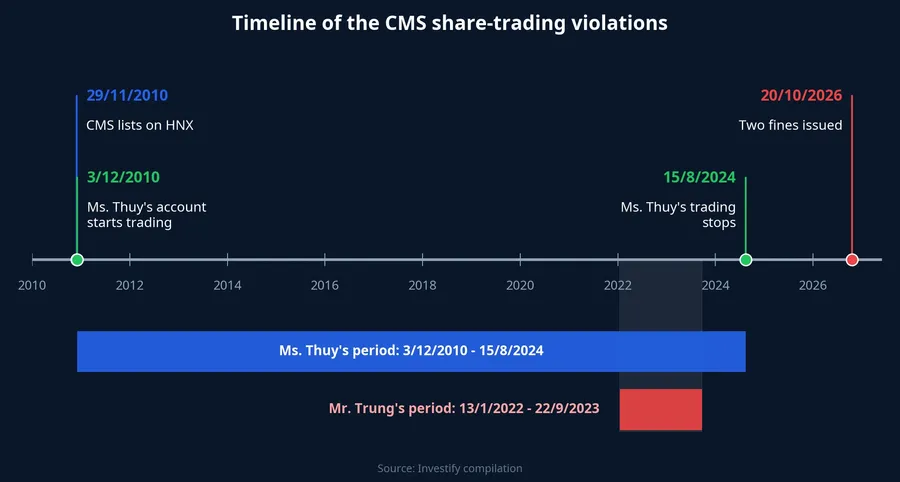
On November 29, 2010, shares of CMH Vietnam Group Joint Stock Company (CMS) listed on HNX. Four days later, a securities account in the name of Nguyễn Thúy Dung at FPT Securities began trading those same shares. According to the State Securities Inspectorate, the person actually behind that account was Ms. Đinh Thị Thủy, now CMS's Chief Accountant.
The account kept trading until August 15, 2024. On October 20, 2026, more than two years after the trades stopped, the Inspectorate issued two penalty decisions: Ms. Thủy and Mr. Trần Văn Trung, CMS's Deputy CEO, were each fined VND 225 million. This piece walks through the milestones in the decisions and asks one question at each: what could CMS shareholders not see?
2010: It started days after the listing
Under Decision 627/QĐ-XPHC, Ms. Thủy used account 058C006567, held in the name of Nguyễn Thúy Dung at FPT Securities, to trade CMS shares from December 3, 2010 to August 15, 2024. The decision states the purpose as concealing the true ownership of CMS shares in order to evade disclosure obligations.
That span runs close to 14 years, and Fili notes it began only days after CMS listed. Put differently, for almost the entire listed life of CMS up to 2024, a stream of trades by someone inside the company ran in parallel without carrying that person's name. The decision as relayed by the press does not say what role Ms. Thủy held at each point, nor the trading volume, profit or loss, or motive. This article therefore uses only her current title and does not speculate beyond what the decision says.
What shareholders were supposed to see
To grasp what was hidden, consider what shareholders get when an insider trades through an account in their own name. Under Circular 96/2020/TT-BTC, as amended by Circular 68/2024/TT-BTC, insiders such as a Deputy CEO or Chief Accountant must disclose a planned trade at least 3 working days in advance. After the trade, they report the result within 5 working days and explain if they did not buy or sell the full registered volume. The detailed rules have changed across several documents over 14 years, but the principle that insiders must report trades in their own company's shares has been constant.
For retail shareholders, these filings are one of the few windows into what insiders are doing. A Chief Accountant buying can be read as the person who knows the books seeing a cheap price. A Deputy CEO selling raises questions. When trades run through an account in someone else's name, that whole chain of signals disappears: no advance notice, no result report, no explanation. On the system, it is just an order from an ordinary investor. Decree 128/2021/NĐ-CP, which amends Decree 156/2020/NĐ-CP on penalties in the securities field, names this conduct precisely: concealing true ownership to avoid disclosure obligations.
2022–2023: A second account
Ms. Thủy's period had not ended when another account appeared. Under Decision 626/QĐ-XPHC, Mr. Trung used account 005C101444, held in the name of Trần Ngọc Linh at MB Securities, to trade CMS shares from January 13, 2022 to September 22, 2023. That is more than 20 months in which two people in the leadership were trading CMS through two accounts not in their own names, at two different brokerages. The decision does not say whether the two accounts were connected, so this article does not link them.
A separate point: CMS has had sharp price swings in its listing history. According to Fili, the stock once rose from around VND 3,600 to the VND 35,000 area (adjusted price) before quickly returning to its old base. The October 20 decisions do not tie either individual to those moves, so they cannot be read as an explanation for them.
August 15, 2024: The trading stops, and no one knows
August 15, 2024 is the last day the account in Nguyễn Thúy Dung's name traded CMS shares, per the decision. Mr. Trung's trading had stopped in September 2023. By the date of the penalty decisions, the gap was just over two years and two months for Ms. Thủy and over three years for Mr. Trung. In that time, CMS shareholders had no information showing such trades had ever happened. The penalty decision was the first time they were made public, and it arrived long after the violations ended.
The delay reflects how this kind of conduct is detected. A regulator has to trace the real person behind an account in someone else's name, which is far harder than checking a late filing. For shareholders, the practical consequence is that information about insiders' real trades, if it exists, tends to arrive only afterward.

October 20, 2026: Who the fines target
On October 20, 2026, the State Securities Inspectorate issued Decision 626/QĐ-XPHC against Mr. Trung and Decision 627/QĐ-XPHC against Ms. Thủy. Each was fined VND 225 million, VND 450 million in total, for the same conduct: concealing the true ownership of a security to evade disclosure obligations. The press reports mention no penalty decision against CMH Vietnam itself. For someone holding CMS shares, that has three consequences.
- The shares in your account do not change. The decision is an administrative penalty on two individuals, not a measure against the company or the stock.
- The fines are paid by the individuals. The VND 450 million does not pass through CMS's books and is not returned to shareholders.
- The remaining impact is on trust in the information. That is something the decision cannot measure in money.
The articles do not cite the specific provision behind the VND 225 million figure, so this piece does not compare it with the penalty range.
Where the two stand now, and how CMS is doing
According to Fili, as of June 30, 2026, Ms. Thủy directly owned nearly 115,000 CMS shares, or 0.451% of charter capital, while Mr. Trung held none in his own name. Beyond their roles at the parent, Ms. Thủy is Head of the Supervisory Board and Mr. Trung is a Board member and Director of Environmental Construction Joint Stock Company (UPCoM: VCE), a subsidiary in which CMS holds 68.44% of charter capital. The 115,000-share figure is the declared holding. The decision speaks only to the past, and nothing indicates whether the account in Nguyễn Thúy Dung's name still holds CMS shares.
On the business side, CMS reported first-half 2026 consolidated net revenue of nearly VND 163 billion, up 19% year on year, but net profit of under VND 2 billion, down 51%. The stock closed on October 23, 2026 at VND 5,200, about 30% below the VND 7,504 (adjusted) at the end of 2025. Most of that decline came before the decision date, so it cannot be attributed to the penalty.
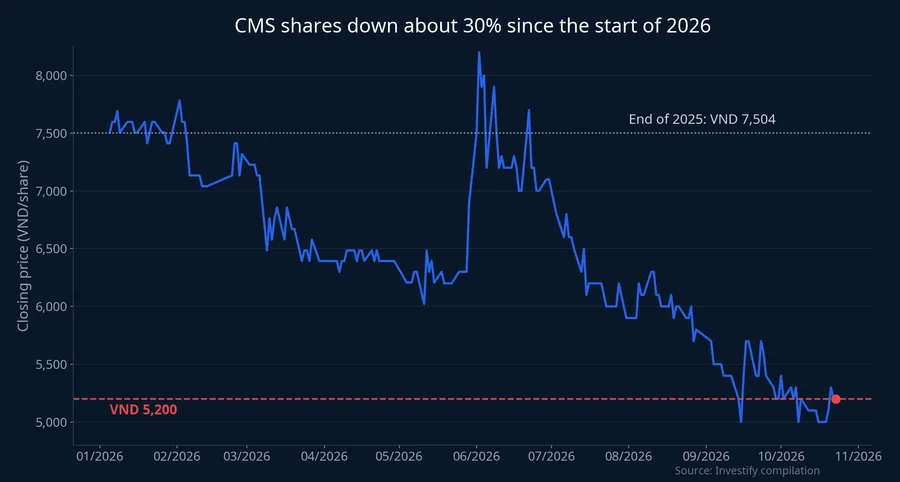
Average liquidity, per Fili, is above 48,000 shares per session. This is a small, thinly traded stock, so a single account can account for a meaningful share of a session's matched volume. This piece has no data on how much the named accounts ever represented.
How to read insider reports at CMS after this decision
The October 20 decision does not change shareholders' rights in their accounts. What it changes is how insider trading reports on this stock should be read. For nearly 14 years, the purchase and sale notices shareholders saw reflected only the declared portion. A period with no insider trade reports from management does not mean management was not trading. So for CMS, insider trading reports are best treated as a floor on what insiders did, not the whole picture, and should be read alongside business results and the stock's overall trading volume.
The next signal to watch is CMS's own response. If the Board announces a change in the Chief Accountant or Deputy CEO role, or introduces a new control mechanism for internal trading, that information will appear on HNX's disclosure channel. If nothing happens, the people who keep the books and run the company remain the two who were just fined for hiding trades in their own company's shares.