
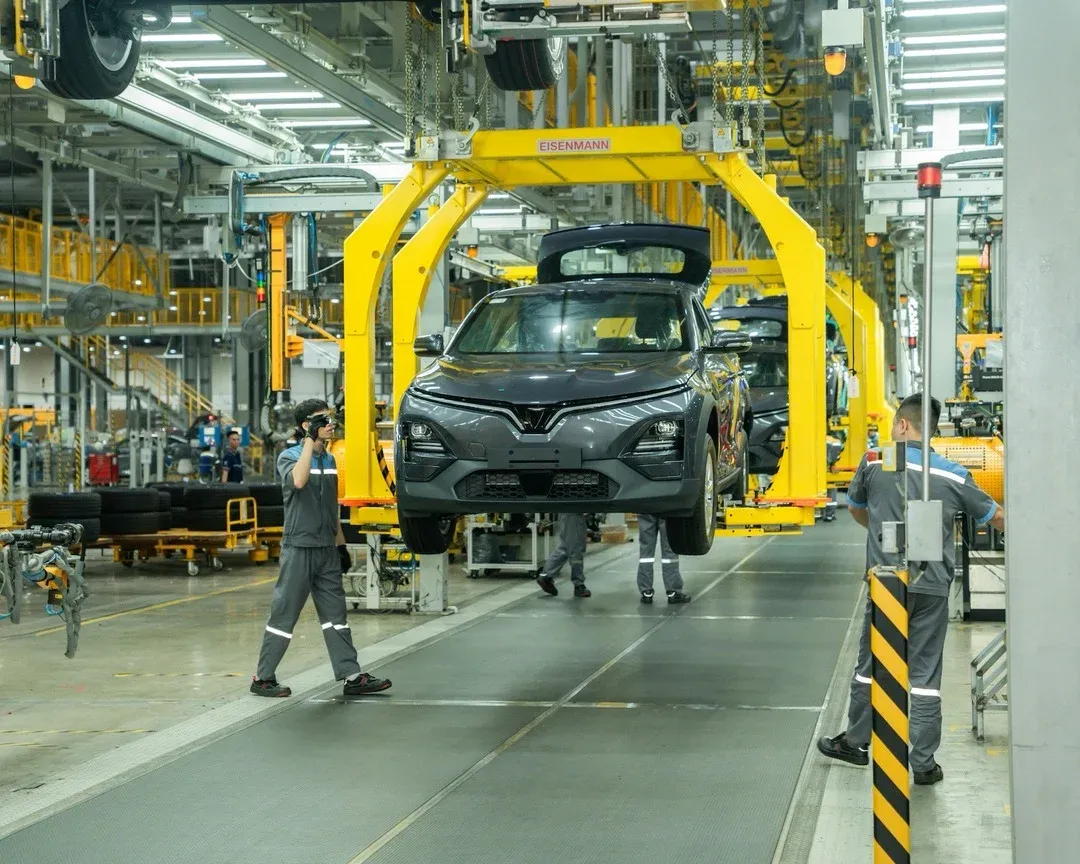

The electric-vehicle plant Vingroup plans to build in the Philippines would start with a capacity of 200,000 vehicles a year.BusinessWorld The entire Philippine car market sold just 241,725 vehicles in the first seven months of this year.Astig.ph Put differently, one plant's planned annual output is roughly four-fifths of what every brand combined sold in that country in about seven months.
For anyone holding Vingroup (VIC) shares, the numbers point one way: this is a new outlay abroad. The payoff has to wait until the plant is built, and on the announced schedule the first car would roll out around 2028 at the earliest.
What the Philippine side has announced
In a statement on Wednesday, October 21, the Philippines' Department of Trade and Industry (DTI) said the plant is worth about PHP 31.74 billion, or USD 500 million, and will build four-wheel electric vehicles for the domestic market and for export. Construction is expected to start in the first quarter of 2027 and finish in under two years.BusinessWorld Some Philippine outlets put the build time at 12 to 18 months.Newsbytes At the October 20 rate of VND 25,885 per dollar, USD 500 million is about VND 12,900 billion.
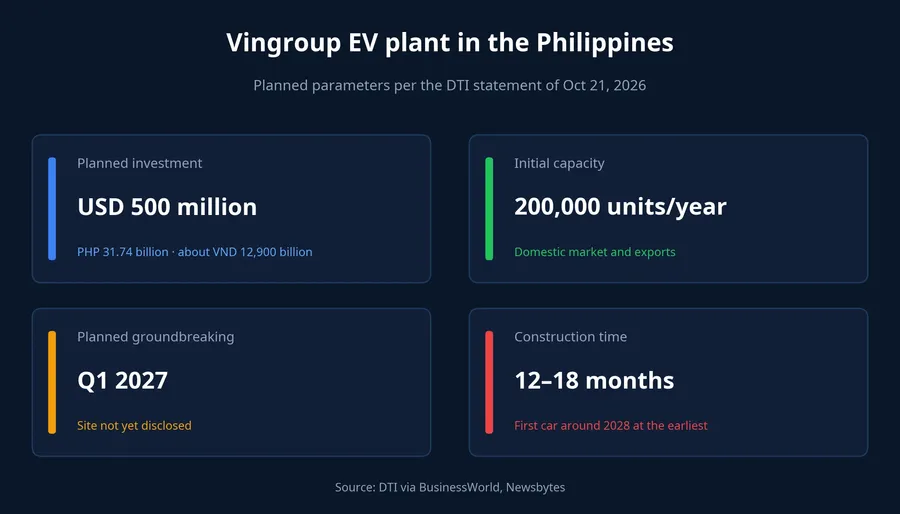
The announcement followed a meeting between Trade and Industry Secretary Maria Cristina Roque and Vingroup's leadership. The project would receive incentives under the CREATE MORE Act (Republic Act 12066) and fast-track permitting through a "green lane".BusinessWorld Roque also told reporters that Vingroup is interested in hospitals and theme parks in the Philippines.
What the statement leaves out is longer than what it includes. The DTI did not say where the plant would sit, how many workers it would employ, how much would be sourced locally, which models it would build, or how output would split between Philippine buyers and exports. Newsbytes also noted that the project still depends on implementation and on completing legal procedures.Newsbytes
Who is paying: Vingroup or VinFast
For VIC shareholders this is the most important question, and the available sources do not answer it.
In the statement, Roque called it "Vingroup's USD 500 million investment". The same BusinessWorld article opens with the line "VinFast is setting up a PHP 31.74 billion manufacturing facility".BusinessWorld Newsbytes and the Daily Tribune name Vingroup, VinFast's parent, as the investor.Daily Tribune
The two labels paint different pictures. If Vingroup puts in the money directly, the outlay goes straight into the group's investment cash flow. If VinFast is the investor, the question becomes where VinFast gets the funds. Either way Vingroup is involved, as VinFast's main source of funding and a major shareholder, but the effect on each company's balance sheet differs.
As of October 22, neither Vingroup nor VinFast has put out any disclosure on the project. Every detail so far comes from the Philippine side. The accurate description today is an investment plan announced by the Philippine government. On what is public, Vingroup has not broken ground, has not committed funds and has not settled on a site.
200,000 vehicles next to what VinFast has today
A capacity of 200,000 vehicles a year matches the first phase of VinFast's Ha Tinh plant, according to the company's announcement when it inaugurated that plant in June 2025.VinFast The Philippines is therefore being set up as a large-scale site from day one, not a pilot assembly shop. Per the Daily Tribune, the DTI places the project within Vingroup's regional expansion, alongside existing operations in Indonesia and India.Daily Tribune
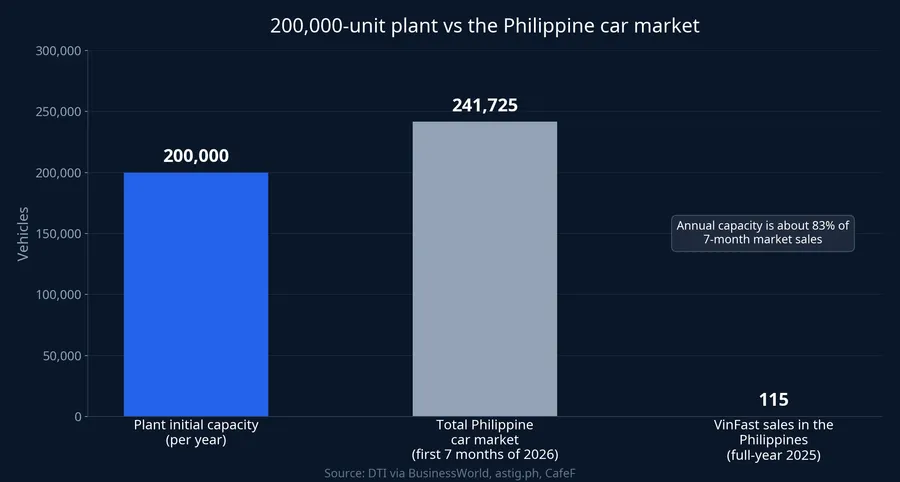
The biggest gap is on the local demand side. In 2025 VinFast sold 115 cars in the Philippines, according to the country's automaker association.CafeF The whole Philippine car market was down about 10% year on year in the first seven months of 2026, and EVs are still a small slice of it.Astig.ph Note that the chart sets full-year capacity beside seven months of sales, so read it as a gauge of scale, not a like-for-like comparison.
The arithmetic says the plant would struggle to live on Philippine buyers alone. To run near capacity it needs one of two things: exporting most of its output, or a Philippine EV market that grows fast on government incentives. There is some basis for the export case: according to PwC figures, VinFast ranked third in the ASEAN car market in the first half of 2026 with more than 120,000 vehicles.Người Quan Sát Still, VinFast already has plants in Vietnam, Indonesia and India, so exports from the Philippines may have to share markets with the company's own other factories.
Why VIC holders should read this as an expense
The project's timeline decides how to read it. Cash starts going out when construction begins in the first quarter of 2027. If the build takes 12 to 18 months, the first vehicle leaves the line around 2028 at the earliest, and output still has to ramp up after that. Through that whole stretch, the plant only consumes cash.
The share price has moved: VIC rose 6.99% in the October 21 session and was up about 3.2% in the afternoon session on October 22. No source ties that gain to the Philippine news, though, and two sessions of prices say nothing about who will bear the outlay.
It is only fair to note the upside. Tax incentives under the CREATE MORE Act and fast permitting could cut costs and shorten construction. A plant inside ASEAN could also give VinFast cheaper access to neighboring markets than shipping from Vietnam. But those benefits only materialize once the plant operates, while the spending comes first.
What will answer the question of who pays
The first piece of evidence is an official disclosure from Vingroup or VinFast. A board resolution or press release naming the investing entity would show whose balance sheet carries the roughly VND 12,900 billion.
The second is Vingroup's third-quarter financial report, expected at the end of October. It cannot contain construction costs because the project has not broken ground. Even so, the notes on investment commitments and support for subsidiaries may show how the group is preparing its funding.
The conclusion is narrow but firm: the Philippines has announced a large-scale plan, the plant needs exports to fill its capacity, and the roughly VND 12,900 billion outlay would come at least two years ahead of revenue. Who the actual investor is will have to wait for the companies' own disclosures. This article makes no call on where VIC or VFS shares are headed.