


Look at the numbers, and the most striking item in the preliminary third-quarter figures from Phu Nhuan Jewelry (PNJ) is not the loss. It is the cash balance. At the extraordinary general meeting on the morning of 21 October, management said the company's cash and deposits fell from about VND 3,700 billion at the end of June to VND 770 billion at the end of September.CafeF That VND 770 billion already includes a VND 700 billion personal loan from Ms. Cao Thi Ngoc Dung, PNJ's Chairwoman of the Board, disbursed in September.
End of June: starting point of about VND 3,700 billion in cash
This is the baseline management used at the meeting. Before the shock, PNJ was a profitable jewelry retailer: in Q3 2025 it earned VND 496 billion after tax.CafeF
One detail matters here, the trade-in policy. Customers who bought diamond jewelry were promised a buyback at a set percentage of the original invoice. According to Mr. Phan Quoc Cong, PNJ's CEO, the accumulated value of these commitments by the end of Q3 was estimated at about VND 21,000 billion, and they carry no expiry date.Mekong ASEAN In normal times, that is a sales tool. When customers return all at once, it becomes a payment obligation.
July: customers sold back nearly VND 6,000 billion in a month
From early July, news linked to the P-Lab case sent customers rushing to sell their diamonds back. Mr. Cong said the value of goods sold back each day rose about tenfold versus normal.Mekong ASEAN For the month, buybacks reached nearly VND 6,000 billion, close to the roughly VND 7,000 billion for all of 2025.Mekong ASEAN
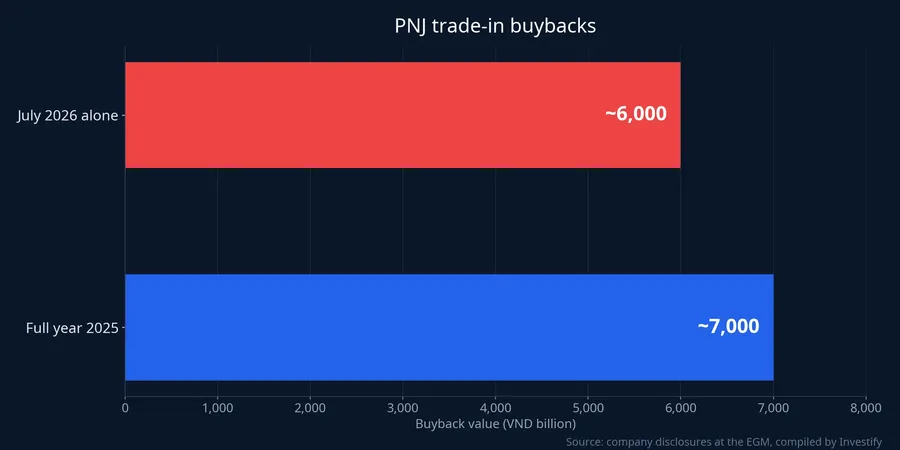
The mechanism is straightforward: every item bought back is cash going out and an item going into the warehouse. Mr. Cong said the trade-in pressure left PNJ short of cash by the end of July, and diamonds and diamond jewelry now make up 52% of total inventory value.Mekong ASEAN That is a hard category to sell. Moving large volumes quickly means deep discounts.
After July: cash preserved, buying power lost
To stem the outflow, PNJ extended the payment period on trade-ins to 120 days and capped the points and time windows for acceptance, while encouraging customers to swap into other products instead of taking cash.Mekong ASEAN From 30 September, payment for gold and jewelry was shortened to T+2 and T+7. Diamonds stay at 120 days.
That eases cash pressure but has a price. Mr. Cong said the policy change hurt trust and buying power, and retail revenue is now below half its normal level before the event.Mekong ASEAN
September: Chairwoman lends VND 700 billion, VND 770 billion left at quarter-end
Management said that, with banks tightening limits and lending conditions, Ms. Dung lent PNJ VND 700 billion personally, disbursed on 15 and 25 September.Mekong ASEAN By the end of September, the cash balance was VND 770 billion.
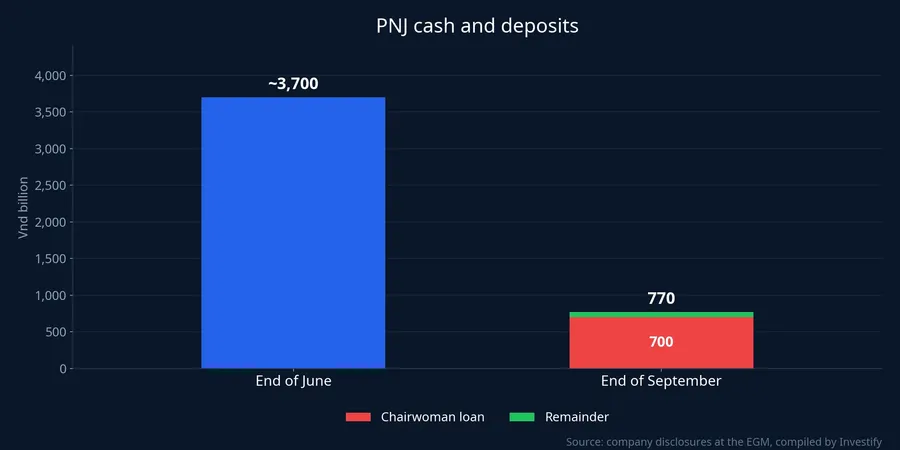
Put the two figures side by side and the scale is clear. Without the VND 700 billion loan, only about VND 70 billion would remain. The drop from about VND 3,700 billion to VND 770 billion is nearly 80%, and it happened even with the Chairwoman's money added.Người Quan Sát
On the other side of the balance sheet, PNJ has about VND 3,000 billion in bank debt, all of it short-term and secured by inventory, plus about VND 125 billion owed to customers and partners on the 120-day schedule.Mekong ASEAN Management said the company still needs about VND 100 to 150 billion a month to cover operations.Mekong ASEAN At that rate, VND 770 billion equals roughly five to seven months, provided bank loans keep being rolled over. This ignores one-off outflows, so read it as a gauge of how thick the cash cushion is, not a forecast.
Q3 results: a VND 258 billion loss, before provisions
According to the preliminary figures released at the meeting, Q3 2026 showed net revenue of VND 6,995 billion, down 14% year on year; gross profit of VND 609 billion, down 62%; and a net loss of VND 258 billion, against a VND 496 billion profit a year earlier.CafeF The loss excludes provisions for the trade-in policy that are being put to shareholders as part of the 2026 plan.
Why a loss before provisions? Quarterly revenue fell only 14% because July still contributed, but August and September revenue was below half the normal level.Người Quan Sát Gross profit fell 62%, far more than revenue, while a store chain's costs do not shrink that fast. On average, PNJ lost about VND 3 billion a day in Q3.Người Quan Sát
Two things should be kept apart. The VND 258 billion loss is an operating result. The cash balance, which fell by nearly VND 3,000 billion, was shaped both by buying back goods from customers (cash turning into inventory) and by the operating loss. The sources do not split the contribution of each. The two numbers move together but are not the same thing, and anyone reading only the loss will underestimate the cash strain the company has been through.
21 October: a plan to raise about VND 8,000 billion
At the meeting, PNJ set out a need to raise about VND 8,000 billion, of which at least 60% goes to the trade-in transition program, 20% to working capital and 20% to repaying loans.CafeF The instrument put forward is a private placement of up to 550 million shares to professional securities investors. At the time of writing, the vote results on the resolutions had not been announced.
Management describes the transition program in two branches. For old commitments, PNJ prioritizes settling customer claims with products and promotions in place of cash.Mekong ASEAN For newly sold products, it trades in at market price at the time of the transaction, instead of committing to a buyback at a percentage of the original invoice. Management estimates the total value to be handled from old commitments at about VND 16,500 billion.Mekong ASEAN
That exposes an implicit condition. At least 60% of about VND 8,000 billion is about VND 4,800 billion, well below the VND 16,500 billion to be handled. The gap closes only if most customers accept products or promotions rather than cash. In other words, the funding plan rests on customer behavior, not just on the money raised from investors.

Speaking at the meeting, Ms. Dung called this the hardest moment in nearly 40 years of PNJ's history and apologized to shareholders.CafeF
2027 to 2029: management's scenario, with conditions
For the first time, PNJ laid out a multi-year profit path after the shock. Under this scenario, 2027 brings revenue of VND 43,400 billion and net profit of about VND 100 billion.CafeF Profit is projected at about VND 1,200 billion in 2028 and VND 1,600 billion in 2029, with revenue of about VND 57,700 billion. Leadership stressed that the scenario depends on raising capital and successfully carrying out the restructuring plan.CafeF
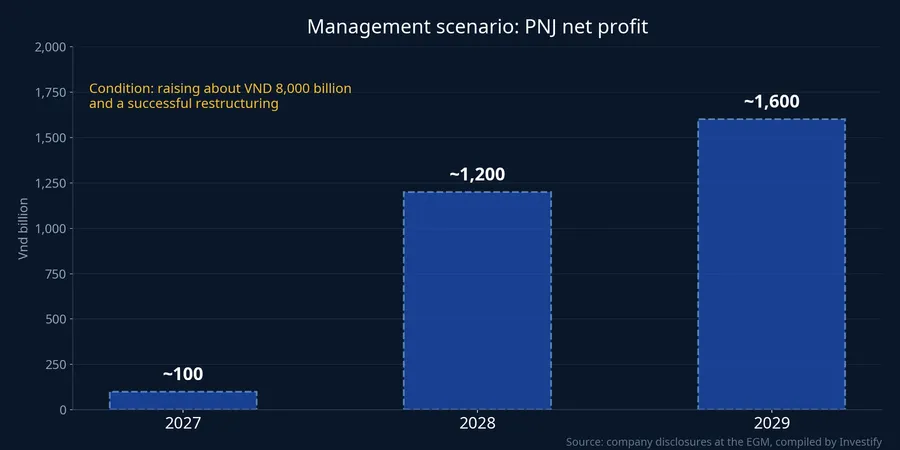
2027 is the year to read most closely. About VND 100 billion of profit on VND 43,400 billion of revenue means the company keeps roughly 0.2 dong of every 100 dong sold. In Q3 2025, before the shock, the equivalent was about 6 dong, from VND 496 billion of profit on about VND 8,100 billion of revenue. So 2027 in the scenario is close to break-even. Management has not broken down the VND 100 billion. A reasonable reading is that 2027 still carries transition costs and a buying power that has not fully recovered, but that is inference, not a figure the company disclosed.
Where shareholders stand
On this timeline, PNJ sits right at the junction between what has happened and the scenario. What has happened already has numbers: a thin cash cushion, about VND 3,000 billion of short-term bank debt, and VND 100 to 150 billion a month needed to cover operations. In the scenario, every milestone hangs on one shared condition: raising the capital.
The key point: the 2027 to 2029 path has a foundation only if the money arrives in full. If it arrives in full and on time in Q4, management's scenario has somewhere to start. If it arrives late or short, the 2027 to 2029 figures need revisiting, because the VND 770 billion cash balance, VND 700 billion of it borrowed from the Chairwoman, remains the company's entire buffer. The data points to watch, in the order they will appear:
- The vote on 21 October: whether the resolutions on the private placement and the 2026 business plan pass, and by what margin.
- The official Q3 financial statements: to check the preliminary figures, especially cash, debt and diamond inventory.
- The board resolution fixing the offer price: the floor in the proposal is book value and the 30-session average, so the final price determines how many shares must be sold to raise about VND 8,000 billion.
- Investor identities and cash actually received: if well below about VND 8,000 billion, the 2027 to 2029 profit milestones lose the condition management itself set.