
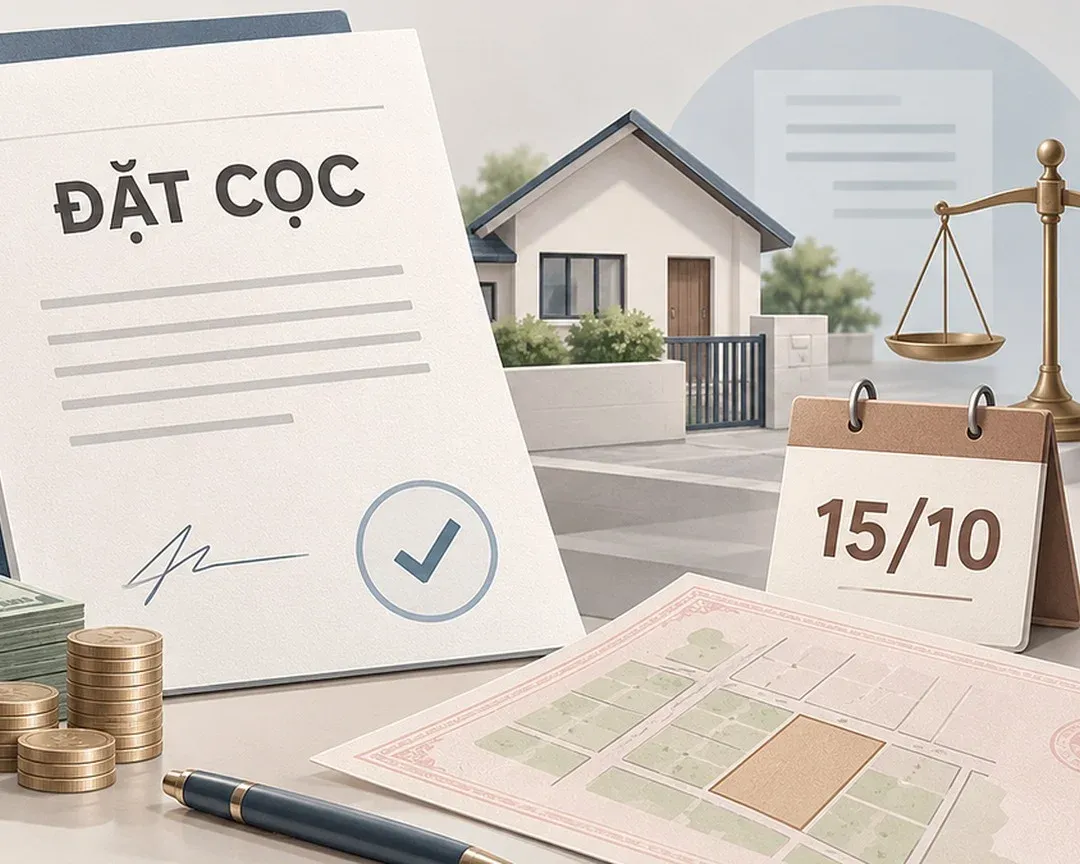

Two parties put down a deposit on a house. The seller promises to obtain the land-use certificate within 3 months or forfeit the deposit. The seller files the paperwork correctly, but after three months the state agency has still not processed it. That is an example given in Resolution 03/2026/NQ-HĐTP of the Council of Judges of the Supreme People's Court: the delay counts as an objective obstacle, and the seller does not face a deposit penalty.VnExpress
The Council of Judges adopted the resolution on August 18, 2026Báo Công lý, and it takes effect today, October 15, 2026.Markettimes If you hold or have received a deposit on a property deal, now is the time to take out the deposit paper and read it again.

A guide for judges, not a new law
First, get the nature of the document right. Resolution 03 is not a new law from the National Assembly. It is a document from the Council of Judges of the Supreme People's Court instructing courts on applying the 2015 Civil Code consistently in deposit disputes. According to VnExpress, it does not create a whole new set of rights and obligations; it clarifies how existing law applies in situations that had drawn different readings.VnExpress
The baseline is still Article 328 of the 2015 Civil Code. Absent another agreement, a depositor who refuses to sign or perform the contract loses the deposit. A recipient who refuses must return the deposit plus an equal amount, commonly called paying back double. Clause 1 of Article 6 of the Resolution restates this principle.Báo Công lý
Missing a deadline is not enough to forfeit
When the contract has no separate terms on handling the deposit, Clause 3 of Article 6 says the party at fault for the contract not being signed, not being performed or being void bears the penalty. If both sides are at fault, or the event is force majeure or an objective obstacle, there is no deposit penalty.Báo Công lý
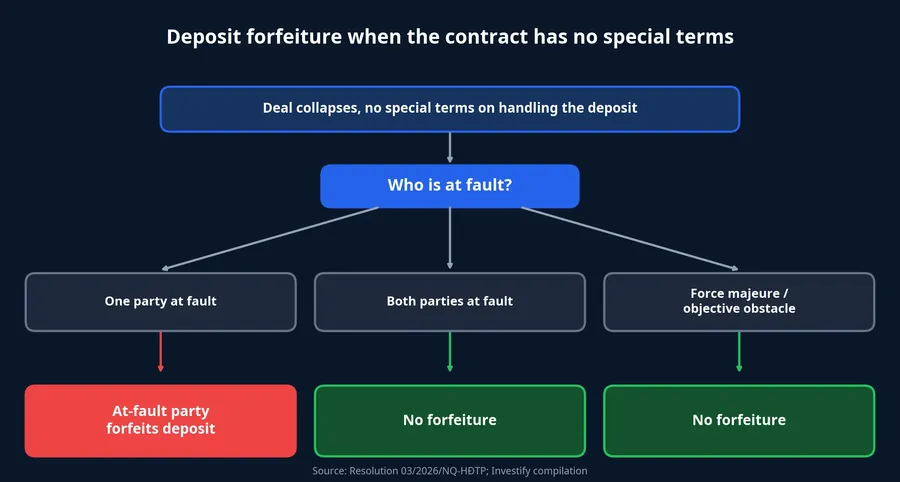
The house awaiting its certificate shows what this means in practice. Failing to meet a commitment on time is not enough to say one side must pay. The court still has to look at the cause, each side's fault and any objective obstacle.Markettimes
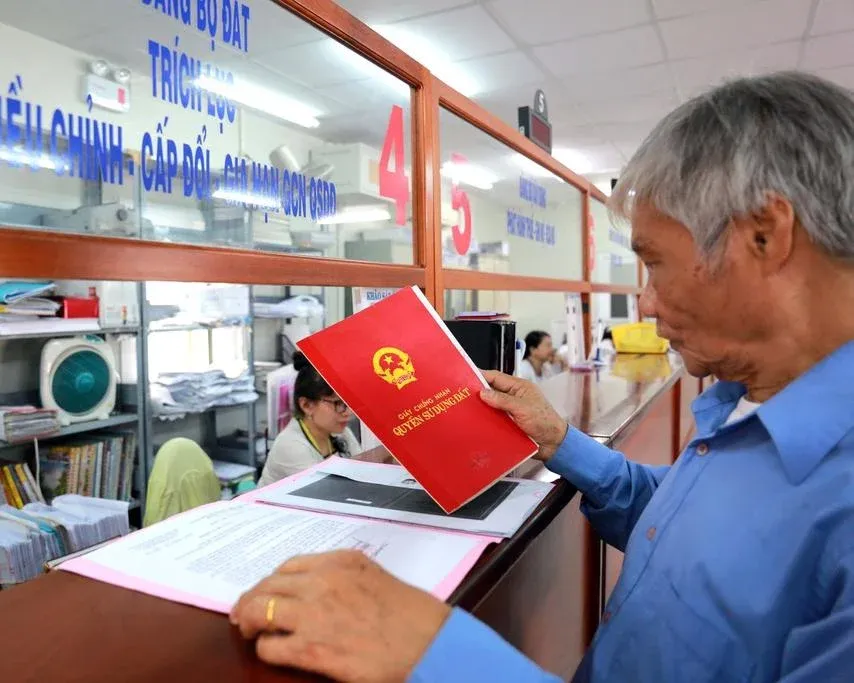
Sellers can misread one point. Escaping the penalty does not mean automatically keeping the deposit, nor that other obligations disappear. Returning property and settling related matters still follow the agreement and the law.VnExpress Put simply, an objective obstacle spares the seller the extra payment; it does not turn the deposit into the seller's money.
For buyers it cuts both ways. They can no longer count on receiving double just because the seller was late. But if the seller is late because they never filed, or filed incompletely, the fault remains the seller's.
A deposit on land not yet in the seller's name can still be valid
A common situation between individuals is a deposit on a plot the seller does not yet hold a certificate for. Article 3 says a deposit agreement securing the signing of a contract can remain valid even if the transfer contract would be void were it signed at the time of the deposit.VnExpress
The condition is that the deposit agreement itself meets Article 117 of the Civil Code on capacity, voluntariness, lawful content and form. A typical case is where the parties agreed on a specific period for the seller to obtain the certificate before transferring.CafeF
The same logic applies to deposit agreements missing details such as plot size or price. A court does not automatically declare a deposit void just because the sale contract was later not signed; it must examine whether the deposit agreement itself is valid.Markettimes
For deposit holders, this means "the land has no certificate yet" or "the deposit paper was sketchy" is a hard excuse for walking away. In the other direction, a valid deposit does not mean the seller may transfer land that does not yet meet legal conditions.VnExpress
A deposit to sign is not a deposit to perform
Many people overlook this when drafting a deposit paper. If the deposit secures only the signing of the contract, then once the sale contract is signed, later breaches, or a later finding that the contract is partly or wholly void, do not lead to a deposit penalty under the original agreement.Báo Công lý The dispute is then handled under rules on breach of contract or consequences of a void contract. Treatment differs if the deposit was agreed to secure performance as well.Markettimes
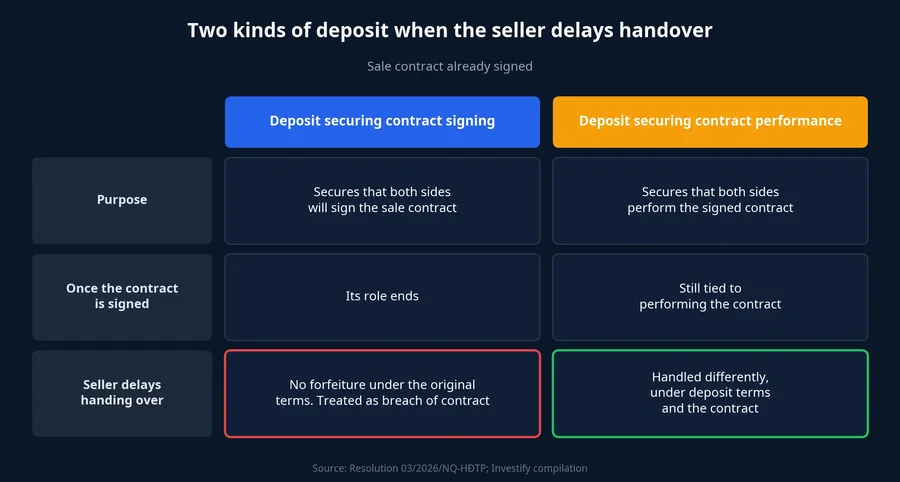
Imagine a buyer who has signed the transfer contract, after which the seller delays handing over the house. If the deposit paper says only "to sign the contract", the buyer cannot demand double the deposit for the delay and must pursue a breach-of-contract claim instead.
How high can a penalty go
The Civil Code lets parties agree terms different from the standard rule, including penalties above one times the deposit. Clause 2 of Article 6 says that if the agreed penalty exceeds the value of the secured contract, the court sets a penalty not exceeding the contract value at the time of first-instance trial.VnExpress
The cap is tied to the value of the secured contract, not to the deposit amount. So the maximum penalty is not always one or two times the deposit. In property deals the contract value is usually many times the deposit, so the range between "penalty equal to the deposit" and "contract-value ceiling" is wide. Anyone signing a penalty clause worth several times the deposit should know a court may uphold that figure.
If a contract sets both a deposit penalty and a breach penalty for the same violation, the court accepts only the deposit penalty.VnExpress
On limitation periods, claims for deposit penalties and damages fall under Article 429 of the Civil Code, which is 3 years.Pháp luật và Văn hóa A claim to recover the deposited asset itself is not subject to a limitation period.Báo Công lý A buyer who sues late may lose the right to the penalty, but not the right to get the deposit back.
Four things to re-read in your deposit paper
Anyone holding a deposit should check the contract against four questions, because they decide what is returned or owed if the deal falls apart.
What the deposit secures. Does the paper say "to sign the contract" or "to sign and perform"? If only signing, the deposit's role ends when the sale contract is signed.
Whether there are separate terms on handling the deposit. The fault-based rule in Clause 3 of Article 6 applies only when the parties have no other agreement. A clause that states when the deposit is lost, returned or not penalized will be the court's first reference.
Whether the deadline depends on a state agency's procedure. If so, state the filing date, who files, and what happens if the authority is slow.
The penalty relative to contract value. A penalty above the contract value will be reviewed and reduced. One below that ceiling, even many times the deposit, is a figure the parties committed to themselves.
Gaps remain. According to Pháp luật và Văn hóa, the Resolution does not define what counts as "refusing to enter" a contract, nor whether the deposit automatically ends when the deadline passes without a signed contract.Pháp luật và Văn hóa Individual rulings will settle both, and a deposit paper that spells out those two situations reduces risk for both sides.
Resolution 03 does not change the law, but it changes how courts read a deposit paper: whose fault, what the deposit is for, and what the parties wrote. Those who write these down clearly at the start leave less for a court to guess. The first rulings applying the two open points above are the signal to watch next.