

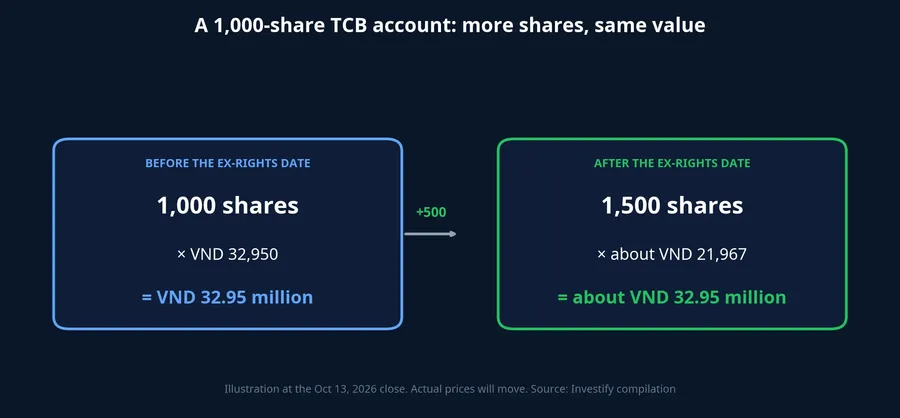
Picture an account holding 1,000 Techcombank (TCB) shares. Once the new dividend goes through, it will show 1,500 shares. No cash arrives, and on the day the price is adjusted, the total value of the holding does not rise either.
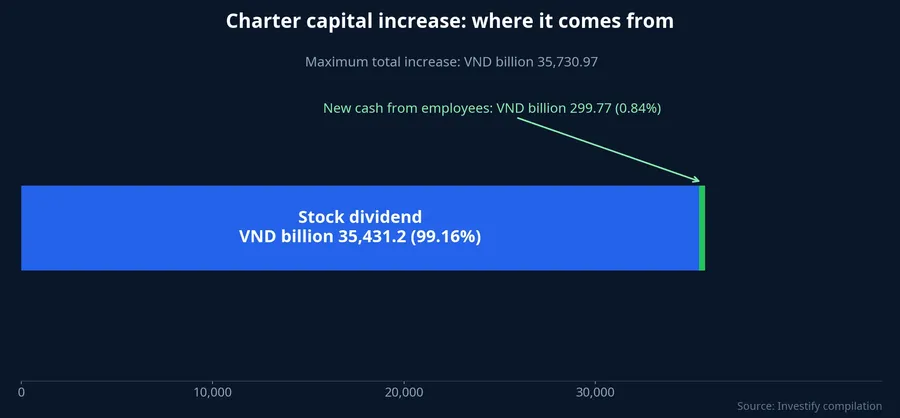
On October 13, 2026, according to Fili and CafeF, the State Bank of Vietnam (SBV) issued a document approving Techcombank to raise its charter capital by up to VND 35,730.97 billion. If completed, charter capital would go from VND 70,862.4 billion to about VND 106,593.38 billion, the highest in the banking system. It is easy to read that as a large pile of money flowing into the bank. In reality, nearly all of it is old profit moving between lines on the balance sheet. This post covers three things: what the approval allows, what changes in your account, and what changes at the bank.
What the October 13 approval allows
The approval has two parts. The big one is a stock dividend: Techcombank may issue shares to existing shareholders worth VND 35,431.2 billion at par value, or more than 3.543 billion shares at a 50% ratio.CafeF For every 100 shares held, a shareholder receives 50 new ones. The source is accumulated undistributed profit in the audited 2025 standalone financial statements.
The small part is an employee share program: 29,977,234 shares at VND 10,000 each, VND 299.77 billion in total, about 0.282% of capital.CafeF These shares are subject to a one-year transfer restriction after the issuance ends.
This approval is the third step of the plan. Shareholders approved it by resolution on September 8, 2026, and the board followed with resolution No. 0506/2026/NQ-HĐQT on September 15, 2026 to carry it out.Fili For a bank, any change in charter capital needs SBV approval first, and that step is done. What remains is securities procedure: an issuance file goes to the State Securities Commission, then Techcombank announces the final registration date.
Inside a TCB holder's account
TCB closed at VND 32,950 per share on October 13. For a 1,000-share account, that is VND 32.95 million.
On the ex-rights date, the exchange divides the reference price by 1.5 to reflect the extra shares. If the price before that day were still VND 32,950, the new reference price would land near VND 21,967 after rounding to the tick size. The account is then 1,500 shares times the adjusted price, still about VND 32.95 million. A newcomer glancing at the price board that day will see TCB "down by a third". That is arithmetic, not a loss.
Two points on timing. First, to be on the dividend list you must hold the shares on the final registration date. Because settlement runs on a T+2 cycle, anyone buying from the ex-rights date onward will not receive the 50 new shares. Second, the new shares cannot be sold right away: stock dividend shares trade only after custody registration and additional listing on HoSE. In the 100% bonus share issue of 2024, Techcombank set the record date on June 21, 2024 and the new shares were listed on August 6, 2024, about a month and a half later. That is the bank's own precedent, not the schedule for this round.
The employee shares do dilute existing holders slightly. Nearly 30 million shares equal only about 0.282% of shares outstanding, so the dilution is small.
At the bank: charter capital up, equity roughly flat
Think of equity as a cabinet with many drawers, and charter capital as just one of them. When paying a stock dividend, Techcombank moves VND 35,431.2 billion from the undistributed profit drawer to the charter capital drawer. Total equity does not change because of this portion, and the bank collects no money from shareholders.
At June 30, 2026, Techcombank's consolidated equity was VND 188,997 billion, of which undistributed profit was VND 68,178.26 billion. The stock dividend therefore uses about half of this accumulated profit. One caveat: the plan draws on undistributed profit in the standalone statements, while these two figures are consolidated, so read them only as orders of magnitude.
The only genuinely new money comes from employees buying shares at VND 10,000: VND 299.77 billion. Against equity of VND 188,997 billion, that is under 0.2%. Of the more than VND 35,700 billion added to charter capital, less than 1% is fresh cash.
So the title of "highest charter capital in the system" says more about the profit Techcombank has retained over the years than about a capital raise. Per CafeF, VPBank and MB passed VND 100,000 billion in charter capital after their September increases, and Techcombank would rank above both if it completes.CafeF A league-table position does not change total equity, which is what actually supports lending. The effect on the capital adequacy ratio has no separately published figure, so this post does not estimate it. What is certain is that the stock dividend brings no new cash.
Earnings per share, divided by a bigger denominator
If both parts complete, shares outstanding rise from 7,086,240,414 (about 7.09 billion) to about 10.66 billion, matching charter capital of about VND 106,593.38 billion divided by the VND 10,000 par value.
Net profit attributable to parent shareholders in H1 2026 was VND 14,021.1 billion. Divided by today's share count, that is about VND 1,979 of profit per share for the half year. The same profit divided by about 10.66 billion shares leaves about VND 1,315.
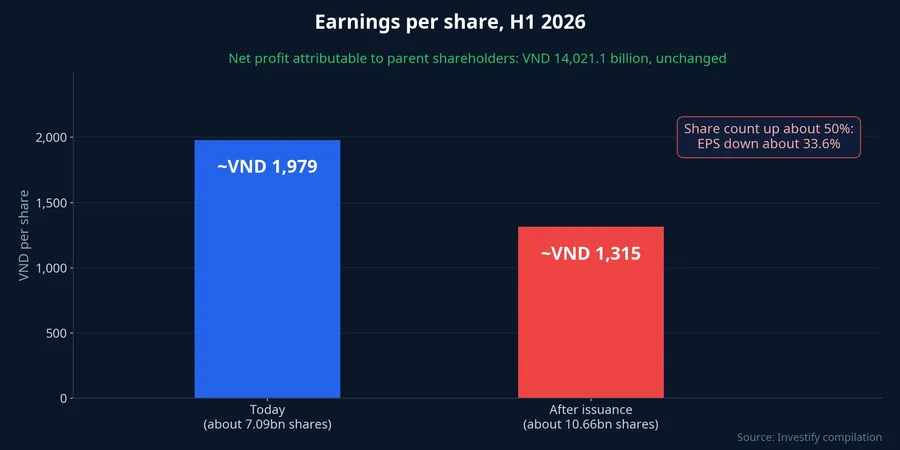
The bank's profit has not fallen. A larger denominator pushes the per-share figure down by about a third. Once the share count has risen, earnings per share (EPS) for earlier periods are restated on the new share count so periods stay comparable, so you should compare against the adjusted figure. Setting the new number beside the old one printed in earlier reports will make profit look like it dropped, when, per CafeF, Techcombank's H1 2026 pre-tax profit reached VND 18,500 billion, up 22.5% year on year.CafeF

The same reading applies to book value per share and share-based valuation ratios such as P/E and P/B. Data sites may update the denominator at different times, so when comparing, check how many shares a figure is calculated on.
What is still pending
As of October 13, Techcombank has not announced the final registration date for the stock dividend, nor a timeline for the employee share issue. These dates will come through the bank's and HoSE's disclosure channels.
The order of milestones a TCB holder will see: the final registration date is announced, the ex-rights date arrives with the reference price divided by 1.5, new shares land in the account, and finally the new shares become tradable. Only at that last step can the extra 500 shares in our example be sold.
The October 13 approval therefore changes nobody's account yet. It clears the way for the registration-date announcement, and that announcement will say when 1,000 shares become 1,500. The signals to watch next: the issuance file filed with the State Securities Commission and Techcombank's final registration date notice.