


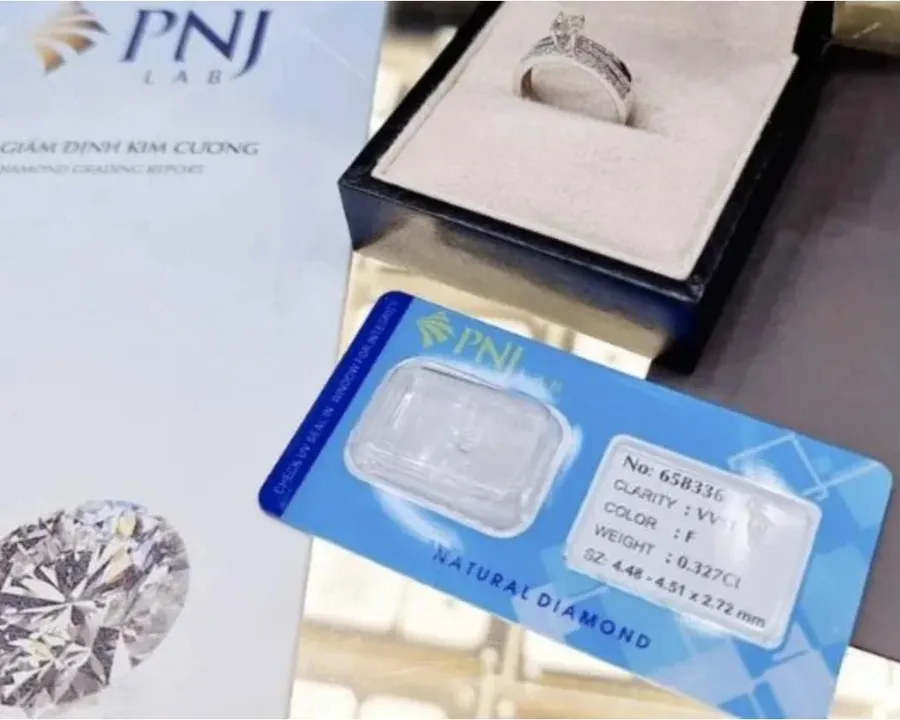
On the evening of October 8, PNJ announced a test result in which P-Lab, its own in-house testing subsidiary, played no part. According to information supplied by PNJ, diamonds currently on sale were drawn at random by Vinacontrol, sealed, and sent to a gemologist at the Asian Institute of Gemological Sciences (AIGS) for analysis.CafeF AIGS's conclusion: 100% of the tested samples are natural diamonds, consistent with the 4C specifications PNJ had disclosed: weight, color, clarity and cut.
The result arrives after PNJ's shares have fallen sharply since July, and just 13 days before an extraordinary shareholder meeting. It needs to be read carefully. It answers one specific question about product quality, and leaves open other questions that determine shareholders' money.
Why PNJ needed an outsider to check the stock
The story starts in early July 2026, when the director of P-Lab was prosecuted in a diamond smuggling case investigated by Thanh Hoa provincial police. According to CafeF, he is accused of grinding off GIA serial numbers from smuggled diamonds, engraving new P-Lab numbers and issuing certificates to legitimize their origin.CafeF
For PNJ this was first a problem of trust, not of goods. On August 20, Thanh Hoa police announced preliminary findings: none of the smuggled diamonds entered PNJ's retail system, and the company's import records were complete.CafeF Still, the unit that certified PNJ's diamonds was the very place where the wrongdoing happened. A result produced by P-Lab checking itself would persuade few people.
This time the work was split across separate parties. Vinacontrol, an independent inspection firm, picked samples at random and sealed them, so PNJ did not choose its best stones to send. AIGS analyzed the samples and issued the certificate. Kennedy Ho, Chairman of the Asian Institute of Gemological Sciences (AIGS), personally handed the certificate to PNJ. PNJ also said all diamonds in its system are formally imported from suppliers in Thailand, Hong Kong and the US, and that it is considering changes to PNJ Lab's procedures.
The scope of the result
The word to read most closely is "sampled." The 100% figure is a share of the samples taken.CafeF As of the morning of October 9, press reports all relied on information from PNJ and had not disclosed three things:
- Sample size: how many stones were drawn, from how many stores, across which product lines.
- Sampling date: when the samples were taken, and whether before or after PNJ adjusted its sourcing.
- Certificate contents: AIGS's detailed certificate has not been made public.
The samples came from stock PNJ is currently selling. So the result speaks to the quality of goods now on the counter. It does not directly test pieces that customers bought, with P-Lab certificates, before July. For that group, the available basis is the preliminary investigation findings of August 20 and a statement by PNJ leadership at a July press briefing: when buying back from customers, the company had found no case with a quality problem.
For anyone holding PNJ diamond jewelry
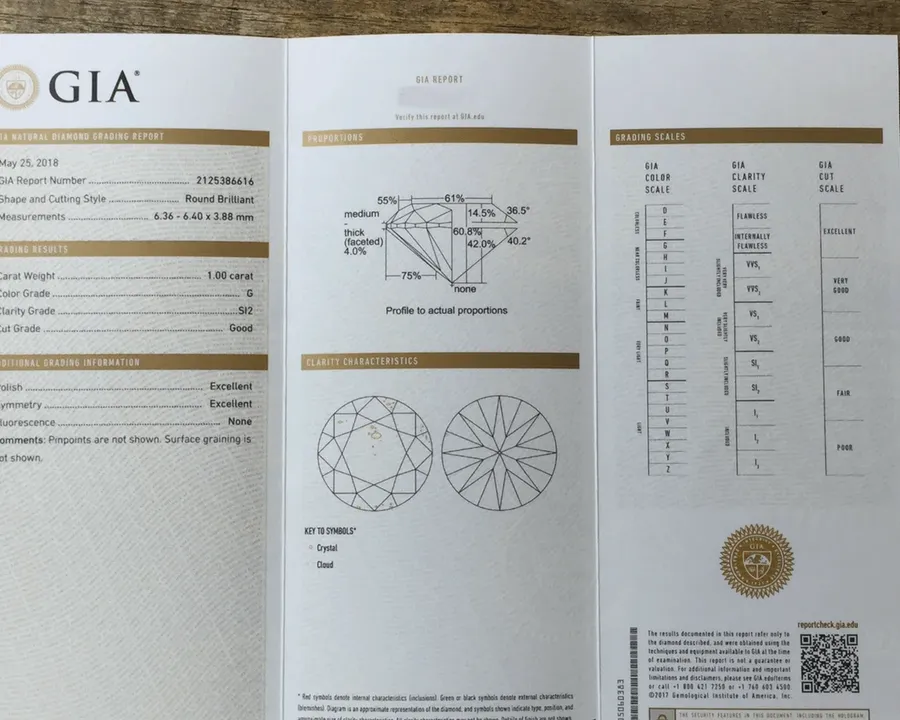
PNJ tells customers to look up their certificates on the Gemological Institute of America (GIA) system and on P-Lab's, using the certificate number or by scanning the QR code.CafeF A lookup shows whether what is printed on the paper matches the records of the body that issued it. A stone with a GIA number can be checked against a system outside PNJ.
On buybacks, PNJ adjusted its policy in late September, and the terms for any given piece still depend on the purchase invoice. This post does not repeat detailed payment schedules because the most recent source is more than a week old; current conditions should be checked against PNJ's latest notice.
For anyone holding PNJ shares
The largest sum in shareholders' story sits outside the scope of a quality test. The documents tabled for the meeting carry a 2026 net profit plan of negative VND 6,271 billion, after an estimated provision of VND 7,071 billion for losses from the buyback policy on jewelry already sold. The provision is calculated on the assumption that customers resell or exchange 80% of the jewelry already sold.
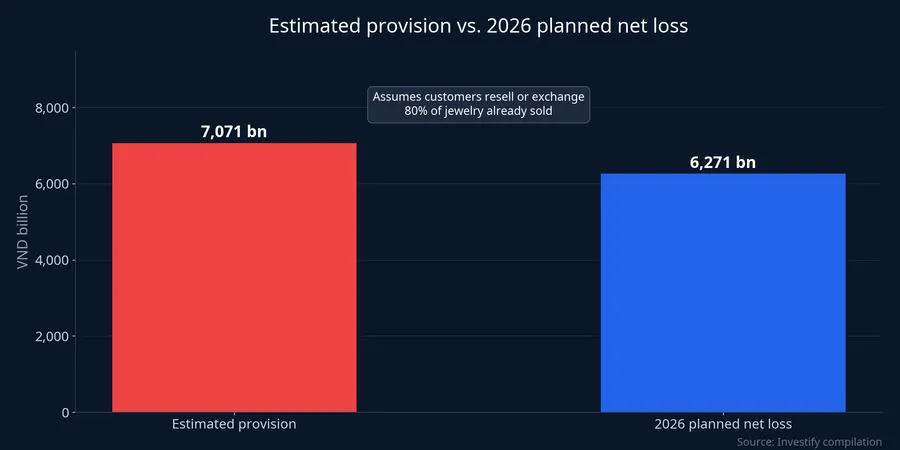
PNJ's explanation to the exchange on October 2 spells out where that assumption comes from. As CafeBiz relays it, the company expects to change how buybacks work, which could raise the share of customers who resell by a significant margin.CafeBiz In other words, the 80% is a forecast of customer behavior once the buyback policy changes. It is not an estimate of how much stock has a problem. A good test result therefore does not automatically pull that number down. The same document says the provision is not cash paid out now, and its final value will be set on actual data when the financial statements are prepared.
The effect of the test result on this number can be read two ways. First: customers who feel reassured are less likely to bring goods back, so actual losses could come in below the provision. Second: resale volume depends mainly on the new buyback terms, meaning price and payment timing, more than on confidence in quality. The available evidence leans toward the second, because PNJ itself ties the 80% assumption to the change in buyback method, and a certificate that has not disclosed its sample size is unlikely to change quickly what people holding the goods decide. Even so, only actual buyback data can settle it.
The second piece is capital. PNJ has asked shareholders to approve a private placement of up to 550 million shares to professional securities investors, expected to start in Q4 2026. That ceiling exceeds the 511 million shares currently outstanding, and privately placed shares face a transfer restriction of at least one year. The test result changes no term in the proposal already published.
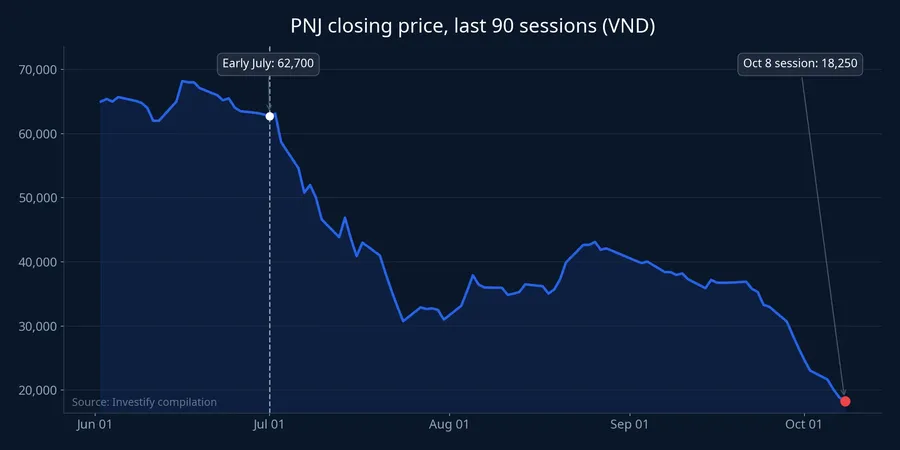
On the exchange, PNJ closed at VND 18,250 on October 8, down 3.44%. According to Viettimes, it was the 12th straight session of losses, and the stock has lost about 72% of its value from before the crisis.Viettimes
Milestones that will answer the rest
AIGS's result answers whether the diamonds on sale are what PNJ says they are, provided the sample is large enough. The rest depends on three pieces of data.
The detailed certificate. If PNJ or AIGS publishes the number of stones, the number of stores and the sampling date, buyers will know how much of the stock on sale the result represents.
The actual buyback rate. This is the number behind the VND 7,071 billion provision. Financial statements in the coming periods will show how many customers actually bring goods back after the buyback method changes, and whether that is close to or far from the 80% assumption. If it is far lower, the unused part of the provision could be reversed in later years. If it approaches or exceeds 80%, the paper loss becomes a real one.
The October 21 meeting. Shareholders will vote on the loss plan and the private placement. After the meeting, the list of investors and the offer price will show the real dilution for existing shareholders.
The test result is the best evidence PNJ has had on product quality since July. For shareholders, the figures that decide the value of the shares remain the actual buyback rate and the terms of the placement.