

On October 6, 2026, Masan Group announced that a wholly owned subsidiary had registered to buy up to 73 million shares of Masan Consumer (MCH), about 5.6% of shares outstanding, through both negotiated deals and order matching on HoSE.Vietstock If the purchase is filled in full, Masan's stake in the fish sauce, instant noodle and beverage maker moves from about 69.4% to about 74.9%.Diễn đàn Doanh nghiệp
The 74.9% sits just under the 75% level that Vietnam's 2019 Securities Law ties to a mandatory tender offer, and the registered volume dwarfs MCH's everyday liquidity. This post follows the money from source to use, then looks at what changes and what stays the same for holders of MSN and holders of MCH.
The cash: subsidiary dividends and Elmet's capital
On September 24, when it announced the tie-up between Masan High-Tech Materials (MSR) and Elmet, Masan Group said it would raise its ownership in its consumer companies step by step.Vietstock Masan called the MCH purchase the first step of that plan.
According to the announcement, the purchase is funded by cash on hand, topped up in recent months from two sources. The first is dividends from group companies: about USD 70 million from Masan Consumer's first 2026 interim dividend (VND 2,000 per share) and about USD 225 million from Masan High-Tech Materials' 2026 dividend (VND 6,000 per share).Diễn đàn Doanh nghiệp The second is USD 125 million that Elmet invested in MSR, completed on October 1, 2026. Together that is about USD 420 million.Tin nhanh chứng khoán
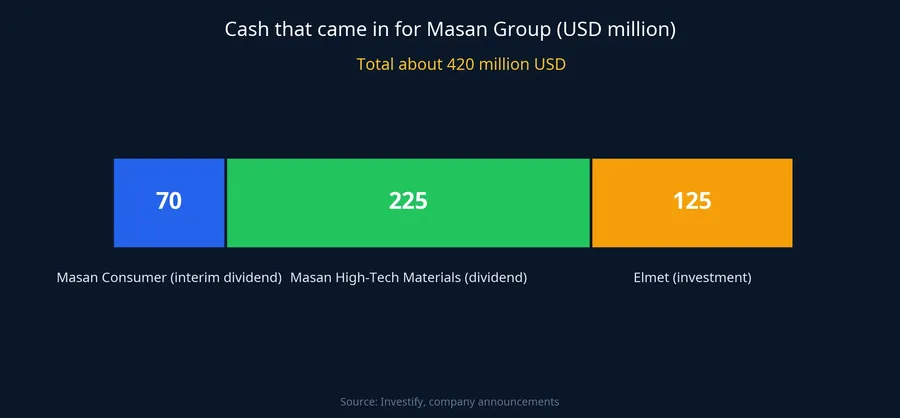
The mechanism linking source and use is simple. Dividends are paid in proportion to ownership, so the more a subsidiary pays out, the more flows back up to the parent. One detail stands out: about USD 70 million of that cash is a dividend paid by Masan Consumer itself, and it is coming back to buy more Masan Consumer shares.
The use: up to 73 million shares in 15 days
The deal is expected to run for 15 days from October 9, 2026, within the permitted price band and at an appropriate price.Vietstock Masan did not disclose a total budget. The figure of about VND 10,300 billion (about USD 400 million) that many people quote is CafeF's estimate based on an MCH price near VND 140,000 per share, not a number Masan gave.CafeF MCH closed at VND 141,000 on October 6. The actual outlay will depend on the matched price and on how much of the 73 million maximum Masan actually buys. Set against about USD 420 million of new cash, the two are of roughly the same size.
What makes this different from an ordinary major-shareholder purchase is the size relative to liquidity. Over the 10 sessions from September 23 to October 6, MCH traded an average of about 244,000 shares a session. The 73 million maximum is about 299 times that.
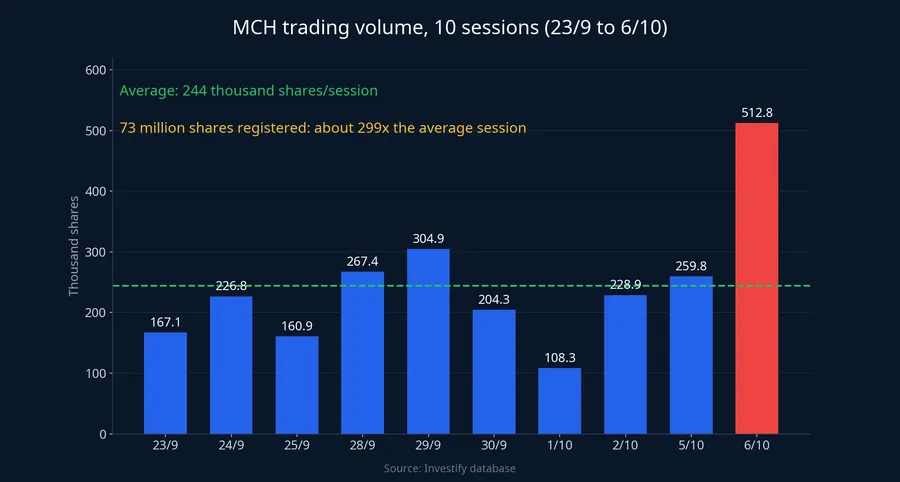
With a gap like that, order matching alone is unlikely to fill the volume in 15 days. Most of it will probably go through negotiated deals, meaning the sellers are large holders, although the announcement does not say who they are. One detail offers a hint: per the announcement, the deal does not change the 20% free-float ratio HoSE applies to Masan Consumer for index calculation.Vietstock A reasonable reading is that most shares come from holders not counted in that ratio, but only the post-trade report will say for sure.
The 74.9% stake and the 75% threshold
Under Article 35 of the 2019 Securities Law, an investor already holding 25% or more of a public company's voting shares must launch a tender offer if further purchases take its stake to or past 35%, 45%, 55%, 65% or 75%, unless an exemption applies.Masan is already above 65%, and the next level is 75%.
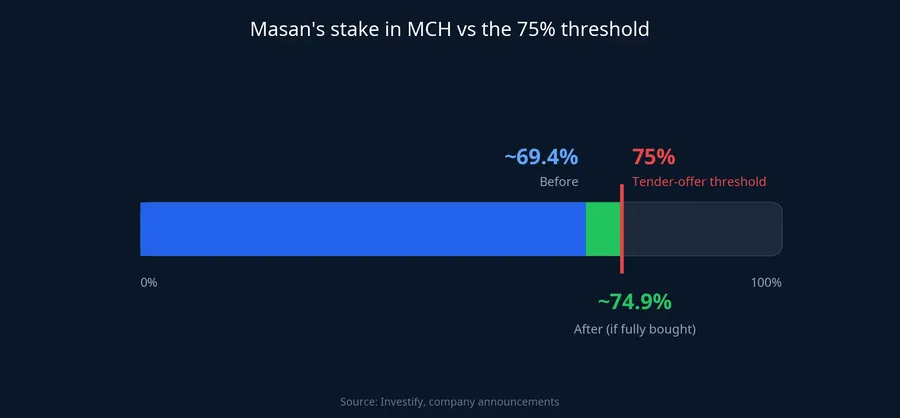
A stake of 74.9% sits just under that line: approaching, not at it. The announcement gives no reason for choosing this level, and this post does not speculate about intent. If Masan wanted to go further later, the question would have to be revisited under the tender-offer rules, unless an exemption applied.
MSN holders: bigger profit share, slower deleveraging
Masan states the purpose plainly: after the deal, the profit and dividends that Masan Consumer contributes to Masan Group will rise.Vietstock For scale, take first-half results. In the first six months of 2026, Masan Consumer's net profit was about VND 3,284 billion, up 10.9% year on year. Each additional 5.5 percentage points of ownership equals roughly VND 180 billion of that half-year profit, if earnings hold at that pace. This is Investify's illustrative arithmetic, not a figure Masan published.
Recent momentum is part of Masan's own case. Per preliminary figures, Masan Consumer's third-quarter 2026 revenue rose about 16% year on year and EBIT grew by double digits. On dividends, the company plans to pay out up to 80% of after-tax profit in cash.Diễn đàn Doanh nghiệp At that payout, the extra stake turns into cash for the group fairly quickly each year.
The other side of the trade-off is the pace of deleveraging. Masan expects consolidated net debt to EBITDA at the end of 2026 at about 2.3 times, down from 2.4 times on June 30, 2026, and that figure already includes the MCH deal.Tin nhanh chứng khoán Debt still falls, but slowly. On the June 30, 2026 balance sheet, Masan's borrowings net of cash and short-term investments were about VND 51,500 billion. If the roughly VND 10,300 billion press estimate went to debt repayment instead of share purchases, that net debt could fall by about a fifth. Masan chose to put the money into a bigger stake in the group's best cash generator, accepting slower deleveraging.
Mr. Danny Le, Chief Executive Officer of Masan Group (MSN), said in the announcement that as dividends from group companies grow and debt keeps falling, the group expects to have more room over the medium term to share more with Masan Group shareholders.Diễn đàn Doanh nghiệp That is a medium-term expectation, not a commitment with a number.
So for MSN holders, the deal trades some deleveraging speed for a larger share of Masan Consumer's profit. The trade works if Masan Consumer keeps growing profit at a double-digit pace. If that pace slows, the cost on the debt side weighs more.
MCH holders: what changes, what stays
Per the announcement, several things stay the same. The 20% free-float ratio used for indices is unchanged, so MCH's weight in the indices that ETFs track is not directly affected. Masan Consumer's dividend plan is unchanged, and the long-term goal of raising free float to about 25% stands.Vietstock
What changes is that for 15 days from October 9, the market has an additional large buyer, with volume hundreds of times the average session. After the deal, the controlling shareholder holds close to three quarters of the company. For small shareholders, the power to decide major matters at the general meeting already belonged to Masan. A 74.9% stake makes that clearer without changing its nature.
The result report will answer what is still open
For now there is only a registration, not a result. Once the 15-day window closes, the trading result report will show how much of the 73 million maximum Masan actually bought, at what average price, and how many shares came through negotiated deals versus order matching.
The actual outlay will show MSN holders how much is left for debt reduction in the fourth quarter. The negotiated-versus-matched split will show MCH holders whether this was mostly a handover among large holders or truly went through the order book. The thesis here stops at the trade-off between profit and leverage; this post offers no view on the MSN or MCH share price.